



Web Accessibility Testing
So, you’ve built a website. You’ve picked the perfect design, written compelling copy, and everything works just the way you want it to. But does it work for everyone? Have you ever thought about how someone who can’t use a mouse navigates your pages? Or how a person with low vision reads your content? This is where web accessibility testing comes in.
At its heart, accessibility testing is the process of checking your website or application to make sure people with disabilities can use it. It’s not about adding a few extra features; it’s about making sure the core experience is functional for all. This includes people with visual, hearing, motor, and cognitive impairments. An accessible website is one that doesn’t put up unnecessary barriers, allowing everyone to access information and complete tasks. This article will walk you through the what, why, and how of getting started with it.
Why Bother with Accessibility Testing?
Making a website accessible isn’t just a kind thing to do, it has real-world effects on your business, your brand, and your legal standing. For many organizations, it’s not an optional extra. It’s a requirement. But beyond that, it opens up your digital front door to a much wider audience and simply leads to a better-built product for all your users.
Meeting Legal Standards like ADA and Section 508
One of the biggest drivers for web accessibility is legal compliance. In the United States, laws like the Americans with Disabilities Act (ADA) and Section 508 of the Rehabilitation Act have been interpreted by courts to apply to digital spaces, including websites. The ADA prohibits discrimination based on disability, and a website that is unusable by people with certain disabilities can be seen as discriminatory.
This has led to a sharp increase in web accessibility lawsuits. Businesses of all sizes have faced legal action for having websites that don’t meet established standards. Failing to meet ADA website requirements can result in costly legal fees and settlements, not to mention the expense of rushing to fix your site under pressure. Similarly, Section 508 compliance is a must for federal agencies and organizations that do business with them. Proactively testing your site is your best defense against these legal risks.
The Business Case: Expanding Your Audience and SEO
An accessible website is good for business. Period. Think about it: about one in four adults in the U.S. has some type of disability. If your site isn’t accessible, you’re potentially shutting out a quarter of your potential customers. These are people with purchasing power who want to buy your products, use your services, and engage with your content. By making your site usable for them, you expand your market.
There are also strong ties between accessibility and search engine optimization (SEO). Many of the practices that make a site accessible also help search engines understand your content. For example, using proper heading structures, providing alternative text for images, and offering transcripts for videos are all things that both screen reader users and Google’s crawlers appreciate. A well-structured, accessible site often sees better performance in search rankings, bringing more organic traffic your way.
The Human Side: Building a Better Web for Everyone
Beyond the legal and business reasons, there’s a simple human element. The internet is a part of everyday life. We use it for banking, education, healthcare, shopping, and connecting with others. When a website is inaccessible, it can lock someone out of these essential activities. Imagine not being able to order groceries online because the “add to cart” button doesn’t work with your screen reader.
Accessibility testing is about more than just checking boxes for WCAG compliance; it’s about empathy. It’s about recognizing that your users are diverse and have different needs. By taking the time to test your site and remove barriers, you’re creating a more inclusive and welcoming digital world. And often, the changes you make for accessibility, like clearer layouts and captions on videos, end up making the experience better for everyone, not just those with disabilities.
Getting Started: The Core Ideas of Accessibility
Before you can start testing, it helps to know what you’re testing for. Digital accessibility is based on a few key principles and standards that have been developed over many years. Knowing these basics will give you a solid foundation for conducting a meaningful accessibility test.
What Are the Web Content Accessibility Guidelines (WCAG)?
When people talk about accessibility standards, they’re usually referring to the Web Content Accessibility Guidelines (WCAG). These are the internationally recognized set of rules for making web content accessible. WCAG is organized around four main principles, which state that content must be:
- Perceivable: Users must be able to perceive the information being presented. It can’t be invisible to all of their senses. This means providing text alternatives for non-text content, like images, and captions for audio.
- Operable: Users must be able to operate the interface. The interface cannot require interaction that a user cannot perform. This involves making all functionality available from a keyboard and giving users enough time to read and use content.
- Understandable: Users must be able to understand the information as well as the operation of the user interface. The content and operation cannot be beyond their understanding. This means making text readable and predictable.
- Robust: Users must be able to access the content as technologies advance. As technologies and user agents evolve, the content should remain accessible. This involves using clean code that plays well with assistive technologies.
WCAG has different conformance levels: A (the minimum), AA (the accepted standard for most websites), and AAA (the highest level). Most organizations aim for Level AA compliance. The WCAG 2.2 guidelines are the latest version, adding new criteria to address mobile use and cognitive disabilities.
Thinking About Different Users and Needs
Accessibility isn’t for a single, monolithic group of “disabled users.” It covers a wide range of permanent, temporary, and situational impairments. For example:
- Visual Impairments: This includes people who are blind and use screen readers, people with low vision who need to magnify content or require high contrast, and people who are colorblind.
- Hearing Impairments: This group includes people who are deaf or hard of hearing and need captions or transcripts for any audio or video content.
- Motor Impairments: This includes people who cannot use a mouse and rely solely on a keyboard or other input devices like switches or voice commands. It could be someone with a permanent condition like cerebral palsy or a temporary one like a broken arm.
- Cognitive Impairments: This is a broad category that includes people with learning disabilities, memory issues, or attention disorders. They benefit from clear, simple language and predictable layouts.
When you perform an accessibility audit, you’re trying to identify barriers that could affect any of these users.
Common Barriers Found on Websites
So what kinds of problems are you looking for? Some of the most common accessibility issues are surprisingly basic. They include things like:
Confusing layout: A lack of proper headings makes it difficult for screen reader users to skim a page and understand its structure.
Missing alt text: Images without descriptive “alt text” are invisible to screen reader users.
Poor color contrast: Text that is too light against its background can be unreadable for people with low vision.
No keyboard access: Interactive elements like menus, buttons, and form fields that only work with a mouse are a dead end for keyboard-only users.
Unclear link text: Links that just say “Click Here” or “Learn More” don’t give screen reader users enough context about where the link will take them.
Missing captions: Videos with spoken content but no captions are inaccessible to deaf and hard-of-hearing users.
The Main Methods for Testing Web Accessibility
There isn’t a single button you can press to perform a complete web accessibility testing process. A good approach uses a combination of different methods, as each has its own strengths and weaknesses. The three main types of testing are automated, manual, and user testing.
Automated Testing: The First Quick Check
Automated testing involves using software to scan your website for accessibility issues. There are many accessibility testing tools available, from free browser extensions to powerful paid platforms. These tools are very fast and can crawl your entire site in minutes, flagging common problems that violate WCAG criteria. An accessibility checker is great at finding things like:
- Missing alt text on images.
- Low contrast ratios between text and background colors.
- Empty links or buttons.
- Missing form labels.
However, automated tools have big limitations. They can only detect about 30-40% of all possible accessibility issues because they can’t understand context or user experience. For example, a tool can tell you if an image has alt text, but it can’t tell you if that alt text is actually useful. An accessibility scan is an excellent first step, but it’s never the whole story.
Manual Testing: The Human-Powered Deep Dive
Manual testing is where a person goes through your website page by page to check for issues that automated tools miss. This is a much more thorough process that focuses on the actual user experience. It’s essential for achieving true WCAG compliance. Manual testing is the only way to answer questions like:
- Is the website logically navigable using only a keyboard?
- Does the reading order for a screen reader make sense?
- Is the alt text for an image meaningful and descriptive?
- Can a user easily complete a multi-step process, like checking out of a store?
Although it takes more time, manual testing gives you a much richer picture of your site’s accessibility. It helps you find those critical, experience-breaking bugs that prevent people from actually using your site.
User Testing: Getting Real-World Feedback
The gold standard of accessibility testing is user testing, which involves recruiting people with disabilities to try to use your website. This is the ultimate reality check. You can run all the automated and manual tests you want, but you won’t truly know if your site is usable until you watch someone who relies on assistive technology try to navigate it.
User testers can provide invaluable feedback on what is genuinely difficult or frustrating. They might uncover issues you never would have thought of because you don’t share their lived experience. For example, you might find that while your site is technically compliant, the workflow for a key task is so confusing for a screen reader user that they give up. This kind of feedback is priceless and helps you move beyond mere compliance to create a genuinely inclusive experience.
A Practical Approach to Manual Accessibility Testing
Manual testing can sound intimidating, but many of the most important checks are quite straightforward. You don’t need to be a developer to do them. Here’s a look at some of the foundational manual tests you can perform.
Can You Use It Without a Mouse? Keyboard-Only Checks
One of the most important tests is to unplug your mouse and try to use your website with just the keyboard. Many users with motor disabilities rely exclusively on the keyboard to navigate. Use the Tab key to move forward through interactive elements (links, buttons, form fields), and Shift + Tab to move backward. As you do this, ask yourself:
- Can I see where I am? There should be a visible focus indicator (like a box or an outline) around the element you’ve tabbed to. If you can’t see your location, you’re lost.
- Can I get to everything? You should be able to reach every interactive element on the page just by tabbing. If you get stuck in a “keyboard trap” where you can’t tab away from a certain section, that’s a major failure.
- Is the tab order logical? The focus should move through the page in a predictable order, usually from top to bottom, left to right. If it jumps around erratically, it can be very disorienting.
How Does It Sound? An Intro to Screen Reader Testing
A screen reader is a software application that reads out the content of a screen for users who are blind or have low vision. Making your site screen reader compatible is critical. You can get a feel for this experience by using a free screen reader, like NVDA for Windows or VoiceOver for Mac. Turn it on and try to navigate your site. Listen to how it announces your content.
- Do images have descriptive alt text? When the screen reader gets to an image, does it read a helpful description, or does it just say “image” or a random filename?
- Are headings used correctly? Screen reader users often navigate a page by jumping between headings. A logical heading structure (H1, then H2, then H3) acts like a table of contents. Is your content organized this way?
- Is link text clear? When a screen reader lists all the links on a page, a list of “click here” links is useless. Link text should make sense on its own. For example, instead of “Click here to read our report,” the link should be on the text “Read our 2025 Annual Report.”
Is Your Content Readable? Checking Colors and Text
Readability is a huge part of accessibility. Many people with low vision need strong contrast between text and its background to be able to read it. WCAG has specific contrast ratios that you must meet. You can use an accessibility checker tool, often as a browser extension, to test these color combinations on your site.
Another aspect is text size. Your site should be readable without zooming, but it’s also important that users can increase the text size without breaking the layout. Try zooming your browser in to 200%. Does the text reflow correctly, or does it get cut off or create horizontal scrollbars? It should remain readable and usable.
Do Your Forms Actually Work for Everyone?
Forms are one of the most interactive parts of a website, and they are often a major source of accessibility problems. Every field in your form must have a visible label that is programmatically associated with it. This tells screen reader users what information they’re supposed to enter in each field.
Error messages are also important. If a user makes a mistake, the error should be clearly identified, and the user should be told how to fix it. For example, if a required field is left blank, a message should appear next to the field that says “Email is required.” The message should be helpful, not just a red box around the field, which would be invisible to a screen reader user.
How to Start an Accessibility Audit Today
Feeling ready to give it a try? Performing a basic accessibility audit is a great way to get a snapshot of where your site stands. Here’s a simple, five-step process to get you started.
Step 1: Pick a Few Key Pages to Check
You don’t need to test your entire website at once. That can be overwhelming. Instead, choose a small but representative sample of pages. Good candidates include:
- Your homepage.
- A major content page (like a key product or service page).
- A contact page with a form.
- The page for a primary user task, like a shopping cart or login process.
By focusing on these key templates, you’ll likely uncover issues that exist across your entire site.
Step 2: Use an Automated Accessibility Checker
Start with the easy part. Run your selected pages through an automated accessibility scanner. There are many free options available as browser extensions, such as WAVE or Lighthouse in Chrome’s developer tools. Run the scan and look at the report. It will give you a list of definite issues, like contrast errors or missing alt text. This gives you a great starting point and some quick wins.
Step 3: Perform Basic Manual Checks
Now it’s time for the human touch. Go to each of your selected pages and perform the manual checks discussed earlier.
- Keyboard Test: Unplug your mouse and tab through the entire page. Can you reach everything? Is the focus visible? Is the order logical?
- Screen Reader Test: Turn on a screen reader and listen to the page. Does it make sense? Are the images and links clear?
- Zoom Test: Zoom your browser to 200%. Does the page still work, or does the layout break?
Step 4: Document Your Findings
As you find issues, write them down. A simple spreadsheet is perfect for this. For each issue, note:
- What the problem is (e.g., “Low contrast on main button”).
- Where you found it (the URL and a screenshot if possible).
- Why it’s a problem (e.g., “Users with low vision may not be able to read it”).
- The relevant WCAG criterion, if you know it.
- A suggestion for how to fix it.
This documentation is essential for creating a plan and for communicating the problems to your developers or designers.
Step 5: Prioritize Fixes and Make a Plan
You will likely find more issues than you can fix at once. That’s okay. The next step is to prioritize. Some issues are more severe than others. A problem that completely blocks a user from completing a task (like a button that can’t be activated by a keyboard) is more critical than a minor heading structure issue. Group your findings by severity (e.g., critical, serious, moderate) and start by tackling the critical issues first. This turns your audit findings into an actionable plan for improvement.
What Happens After the Test?
Finding accessibility problems is only half the battle. The real work begins when you start fixing them and putting processes in place to prevent them from happening again.
From Audit Report to Action Plan
Your audit documentation is your roadmap. Share it with your team and work together to get the issues fixed. If you work with outside developers, a clear report with screenshots and explanations is key to getting good results. Track your progress as fixes are made, and be sure to re-test them to confirm that the issue is truly resolved.
Making Accessibility Part of Your Workflow
The most effective way to maintain an accessible website is to think about it from the very beginning. Instead of testing for accessibility at the end of a project and then scrambling to fix problems, build it into every stage of your process.
- Design: Think about color contrast, readable fonts, and logical layouts from the start.
- Development: Write clean, semantic code and follow best practices for interactive elements.
- Content Creation: Write clear copy and always add alt text to images.
When accessibility is part of everyone’s job, it becomes a natural part of your culture, not an afterthought.
Ready to Make Your Website More Accessible?
Taking the first steps into web accessibility testing can feel like a lot, but every small improvement you make can have a huge impact on someone’s ability to use your site. You don’t have to be perfect overnight. Start with a simple audit, fix a few high-priority issues, and commit to learning more.
Using Automated Tools for Quick Insights (Accessibility-Test.org Scanner)
Automated testing tools provide a fast way to identify many common accessibility issues. They can quickly scan your website and point out problems that might be difficult for people with disabilities to overcome.
Visit Our Tools Comparison Page!
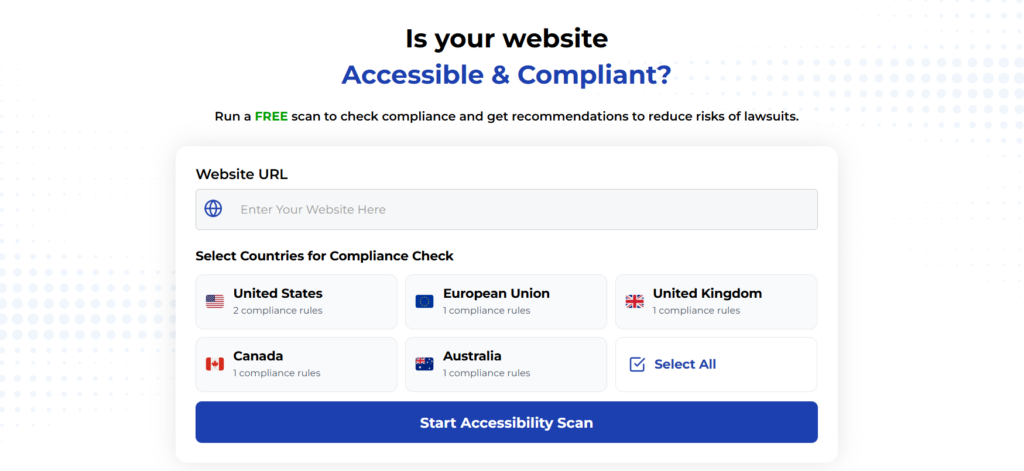
Run a FREE scan to check compliance and get recommendations to reduce risks of lawsuits
Final Thoughts
If you’re ready to see where your website stands, a great first step is to use a free accessibility checker to get an instant report on your homepage. It can give you a quick, actionable list of improvements to get started on. Making the web accessible is a team effort, and by reading this, you’re already on your way to being part of the solution.
Start your compliance journey, update your accessibility statement, and keep EAA top of mind in every project going forward.
Run a Free Scan to Find E-commerce Accessibility Barriers
Want More Help?
Try our free website accessibility scanner to identify heading structure issues and other accessibility problems on your site. Our tool provides clear recommendations for fixes that can be implemented quickly.
Join our community of developers committed to accessibility. Share your experiences, ask questions, and learn from others who are working to make the web more accessible.