


Setting Up Your Website For Accessibility
ADA compliance testing means you check your digital content to make sure people with disabilities can actually read and interact with your pages. You want everyone to buy your products and read your blog posts. I remember watching a QA tester try to use a screen reader for the very first time. They closed their eyes, turned on VoiceOver, and immediately got stuck on a pop-up window they couldn’t close. That frustrating moment showed our whole team why we need real human testing, not just a quick automated scan. Do you know what happens when a blind user visits your store right now? We need to find out.
What This Testing Process Means
The Web Content Accessibility Guidelines give you a strict rulebook. You test your site against these rules to make sure you do not block anyone. The law expects businesses to make their physical stores open to all, and the exact same rule applies to your digital store. You check for missing image descriptions, bad color choices, and confusing layouts. The newest rules, WCAG 2.2, give you even more specific checks to run
Who Takes The Blame?
Usually, business owners take the legal hit if a site fails. But QA testers and content creators share the daily responsibility of checking the work. If you write a new blog post, you have to add alternative text to your pictures. If you design a new button, you have to make sure someone can click it with a keyboard. Everyone on the team needs to care about these steps. You cannot just pass the buck to one single person in the office.
Getting Your Testing Environment Ready
You need a dedicated testing station for each major browser. Chrome handles some screen readers differently than Safari does. Firefox has its own way of showing focus rings. Set up a testing computer with the newest versions of all three browsers. You also need to test on mobile devices because phones handle touch targets very differently than a desktop mouse. A button that works perfectly on Chrome desktop might completely fail on Safari mobile.
Setting Up Screen Readers
You cannot test properly without hearing your website read out loud. Download NVDA if you use a Windows computer because it costs nothing. If you use a Mac, press Command and F5 right now to turn on VoiceOver. I always recommend putting on headphones. Listen to the voice read your main menu. Does it make any sense? Often, you will hear a jumbled mess of strange words that do not help the user at all.
Making A Keyboard-Only Station
Unplug your mouse and put it in a drawer. You have to rely entirely on your Tab key, your Spacebar, and your Enter key. Many users cannot hold a mouse because of motor disabilities. If you cannot reach your checkout button using just the Tab key, you have a massive barrier on your site. This simple test finds the most common usability errors in about five minutes. I always make new testers try this on their very first day.
Selecting Your ADA Compliance Tools
You should always start with free software to catch the obvious mistakes. WAVE runs right in your browser and puts big red icons next to your errors. Axe DevTools works directly inside Chrome and gives you a list of broken rules. These ada compliance tools act like a spell checker for your code. They point out the easy mistakes so you can fix them fast.
Browser Extensions For Quick Checks
Add the Microsoft Accessibility Insights extension to your browser. This plugin lets you see the exact path a keyboard user takes through your page. I love using extensions because they sit right in your toolbar. You do not have to open a separate program. You just click the icon and get immediate feedback on the page you are looking at.
Premium Testing Platforms
Large websites need heavy-duty scanners. You might want to pay for a tool like Siteimprove or AAArdvark. These platforms crawl thousands of pages overnight and send a report to your inbox. They cost money, but they save a QA tester hundreds of hours of manual clicking. Always check the features and the price tag before you sign a contract. You want something that fits your exact team size.
The Automated Testing Phase
Type your web address into the accessibility checker and hit the start button. The software will read your page in seconds. It looks for missing labels, empty links, and tiny text. Automated tools provide a fast way to identify many common errors. I suggest running this scan on your homepage first, because your homepage usually contains the most complex design elements.
Reading The Error Reports
Do not let the long list of red errors scare you. The report will tell you exactly what went wrong. You might see a warning that says “contrast ratio too low.” This means your text color blends into the background color too much. The report usually links directly to the exact rule you broke, which helps you understand how to fix it. You read the report, find the problem element, and change it.
Knowing What Automation Misses
A machine scanner cannot understand meaning. If you put a picture of a dog on your site, and you label it “elephant,” the scanner will pass it. The scanner only checks if a label exists, it does not check if the label tells the truth. Automated testing only catches about thirty percent of the total errors on a typical webpage. You still need human eyes to review the actual content.
Manual ADA Web Testing
Manual ada web testing means you act like a real user with a disability. Press the Tab key repeatedly to jump from link to link. Watch the screen carefully. You should see a box or a ring around the currently selected item. If you lose track of where you are, your users will lose track too. Can you reach the bottom of the page? If the keyboard gets stuck in a loop, you have to rewrite that section.
Checking Focus Indicators
I mentioned the focus ring, but we need to talk about it more. That little blue or black box tells a keyboard user exactly where they are. Many designers hate how this box looks and they try to hide it with custom styling. Do not let your designers hide the focus ring. If you cannot see the ring, a keyboard user cannot move through your site. You have to make the ring thick and highly visible.
Moving With A Screen Reader
Turn your screen reader back on and close your eyes. Can you understand the purpose of the page just by listening? The voice should announce headings, lists, and buttons clearly. You might find that the screen reader skips right over text. When I test with NVDA, I often find that dropdown menus completely trap the software, preventing the user from moving forward. You have to fix these traps immediately.
Reviewing Visual Rules & Content Structure
People with low vision need high contrast to read your words. Grab a free contrast checker tool and select your text color and your background color. The tool will calculate a ratio. You want a ratio of at least 4.5 to 1 for normal text. Black text on a white background gives you the best possible contrast. Stop using light gray text on a white background immediately. It hurts everyone’s eyes.
Zooming In On Your Page
Some users have very poor eyesight and they need to make everything bigger. Hold down your Command or Control key and press the Plus key until your browser zooms in to 200 percent. What happens to your layout? Does the text spill out of the boxes? Do the buttons disappear off the side of the screen? Your site must remain perfectly usable at double its normal size.
Testing Your Headings
Screen reader users rarely read a page from top to bottom. They press a shortcut key to jump from heading to heading. Your headings act as a table of contents. You must start with one main H1 heading at the top. After that, use H2 headings for big sections, and H3 headings for smaller parts underneath. Never skip a heading level just because you want the text to look a certain size.
Evaluating Alt Text on Images
Alternative text describes an image for someone who cannot see it. You have to manually read every single description. Ask yourself if the text paints an accurate picture in your mind. If you have a picture of a woman drinking coffee, your text should say “Woman smiling while drinking coffee at a cafe.” Do not stuff keywords into your image descriptions. Write for humans. If an image is purely decorative, you have to tell the screen reader to ignore it completely.

Testing Specific Website Features & Next Steps For Your Team
Checking Online Forms
Forms cause more problems than almost anything else on the web. A screen reader needs to know exactly what to type into a box. You must connect a visible text label to every single input field. If a user makes a mistake and types a letter into a phone number box, your error message needs to tell them exactly how to fix it. Do not just say “Error.” Tell them “Please use numbers only.”
Testing Dropdown Menus
Hover your mouse over a menu to see if a dropdown list appears. Now, try to open that exact same list using only your keyboard. Many custom menus completely ignore keyboard commands. If a user cannot open the menu, they cannot buy your products. You have to write the menu in a way that respects the Enter key and the Arrow keys. The user must have full control at all times.
Reviewing Video Players
Look at the video player you use on your blog. Can a keyboard user press the play button? Can they adjust the volume without a mouse? Some video players trap the keyboard focus, meaning the user can get into the player but they can never get out. Test your video controls carefully to make sure they work for everyone. A trapped user will simply leave your site.
Looking At Pop-Up Windows
Everybody hates pop-up windows, but they create a literal wall for disabled users. When a pop-up appears, the keyboard focus must move instantly into the new window. If the focus stays on the main page behind the pop-up, the user will not even know the window opened. You also must include a clearly labeled close button that works with the Escape key. If a user cannot close the pop-up, they cannot read your content.
Reviewing Your Findings
Gather your team in a room and look at the testing results. Sort the errors by how much they hurt the user. A completely broken checkout button hurts more than a slightly light text color. Fix the blockers first. Celebrate the small wins, because fixing even one barrier makes the web a better place for someone today. You do not have to fix everything in one afternoon.
Connect With Accessibility-Test.org
Testing takes time, but you do not have to figure it out alone. Start practicing these methods on your own site this afternoon. Check out our free accessibility checker on Accessibility-Test.org to get your very first automated report today. We have resources to help you train your entire team. Download our checklists, share them with your developers, and start fixing those barriers right away!
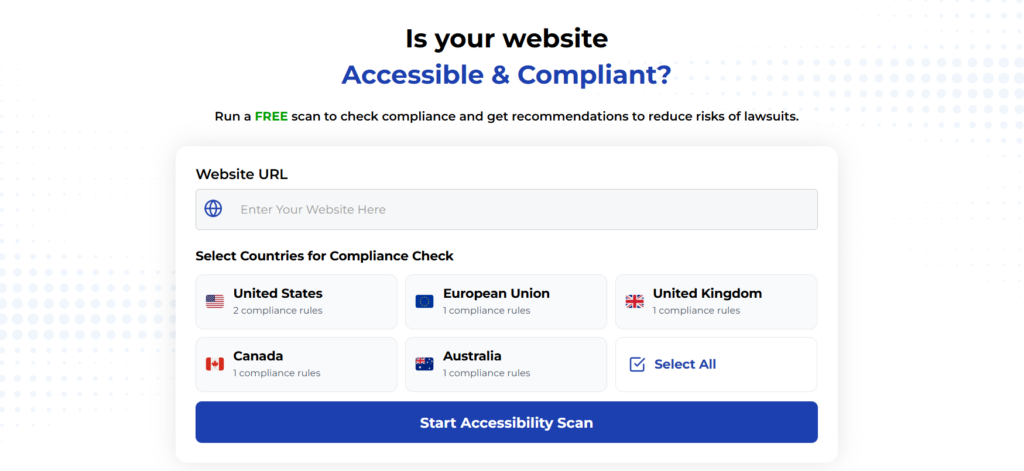
Using Automated Tools for Quick Insights (Accessibility-Test.org Scanner)
Automated testing tools provide a fast way to identify many common accessibility issues. They can quickly scan your website and point out problems that might be difficult for people with disabilities to overcome.
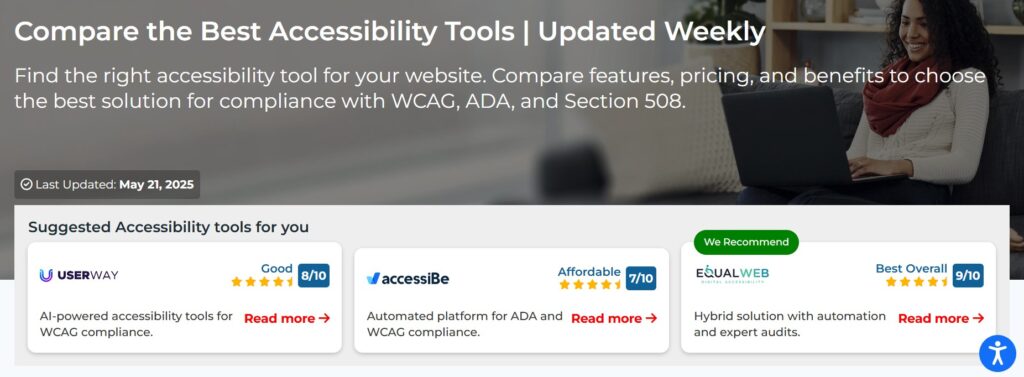
Visit Our Tools Comparison Page!
Run a FREE scan to check compliance and get recommendations to reduce risks of lawsuits
Final Thoughts
Lawyers send thousands of demand letters every single month to businesses with broken websites. If you ignore ADA compliance testing, you paint a massive target on your back. Settling a lawsuit costs thousands of dollars, and you still have to pay to fix the website afterward. Testing your site now acts as cheap insurance against a massive legal headache later. You want to avoid the courtroom entirely.
Run a Free Scan to Find E-commerce Accessibility Barriers
Want More Help?
Try our free website accessibility scanner to identify heading structure issues and other accessibility problems on your site. Our tool provides clear recommendations for fixes that can be implemented quickly.
Join our community of developers committed to accessibility. Share your experiences, ask questions, and learn from others who are working to make the web more accessible.