



How Better Accessibility Can Boost Your Google Rankings
For years, developers and marketers have treated Search Engine Optimization (SEO) and web accessibility as separate disciplines. SEO was for attracting search engines, and accessibility was for helping users with disabilities. But what if we told you that line is blurring? Recent data suggests that making your website more accessible can directly lead to higher rankings and a significant increase in organic traffic.
It turns out that what’s good for users with disabilities is also what’s good for Google’s crawlers and its evaluation of user experience. The same principles that allow a screen reader to navigate your site smoothly also help a search engine understand your content’s structure and relevance. As Google gets smarter about how real people interact with websites, the connection between accessibility and SEO performance is becoming impossible to ignore. This isn’t just about compliance anymore; it’s about getting a real competitive edge.
Google’s Accessibility-SEO Connection Confirmed
The link between a good user experience and better search rankings is not new. Google has been telling us for years to focus on the user. However, recent algorithm updates have made this connection more direct than ever. The technical elements that support a great experience for people with disabilities are now being measured more closely as direct ranking signals. Think about it from Google’s perspective. Its goal is to provide users with the most relevant and usable content. A website that is confusing, hard to navigate, or broken for a portion of its visitors is not a high-quality result. By rewarding accessible websites, Google ensures a better experience for everyone, including the one in four adults who have some form of disability. This alignment means that your accessibility efforts are now directly contributing to your bottom line.
Core Web Vitals + Accessibility = Higher Rankings
Google’s Core Web Vitals (CWV) are a set of specific metrics that measure a website’s loading performance, interactivity, and visual stability. While they were introduced as user experience metrics, they have a massive overlap with accessibility. A site that scores well on CWV is almost always more accessible.
Let’s break it down:
- Largest Contentful Paint (LCP): This measures how quickly the main content of a page loads. A slow-loading site is frustrating for everyone, but it can be a major barrier for users on slow internet connections or those using assistive technology that has to process the entire page. Fast LCP times mean content is available quickly, which is a win for both SEO and accessibility.
- Interaction to Next Paint (INP): This new metric replaces First Input Delay (FID) and measures a page’s overall responsiveness to user interactions. For a person using a keyboard or a screen reader, a page that freezes or lags after a click is unusable. An unresponsive page tells Google that the user experience is poor, which can hurt your rankings.
- Cumulative Layout Shift (CLS): This tracks how much a page’s content unexpectedly moves around as it loads. For someone with a visual or motor impairment, a button that shifts just as they are about to click it is a huge problem. Low CLS scores mean a stable, predictable interface, a cornerstone of both accessible design and a positive user experience that Google rewards.
User Experience Signals That Matter Most
Beyond Core Web Vitals, Google uses other user behavior signals to judge your website’s quality. These are indirect measures of how satisfied users are with your content, and they are heavily influenced by your site’s accessibility.
First is dwell time, or how long a visitor stays on your page before returning to the search results. If a person using a screen reader lands on your site and finds it impossible to navigate because of missing headings or confusing links, they will leave immediately. This short dwell time signals to Google that your page was not a good result for their query. Conversely, a well-structured, accessible page encourages longer visits, signaling high value.
Next is bounce rate. A high bounce rate means visitors leave after viewing only one page. This often happens when content is unreadable, forms are unusable, or navigation is broken for assistive technologies. For example, if a user with low vision can’t adjust font sizes or contrast, they are forced to leave, adding to your bounce rate.
Finally, there’s the concept of “pogo-sticking,” where a user clicks on your result, immediately bounces back to Google, and clicks on a different result. This is a powerful signal that your page failed to meet their needs. For users with disabilities, this can happen constantly if sites aren’t built with WCAG compliance in mind. An accessible site stops the pogo-sticking, keeps users engaged, and shows Google it’s the right answer.
The Technical SEO-Accessibility Overlap
Many of the technical tasks you already perform for SEO have a dual benefit for accessibility. When you structure your content logically and use descriptive elements, you’re not just feeding the Googlebot, you’re creating a better experience for people using assistive devices. This overlap is where you can achieve some of the biggest wins for both sides with minimal extra effort.
By focusing on these shared technical elements, you make your site more robust, understandable, and visible. It’s about building a solid foundation that serves every visitor and every search crawler effectively. From the code that structures your page to the descriptions you write for your images, these details matter more than you think.
Semantic HTML: SEO and Screen Reader Benefits
Semantic HTML is the practice of using HTML tags to reinforce the meaning and structure of your content, not just its appearance. For example, using an `<h1>` for your main heading, `<p>` for paragraphs, and `<ul>` for bulleted lists. This is something SEO professionals have been doing for years because it gives search engines clear clues about a page’s information hierarchy.
This is exactly what screen readers need, too. When a visually impaired user visits a page, their screen reader uses the HTML structure to announce the content. It will say “Heading Level 1” for an `<h1>` or “list with 3 items” for a `<ul>`. This allows the user to quickly understand the page layout and skip to the section that interests them. A page built with non-semantic tags, like using `<div>`s and CSS to style text to look like a heading, is just a wall of undifferentiated text to a screen reader.
Proper use of `accessible headings` (`<h1>` through `<h6>`) in a logical order is one of the most important parts of both on-page SEO and web accessibility. It creates a document outline that Google uses to understand your main topics and that screen reader users depend on for navigation.
Measuring Your Accessibility-SEO Performance
To make real progress, you need to track your efforts. Just as you monitor keyword rankings and organic traffic for SEO, you should measure how your accessibility improvements are affecting your site’s performance. Combining these metrics gives you a much fuller picture of your website’s overall health and user-friendliness.
The goal is to move beyond seeing accessibility as a simple checklist and instead view it as an ongoing driver of business value. By identifying the right Key Performance Indicators (KPIs) and using tools that can monitor both accessibility and SEO, you can demonstrate the ROI of your work and make smarter decisions about where to invest your resources next.
KPIs That Track Both Goals
You don’t need to reinvent the wheel to measure your accessibility-SEO success. You can use many of the same KPIs you’re already familiar with, but look at them through an accessibility lens.
- Organic Traffic & Rankings: This is the most obvious one. As you fix accessibility issues, are you seeing a corresponding lift in your traffic from search engines? Are your rankings for important keywords like accessibility testing tools or WCAG standards improving ? This is your top-line indicator that the changes are working.[1]
- User Engagement Metrics: Dig into your analytics. Is your bounce rate decreasing? Is time on page or dwell time increasing? These improvements often point to a better, more accessible user experience. For example, if you see that pages with newly added accessible forms have a lower exit rate, it’s a strong sign that you’ve removed a major frustration point for users.
- Conversion Rate: Ultimately, you want users to take action. Whether it’s filling out a contact form, buying a product, or signing up for a newsletter, a more accessible website should lead to higher conversion rates. Track conversions on key pages before and after making accessibility fixes. Removing barriers for users with disabilities opens up your funnel to more people, which should translate directly into better business results.
Tools for Dual Monitoring
A good toolkit can help you keep an eye on both accessibility and SEO without doubling your workload. Many platforms now recognize the close relationship between these two areas and offer features that help you monitor both from a single dashboard.
For SEO, tools like Semrush and Ahrefs are excellent for tracking your keyword rankings, backlink profile, and overall search visibility. You can use them to see how your site’s performance changes over time as you roll out accessibility improvements. The Semrush report shows dozens of relevant keywords to track, such as web accessibility testing and ADA compliance.[1]
For accessibility, accessibility checker tools are essential. Automated scanners like WAVE, Accessibility Insights for Web, and Lighthouse (built into Chrome’s developer tools) can quickly audit your pages for common WCAG compliance issues. These tools are a great starting point for finding problems like missing alt text, low-contrast text, and improper heading structures.
For a more complete picture, you need to combine automated scanning with manual testing and user feedback. An accessibility audit from a specialized service can give you a deep dive into how real users interact with your site. Pairing the findings from an audit with your SEO data can reveal powerful connections. For example, you might find that a page with a low SEO ranking is also flagged for having a complex and inaccessible navigation menu. Fixing the navigation could improve both usability and search performance.
Quick Wins: Changes That Boost Both Rankings and Access
Getting started with accessibility doesn’t have to be a massive, months-long project. There are several high-impact changes you can make that will quickly improve the experience for users with disabilities and send positive signals to search engines. These “quick wins” are the perfect way to build momentum and demonstrate the value of accessibility to your team.
Focusing on these foundational elements first provides the greatest return for your effort. They are relatively simple to implement, yet they fix some of the most common and frustrating barriers found on the web today.
Improve Your Page Titles and Headings
Your page title (the text that appears in the browser tab) is one of the most important elements for both SEO and accessibility. It’s often the first thing a user sees in search results and the first thing a screen reader announces when a page loads. Make sure every page has a unique, descriptive title that clearly explains its content.
Within the page, use a logical heading structure. There should only be one `<h1>` per page, which serves as the main heading. Use `<h2>`s for main sections, `<h3>`s for sub-sections, and so on. Don’t skip heading levels (e.g., jumping from an `<h2>` to an `<h4>`). This simple hierarchy helps Google understand your content’s structure and allows screen reader users to navigate the page efficiently. Fixing your heading structure is a fast and effective way to score points for both disciplines.
Add Alt Text to All Informative Images
Go through your website and make sure every image that conveys information has descriptive alt text. This is a simple task that can have a big impact. As discussed earlier, it’s a huge help for visually impaired users and gives search engines valuable context about your page content.
Decorative images, like stylistic borders or abstract background patterns, should have empty alt attributes (alt=””). This tells screen readers to ignore them, preventing unnecessary noise for the user. Focus your effort on images that actually mean something: product photos, charts, infographics, and headshots. This alt text accessibility is a fundamental check in any accessibility audit.
Ensure All Links Are Descriptive
Look at the links on your pages. Do they make sense out of context? A screen reader user can pull up a list of all the links on a page to navigate quickly. If that list is just a series of “Click Here,” “Learn More,” and “Read More,” it’s completely useless. This forces the user to go back and read the surrounding text to understand where each link goes.
This is also a missed opportunity for SEO. Anchor text (the clickable text in a link) gives Google a clue about the content of the destination page. Instead of “Click here to download our report,” use descriptive links like “Download our 2025 Web Accessibility Report.” It’s clearer for all users and provides better keyword context for search engines. This is a simple change that makes a world of difference.
Check for Color Contrast
Low-contrast text, like light gray text on a white background, can be difficult or impossible to read for people with low vision, including many older adults. The Web Content Accessibility Guidelines (WCAG) provide specific contrast ratios that text and background colors must meet to be considered readable.
Use a free accessibility checker or color contrast tool to test the main text and interface elements on your site. Adjusting your site’s colors to meet these minimum ratios is often a simple CSS change. Not only does this make your content readable for more people, but it also improves the general legibility for all users on different screens and in various lighting conditions. A site that is physically easier to read encourages longer engagement, which is a positive signal for SEO.
By focusing on these practical connections, you can stop treating accessibility as a separate, burdensome task. Instead, see it for what it is: a core part of creating a high-quality, user-friendly website that performs better for everyone, including search engines.
Alt Text: Beyond Compliance to Search Visibility
Alternative text, or “alt text,” is a short, written description of an image in your website’s HTML. Its primary purpose is to provide a text equivalent for users who cannot see the image, such as people who are blind and use screen readers. The screen reader will read the alt text aloud, allowing the user to understand what the image communicates. For years, this was seen purely as an accessibility or ADA compliance requirement.
However, alt text is also a powerful SEO tool. Google’s image recognition is good, but it still relies heavily on alt text to understand what an image is about and how it relates to the surrounding content. When you write descriptive, keyword-rich alt text, you give Google another piece of data to confirm your page’s topic. This helps your page rank in standard search and gives your images a chance to appear in Google Image Search, which can be a significant source of traffic. Think of alt text as a win-win. It makes your visual content accessible to everyone and gives you a direct SEO advantage. Good alt text is not just “image of a dog,” but “Golden retriever puppy chewing on a red toy in the grass.” It’s descriptive for both people and search engines.
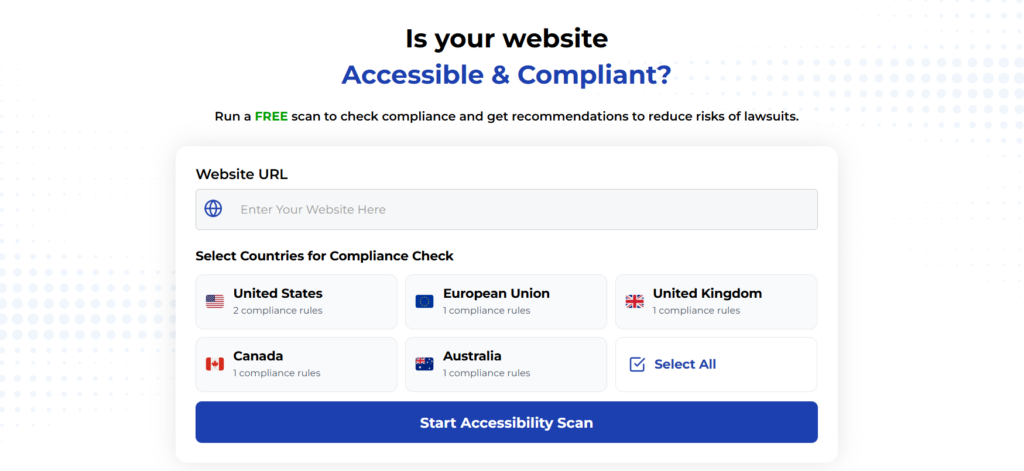
Using Automated Tools for Quick Insights (Accessibility-Test.org Scanner)
Automated testing tools provide a fast way to identify many common accessibility issues. They can quickly scan your website and point out problems that might be difficult for people with disabilities to overcome.
Visit Our Tools Comparison Page!
Run a FREE scan to check compliance and get recommendations to reduce risks of lawsuits
Final Thoughts
Ready to find out how accessible your website is? Don’t wait for your rankings to drop. Try our free accessibility scanner today to get an instant analysis and discover your first set of quick wins.
Run a Free Scan to Find E-commerce Accessibility Barriers
Want More Help?
Try our free website accessibility scanner to identify heading structure issues and other accessibility problems on your site. Our tool provides clear recommendations for fixes that can be implemented quickly.
Join our community of developers committed to accessibility. Share your experiences, ask questions, and learn from others who are working to make the web more accessible.