



Understanding Web Accessibility Testing
Have you ever landed on a website and found it impossible to use? Maybe the text was too small to read, or you couldn’t figure out how to click the right button. For many people with disabilities, this is a daily reality. This is where accessibility testing comes in. Simply put, an accessibility test checks if a website, app, or other digital product can be used by everyone, including people with disabilities. It’s not about adding a few features here and there; it’s about a fundamental approach to design and development that ensures no one is left out. This process involves evaluating a site to find and fix barriers that might prevent someone from getting information or completing a task. This article will walk you through what an accessibility test is, why it matters so much, and how it’s done.
What Exactly Is an Accessibility Test?
An accessibility test is an evaluation of a website or application to determine its usability for people with disabilities. The main goal is to identify any part of the user experience that could create a barrier for individuals with visual, auditory, motor, or cognitive impairments. Think of it like a building inspection. An inspector checks for wheelchair ramps, accessible restrooms, and clear signage to make sure everyone can enter and navigate the building. An accessibility test does the same for your digital property.
This evaluation isn’t a single, simple check. It is a multi-step process that compares your website against a set of established criteria, most commonly the Web Content Accessibility Guidelines (WCAG). These guidelines provide a shared standard for making web content more accessible. The test looks for specific problems, such as images that a screen reader can’t describe, videos without captions, or navigation that can’t be operated with just a keyboard. By finding these issues, you can work to fix them and open up your website to a much wider audience.
Why Should You Care About Accessibility Testing?
Making your website accessible isn’t just a kind gesture; it’s a smart decision for any business or organization. The reasons go beyond simple ethics and touch on audience reach, legal responsibilities, and even your site’s overall quality. Ignoring accessibility means you are actively choosing to exclude people, and that choice has consequences.
Reaching a Wider Audience
Over one billion people worldwide live with some form of disability. When your website isn’t accessible, you are effectively closing your digital doors to a massive segment of the population. These are potential customers, clients, and readers who cannot engage with your content or buy your products simply because of technical barriers. By conducting accessibility tests and fixing the issues you find, you make your site usable for more people. This not only broadens your audience but also shows that you value every user, which can build strong brand loyalty. An accessible website is a more welcoming website, and that benefits everyone.
The Legal Side of Digital Access
In many countries, digital accessibility is not just a recommendation, it’s the law. Laws like the Americans with Disabilities Act (ADA) in the United States and various regulations in other regions require that digital properties, including websites, be accessible to people with disabilities. Businesses that fail to meet these requirements face a growing risk of legal action. Lawsuits related to website accessibility have become increasingly common, leading to costly settlements and mandated repairs. Performing regular accessibility tests is a key part of your legal due diligence. It helps you identify and address compliance gaps, protecting your organization from legal trouble while doing the right thing for your users.
Improving the User Experience for Everyone
Have you heard of the “curb-cut effect”? It’s the idea that features designed for people with disabilities often end up helping everyone. Curb cuts in sidewalks were created for wheelchair users, but they also help people pushing strollers, pulling luggage, or riding bikes. The same is true for web accessibility. For example, captions on videos were made for people with hearing impairments, but they’re also used by people in noisy offices or quiet libraries. Good color contrast helps people with low vision, but it also makes your screen easier to read in bright sunlight. A website that’s easy to navigate with a keyboard is a lifesaver for someone with a motor disability, and it’s also helpful for a power user who prefers keyboard shortcuts. Accessibility testing leads to a better-designed website for all your visitors.
Boosting Your Website’s SEO
Search engine optimization (SEO) and accessibility share a surprising amount of common ground. Many of the practices that make a website accessible also help it rank higher in search results. For instance, using descriptive alt text for images helps screen reader users understand visual content, and it also gives search engines context about what the image shows. A logical heading structure (H1, H2, H3) is critical for screen reader navigation, and it’s also a strong signal to Google about your content’s organization. Because accessible design creates a better user experience, visitors are more likely to stay on your site longer, reducing bounce rates. These positive user signals can contribute to improved search rankings over time.
The Main Types of Accessibility Testing
There isn’t a single button you can press to perform an accessibility test. Instead, testers use a combination of methods to get a full picture of a site’s usability. These methods generally fall into three categories: automated, manual, and user testing. Each one has its own strengths and weaknesses, and a solid testing strategy will almost always involve a mix of all three.
Automated Accessibility Testing
Automated testing uses software tools to scan your website and check for accessibility issues against a predefined set of rules, usually based on WCAG. These tools, often called accessibility checkers or scanners, are very fast and can analyze hundreds of pages in minutes. They are great at catching certain types of problems, such as missing alt text on images, low text-to-background color contrast, or form fields without labels.
However, automated tools are only a starting point. It’s widely accepted that they can only detect about 20-30% of all potential accessibility issues. They can tell you if an image has alt text, but they can’t tell you if that alt text is actually meaningful or just gibberish. They can’t determine if your page’s reading order makes sense or if your keyboard navigation is logical. Because of these limitations, relying only on automated testing gives a false sense of security.
Manual Accessibility Testing
Manual testing is where a human takes over. A tester methodically moves through your website using the same tools and techniques that a person with a disability might use. This includes trying to navigate the entire site using only a keyboard, checking if all interactive elements like buttons and links have a visible focus indicator, and using a screen reader to listen to how the content is announced.
This human-led process is essential because it catches the nuanced and contextual problems that automated tools miss. Is the link text “click here” clear enough? Can a user understand the layout of a complex data table when it’s read aloud? Only a person can answer these questions. While it is more time-consuming than automated scanning, manual testing is absolutely necessary for ensuring your website is truly usable and compliant with accessibility standards.
A Closer Look at the Accessibility Testing Process
A proper accessibility test is a structured project, not a random check. It follows a clear process that begins with setting goals and ends with a plan for fixing the problems that were found. Understanding these steps helps demystify what’s involved in an audit.
Defining the Scope and Standards
Before any testing begins, you must decide what you’re testing and what standards you’re aiming for. The global standard for web accessibility is WCAG, which has three levels of conformance: A (the minimum), AA (the target for most organizations), and AAA (the most stringent). The team will decide which level to audit against, which is typically Level AA. You also need to define the scope. Are you testing the entire website, or just the most critical user journeys, like the registration process, the shopping cart, or the main dashboard? Clarifying these points ensures the testing is focused and delivers relevant results.
Combining Automated and Manual Methods
A good testing workflow uses both automated and manual approaches. The process often starts with an automated scan of the entire site. This provides a quick overview of common, widespread issues that can be fixed relatively easily. It’s the low-hanging fruit. Once that initial scan is complete and the results are reviewed, the manual testing phase begins. Testers dig deeper into the key user flows identified in the scope, using assistive technologies to simulate real-world usage. This combined approach is both efficient and thorough, catching a much wider range of issues than either method could alone.
Reporting and Fixing the Issues
The outcome of an accessibility test is an audit report. A useful report does more than just list problems. It should clearly explain each issue, state where it can be found on the site, and identify which WCAG success criterion it violates. Most importantly, it should provide clear, actionable recommendations on how to fix the problem. Good reports often include screenshots or code snippets to help developers pinpoint the issue. The final step is to prioritize the findings. Some issues, known as blockers, might prevent a user from completing a task entirely and should be fixed first. Others might be less severe and can be addressed in a later phase. This report becomes the roadmap for the development team to make the necessary improvements.
Common Issues Found During an Accessibility Test
While every website is different, many of the same accessibility problems appear again and again. An accessibility test will often uncover a recurring set of issues that create significant barriers for users. Here are some of the most common ones:
Improper Heading Structure: Using headings (H1, H2, H3, etc.) just for styling purposes breaks the logical structure of a page. Screen reader users rely on a proper heading hierarchy to understand the page layout and navigate to different sections quickly.
Missing or Poor Alt Text: Images are a big part of the web, but if they don’t have descriptive alternative text, a screen reader user has no way of knowing what they convey.
Low Contrast Text: When text color is too similar to its background color, it becomes difficult to read for people with low vision and even for users in certain lighting conditions.
Inaccessible Forms: Forms are critical for interaction, but they are often a major point of failure. Issues include form fields without clear labels, error messages that aren’t announced by screen readers, and submission buttons that are hard to activate.
Keyboard Traps: This happens when a keyboard user can navigate into a component, like a pop-up window or a widget, but cannot navigate out of it without using a mouse. They are effectively stuck.
Vague Link Text: Links that say “Click Here” or “Learn More” are not helpful for screen reader users, who often navigate by pulling up a list of all links on a page. Descriptive link text gives them the context they need.
Missing Video Captions: Any video with spoken content must have captions for users who are deaf or hard of hearing. Similarly, a transcript should be available.
Who Performs an Accessibility Test?
An accessibility test can be carried out by several different groups, each with its own advantages. Some organizations choose to build this capacity internally, while others prefer to hire outside specialists.
Third-Party Consultants: Many organizations hire specialized agencies or consultants to conduct an accessibility audit. These experts bring deep knowledge of accessibility standards and testing methodologies. Because they are not part of the internal team, they can provide an unbiased and objective assessment of the website. An audit from a third party often carries more weight and provides a clear, expert-backed plan for remediation.
In-house Teams: Some companies train their own developers, designers, and quality assurance (QA) staff to perform accessibility tests. The advantage of this approach is that it embeds accessibility knowledge directly within the team, making it a natural part of the development cycle. It promotes a culture where accessibility is considered from the start, rather than as an afterthought.
User Testing with People with Disabilities
The most insightful form of accessibility testing involves real users. This means recruiting people with different types of disabilities to try to perform specific tasks on your website. You might ask a screen reader user to purchase a product, a keyboard-only user to fill out a contact form, or a user with low vision to find a piece of information on your blog.
This method moves beyond technical compliance and gets to the heart of usability. A website can technically pass every WCAG check but still be confusing or frustrating for a real person. Observing users as they navigate your site provides invaluable feedback on the practical challenges they face. Their direct experiences reveal barriers you might never have imagined. This is the ultimate test of your site’s accessibility because it centers the people you’re trying to serve.
Using Automated Tools for Quick Insights (Accessibility-Test.org Scanner)
Automated testing tools provide a fast way to identify many common accessibility issues. They can quickly scan your website and point out problems that might be difficult for people with disabilities to overcome.
Visit Our Tools Comparison Page!
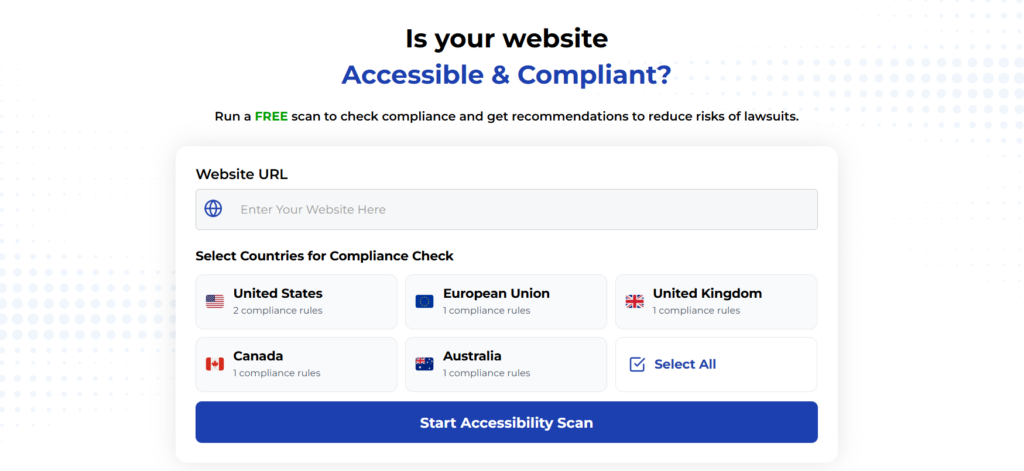
Run a FREE scan to check compliance and get recommendations to reduce risks of lawsuits
Final Thoughts
An accessibility test is a vital health check for your website. It’s the process of finding out where your digital property fails to serve people with disabilities and identifying how to fix those failures. It’s not about aiming for a perfect score, but about committing to a process of continuous improvement. By combining automated tools, manual expert review, and feedback from real users, you can uncover the barriers that exclude people from your content and services. This work is essential for reaching a broader audience, complying with legal standards, and simply creating a better experience for every single person who visits your site.
Ready to see where your website stands? Start with an initial check using our free website accessibility scanner to get a snapshot of your site’s health and identify your first steps toward a more inclusive digital presence.
Start your compliance journey, update your accessibility statement, and keep EAA top of mind in every project going forward.
Run a Free Scan to Find E-commerce Accessibility Barriers
Want More Help?
Try our free website accessibility scanner to identify heading structure issues and other accessibility problems on your site. Our tool provides clear recommendations for fixes that can be implemented quickly.
Join our community of developers committed to accessibility. Share your experiences, ask questions, and learn from others who are working to make the web more accessible.