



Third-Party Tools and Your Site’s Accessibility: Are You Exposed?
You’ve spent time and money making your website sleek, functional, and user-friendly. You’ve added a helpful chatbot, an interactive map, and a slick video player to show off your product. These tools, often from third-party vendors, are designed to make your site better. But what if they’re actually putting your business at risk? Many website owners believe, “If I didn’t create the content, it’s not my problem.” Unfortunately, when it comes to web accessibility and laws like the European Accessibility Act (EAA), that’s a dangerous myth.
The reality is simple: you are responsible for everything on your website. Every widget, every embedded feed, every analytics script. If a user with a disability can’t use a feature on your site because a third-party tool is inaccessible, your website is the one failing to comply. This can lead to legal complaints, lost customers, and a damaged reputation. This isn’t just about avoiding lawsuits; it’s about ensuring every person who visits your site can actually use it.
This article will break down the hidden dangers of third-party content. We’ll show you how to spot high-risk integrations, what you can do to manage them, and how to protect your business from accessibility failures you didn’t even know you had.
What Exactly is Third-Party Content?
Before we dive deeper, let’s get clear on what we’re talking about. “Third-party content” is any element on your website that you didn’t create yourself. It’s code or content that’s pulled in from an outside source and displayed on your pages. It’s incredibly common; most modern websites use several third-party tools to add functionality without having to invent it from scratch.
Think about the building blocks of your site. Did you add a map to your contact page? A feed of your latest social media posts? A calendar for booking appointments? If the answer is yes, you’re using third-party content.
Here are some of the most frequent examples you’ll find:
- Customer support chat widgets that pop up to help users.
- Embedded videos from platforms like YouTube or Vimeo.
- Social media feeds showing your latest posts from Instagram, Twitter, or Facebook.
- Maps and location services, like Google Maps.
- Analytics and advertising scripts that run in the background.
- Booking engines for appointments, reservations, or tickets.
- Payment gateways that handle customer transactions.
- Cookie consent banners that manage user privacy choices.
Each of these adds a layer of code and functionality to your site that you don’t directly control. And if the original creator didn’t prioritize accessibility, those barriers are now on your website.
Finding High-Risk Third-Party Content
Not all third-party tools carry the same level of risk. Some are more likely to cause serious accessibility problems than others. The most dangerous culprits are often the ones that require a lot of interaction from the user. If a person can’t complete a main task on your site; like getting help, watching a video, or making a purchase; because of a faulty tool, you have a big problem. Let’s look at some of the most common offenders.
Maps and Location Services
Interactive maps are great for showing your business location, but they can be a nightmare for people who don’t use a mouse. Someone using only a keyboard might find they can’t zoom in or pan around the map because the controls don’t respond. They might get stuck in the map; an issue known as a “keyboard trap”; and be unable to continue navigating the rest of the page.
For people who use screen readers, the information on the map might be completely silent. The pins, locations, and directions that are obvious to a sighted user may be totally missing for them. This is a perfect example of a tool that seems helpful but can exclude a whole group of users. A person who can’t figure out where you’re located is not likely to become a customer.
Customer Support Chat Widgets
Live chat is a popular feature for instant customer support. Yet, many off-the-shelf chat widgets are surprisingly inaccessible. Users who rely on keyboards may not be able to open the chat window, type in their questions, or hit the “send” button. The buttons and input fields might not have proper labels, so a screen reader might just announce “button” or “edit text” without explaining what it’s for.
Imagine trying to get urgent help but being unable to even start a conversation with the support agent. This creates a frustrating experience that reflects poorly on your business. When you select a chat tool, you need to ask if it’s been tested for keyboard navigation and screen reader compatibility. If the vendor doesn’t know, that’s a major red flag.
Analytics and Advertising Scripts
You might think that scripts running in the background can’t cause accessibility issues. They’re invisible, right? But these scripts can seriously disrupt the user experience. Advertising scripts are known to pop up sudden, unexpected overlays or banners that can trap keyboard focus or block content on the page.
Analytics scripts can sometimes interfere with how the page loads, changing the order of content and confusing screen reader users who expect a logical flow. They can also, in some cases, slow the website down, which disproportionately affects users with slower internet connections or older devices. While you need analytics to understand your audience, it’s important to use tools that don’t come at the expense of a functional website for everyone.
Social Media Feeds
Embedding a feed of your latest Instagram or Twitter posts seems like a smart way to keep your content fresh. But these feeds are often accessibility minefields. The images that pull in from your social media account frequently lack alternative text, leaving screen reader users with no idea what’s being shown. Videos might auto-play without any warning or way to stop them, which can be distracting and distressing.
Furthermore, the “like,” “share,” and “comment” buttons within the embedded feed may not be accessible via keyboard. A user might see your engaging content but be unable to interact with it. Instead of drawing them into your community, the inaccessible feed just reminds them that they’re being left out.
Embedded Video Players
Video is a powerful medium, but only if everyone can access the information. Most embedded players from sites like YouTube and Vimeo have decent accessibility built-in, but it depends on how you use them. Are you providing accurate, synchronized captions for people who are deaf or hard of hearing? If a video has important visual information, are you providing audio descriptions for people who are blind?
The player controls themselves; play, pause, volume, and captions; must be operable with a keyboard. If a user can’t start or stop the video, they don’t have control over their experience. Making your video content accessible isn’t just a recommendation; it’s a firm requirement under standards like WCAG 2.2.
Booking Systems and Payment Gateways
If your website’s purpose is to sell something or schedule a service, your booking and payment tools are your most important features. They are also among the most likely to be inaccessible. These tools often involve complex forms, with date pickers, dropdown menus, and timed sessions. If these forms aren’t built correctly, they can be impossible for some people to use.
Common problems include form fields without clear labels, date-selection calendars that require a mouse, and error messages that don’t tell a screen reader user what went wrong or how to fix it. If a person with a disability tries to give you their money but can’t complete the purchase, you’re not just losing a sale. You’re actively discriminating against them, which is a serious legal concern under laws like the ADA and EAA. When it comes to accessible forms, there is no room for error.
The Human and Business Cost of Inaccessible Tools
Let’s step back from the technical details for a moment. What does this actually mean for the people visiting your site? Imagine a student with a motor disability who uses a keyboard for everything. They’re trying to book a study room at their university library’s website. They get to the booking calendar, a third-party widget, but they can’t select a date. The arrow keys don’t work, and hitting “Tab” just skips over the entire calendar. They’re stuck. Frustrated, they give up and call a friend for help, feeling defeated.
Now, think about it from a business standpoint. That inaccessible calendar didn’t just frustrate a student; it failed to provide a service. Multiply that single negative experience by thousands of users with different disabilities facing similar barriers with chat widgets, payment forms, and information feeds. The result is lost revenue, a tarnished brand image, and potential legal action. People talk about their bad experiences. A reputation for being difficult or impossible to use is not one any business wants. Digital accessibility compliance isn’t just a technical task; it’s a core part of customer service.
Taking Control: How to Manage Third-Party Risk
Feeling a little worried? That’s understandable. The good news is you can take steps to manage these risks. You don’t have to be a passive victim of inaccessible third-party code. It starts with being proactive and making accessibility a priority in how you choose and manage your website’s tools.
Start with a Third-Party Content Audit
You can’t fix what you don’t know is broken. The very first step is to conduct an audit to identify every third-party tool running on your website. Make a list of all of them, from the obvious chat widget to the hidden analytics scripts. Once you have your list, you need to test each one for basic accessibility.
You can begin with an accessibility checker or another automated accessibility testing tool. These scanners can quickly find some common problems, like missing form labels or contrast issues. But remember, automated tools can’t catch everything. You’ll also need to do some manual testing. Try to use these tools yourself using only your keyboard. Can you access every feature? Do you get stuck anywhere? This kind of hands-on testing will reveal many of the most serious barriers. A full accessibility audit performed by professionals can give you an even clearer picture of your risk.
Vet Your Vendors Before You Buy
The best way to avoid problems is to choose accessible tools from the start. Before you add any new widget or script to your site, do your homework on the vendor. Don’t just ask them, “Is your product accessible?” Ask specific questions that show you’re serious about compliance.
Here are a few questions you should ask any potential vendor:
- Can you provide an Accessibility Conformance Report (ACR) or a VPAT?
- Do you test your product with screen readers like JAWS, NVDA, or VoiceOver?
- Is all functionality available using only a keyboard?
- Does your product conform to WCAG 2.2 guidelines at Level AA?
If the vendor can’t give you clear, confident answers, you should probably look elsewhere. A vendor who takes accessibility seriously will have this information ready and will be happy to share it. Their commitment to accessibility should be a deciding factor in your purchase.
Make Accessibility a Contractual Requirement
When you sign a contract with a service provider, you have the power to set expectations. Use it. Work with your legal team to add a clause to your vendor contracts that requires their product to meet specific accessibility standards, such as WCAG 2.2 AA. This is becoming a standard practice for businesses that are serious about digital accessibility compliance.
This clause does two important things. First, it makes your expectations crystal clear to the vendor. Second, it gives you legal recourse if they fail to deliver an accessible product. By putting accessibility in your contracts, you shift some of a shared responsibility to the company that actually builds the tool. This protects your business and pushes the software industry as a whole to treat accessibility as a mandatory feature, not an optional extra.
Search for Accessible Alternatives
What if you’ve already audited your site and found that a tool you rely on is inaccessible? Your first move should be to search for an accessible replacement. In today’s market, you’d be surprised how many options there are. Many companies now compete based on their accessibility, offering products that are designed to be inclusive from the ground up.
Instead of just searching for a “chat widget,” try searching for a “screen reader compatible chat widget” or an “accessible booking system.” You’ll find vendors who proudly advertise their commitment to accessibility. Migrating to a new tool might take some work, but it’s a far better solution than knowingly leaving a barrier on your site that excludes people with disabilities and puts you at legal risk.
Use Accessible Wrappers as a Last Resort
Sometimes, you might be stuck with an inaccessible tool. Maybe it’s a legacy system that’s too complicated to replace immediately, or a niche tool with no accessible alternatives. In these limited situations, you can sometimes build an “accessible wrapper” around the content to mitigate the problem.
This means providing an alternative way for users to get the same information or complete the same task. For an inaccessible, interactive chart, you could add a simple, well-structured data table with the same information below it. For a video that has issues with its captioning feature, you could provide a full, accurate accessibility transcript on the same page. This isn’t a perfect fix, and it should only be a temporary measure. The goal should always be to get the third-party provider to fix their product. But in the short term, a wrapper can provide a necessary bridge for users who would otherwise be completely blocked.
Being Transparent in Your Accessibility Statement
Even with the best efforts, you might have some third-party content on your site with known accessibility issues. The best way to handle this is with honesty and transparency. Your website’s accessibility statement is the perfect place to do this. An accessibility statement is a public document where you describe your commitment to accessibility and any known issues you’re working on.
When documenting third-party problems, be specific. For example, you could write: “Our website uses the [Tool Name] for booking appointments. We are aware that the date-picker in this tool is not fully keyboard accessible. We have contacted the vendor about this issue and are working with them to find a solution. In the meantime, please call us at [Phone Number] to book your appointment, and we will be happy to assist you.”
This kind of statement doesn’t excuse you from your legal obligations. But it does show that you are aware of the problem, taking responsibility for it, and providing an alternative for affected users. It builds trust and demonstrates a good-faith effort to provide an inclusive experience.
Creating a Culture of Accessibility First
Ultimately, managing third-party risk isn’t about a one-time fix or a single accessibility audit. It’s about building a culture within your organization where accessibility is considered at every stage of the process. When your marketing team suggests a new social media widget, the first question should be, “Is it accessible?” When your procurement department is choosing a new software vendor, ADA website requirements and WCAG conformance should be on the checklist.
This proactive approach saves you time, money, and headaches down the road. It positions your brand as one that is modern, inclusive, and responsible. By making accessibility a non-negotiable part of your digital strategy, you turn a potential liability into a competitive advantage. You create a website that not only complies with the law but also works better for every single user, with or without a disability.
Using Automated Tools for Quick Insights (Accessibility-Test.org Scanner)
Automated testing tools provide a fast way to identify many common accessibility issues. They can quickly scan your website and point out problems that might be difficult for people with disabilities to overcome.
Visit Our Tools Comparison Page!
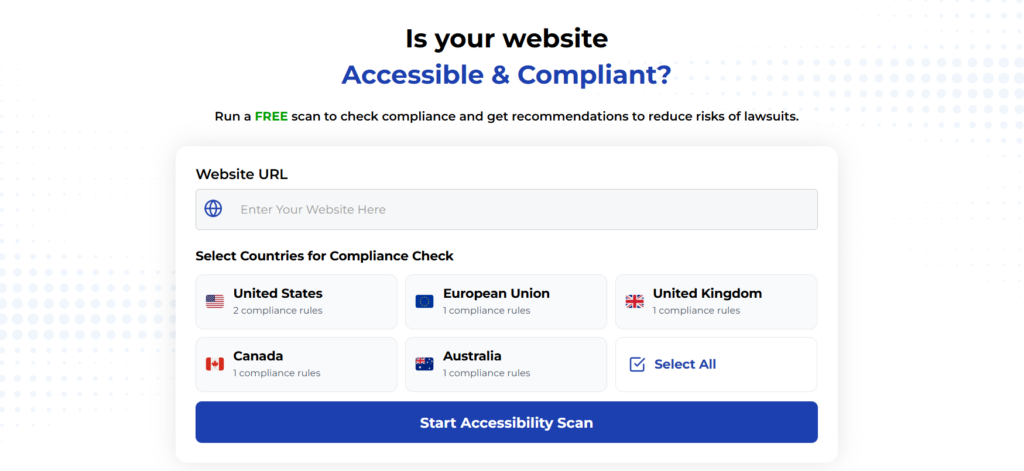
Run a FREE scan to check compliance and get recommendations to reduce risks of lawsuits
Final Thoughts
Feeling uncertain about the third-party tools on your website? You don’t have to stay in the dark. Understanding your exposure is the first step toward protecting your business and serving all your customers.
Start today by using a free accessibility scanner to get a quick report on your site’s health. For a complete picture of your third-party risks and a clear path forward, consider a professional accessibility audit. Let our experts help you identify your hidden liabilities and build a website that is truly open to everyone.
Run a Free Scan to Find E-commerce Accessibility Barriers
Curious about where your site stands? An automated scan is a great first step to identify potential accessibility issues on your e-commerce platform. Run a free scan on our website today to get an initial report on your site’s accessibility health.
Want More Help?
Try our free website accessibility scanner to identify heading structure issues and other accessibility problems on your site. Our tool provides clear recommendations for fixes that can be implemented quickly.
Join our community of developers committed to accessibility. Share your experiences, ask questions, and learn from others who are working to make the web more accessible.