



Your Business Guide to the European Accessibility Act
The European Accessibility Act (EAA) is no longer a future concern; it’s a present-day reality. With the enforcement date of June 28, 2025, now past, businesses operating within the European Union must have their digital products and services aligned with its requirements. This isn’t just about updating a few lines of code; it’s a fundamental shift in how companies approach digital inclusion.
For businesses that haven’t yet addressed these standards, the clock has run out. Enforcement bodies across the EU are actively monitoring for compliance, and the penalties for failing to meet the standards are now in effect. The conversation has moved from “how to prepare” to “how to comply and maintain.” This article walks you through what the EAA demands, who it affects, and the concrete steps you need to take to ensure your business is not left behind.
What is the European Accessibility Act?
The European Accessibility Act is a landmark piece of EU legislation adopted in 2019. Its main goal is to improve the functioning of the internal market for accessible products and services by removing barriers created by different rules in member countries. Before the EAA, a business might have faced a confusing web of national accessibility laws, making it difficult to sell products across the EU. The EAA harmonizes these rules, creating a single set of standards for everyone.
This law is built on the principles of the UN Convention on the Rights of Persons with Disabilities (UNCRPD), which asserts that people with disabilities have the right to participate fully in society. The EAA translates this principle into practical, legally binding requirements for the private sector. The timeline was clear: after its adoption in 2019, EU member states had until June 2022 to write it into their national laws, and businesses were given a three-year transition period until June 28, 2025, to become compliant. That deadline has now passed.
Who Benefits from the EAA?
While the EAA is designed to support the estimated 87 million people in the EU with some form of disability, its benefits extend much further. Think about older adults who may experience changes in vision, hearing, or motor skills. Or someone trying to watch a video on a noisy train; captions help them, too. A well-designed, accessible website with clear navigation and readable text improves the user experience for every single customer. By making digital products and services more usable for everyone, the EAA helps businesses create more intuitive and effective platforms that serve a wider audience.
Which Businesses Must Comply with EAA Requirements?
The EAA has a wide reach, applying to any business offering specific products and services within the EU market, no matter where the company itself is located. If you have customers in Europe, these rules almost certainly apply to you. The law covers a range of key economic sectors.
E-commerce Platforms and Digital Services
Any website or mobile application where customers can buy goods or services is covered. This includes everything from major online retailers to small independent webshops. The entire customer journey must be accessible; from browsing products and reading descriptions to adding items to a cart and completing the checkout process. If a user with a visual impairment can’t use their screen reader to complete a purchase, that platform is not compliant.
Banking and Financial Services
The financial sector is a major focus. This includes consumer banking services like online banking portals and mobile apps, which people use for everyday tasks like checking their balance, paying bills, and transferring money. It also extends to physical hardware, such as automated teller machines (ATMs), ticketing machines, and payment terminals. Financial information must be presented in a way that is understandable and usable for people with various disabilities.
Transportation and Travel Companies
Companies involved in transport must ensure their digital touchpoints are accessible. This includes airline, bus, and rail company websites and mobile apps. Users must be able to search for routes, check timetables, book tickets, and manage their bookings without barriers. The rules also apply to real-time travel information and self-service terminals like check-in kiosks and ticketing machines at stations.
Other Covered Products and Services
Beyond these major areas, the EAA also applies to:
- Computers and operating systems.
- Smartphones, tablets, and other communication devices.
- TV equipment and services, like digital television and on-demand platforms.
- E-books and the software used to read them.
- Access to emergency services, including calls to the single European emergency number, 112.
It is worth noting that microenterprises; businesses with fewer than 10 employees and an annual turnover under €2 million; are exempt from the EAA’s obligations. However, they are still encouraged to make their services accessible, as it is good for business and supports social inclusion.
EAA Compliance: Understanding the Technical Rules
The EAA doesn’t invent new accessibility standards from scratch. Instead, it points to an existing European standard, EN 301 549, as the technical benchmark for compliance. This standard is closely aligned with the globally recognized Web Content Accessibility Guidelines (WCAG). For most businesses with websites and apps, the simplest path to EAA compliance is to meet WCAG 2.1 Level AA.
Technical Standards You Must Meet
Meeting these standards means building your digital products around four core principles, often remembered by the acronym POUR:
Robust: Content must be robust enough that it can be interpreted reliably by a wide variety of user agents, including assistive technologies like screen readers. This comes down to writing clean, standards-compliant HTML so that technology can make sense of the content and present it to the user accurately.
Perceivable: Users must be able to perceive the information being presented. It can’t be invisible to all of their senses. This means providing text alternatives (alt text) for images, offering captions and transcripts for video and audio content, and ensuring a color contrast ratio of at least 4.5:1 for normal text to help people with low vision.
Operable: Users must be able to operate the interface. The interface cannot require interaction that a user cannot perform. This is why all functionality must be available from a keyboard, so someone who cannot use a mouse can still navigate. Websites must also avoid content that flashes at a rate known to cause seizures and give users enough time to read and use content.
Understandable: Users must be able to understand the information as well as the operation of the user interface. This involves using clear and simple language, making website functions operate in predictable ways, and helping users avoid and correct mistakes with clear instructions and error messages.
Documentation Requirements
Proving you’ve met the technical standards isn’t enough. The EAA also requires businesses to be transparent about their accessibility efforts. This is done through a formal accessibility statement. This document must be published on your website and should be easy for users to find.
A proper accessibility statement includes:
- A declaration of your organization’s commitment to digital accessibility.
- The conformance status; whether your site is fully or partially compliant with the standards.
- A list of any known inaccessible areas, with explanations for why they are not accessible and what accessible alternatives are available.
- The date the statement was prepared and the method used for the assessment (e.g., self-assessment, third-party accessibility audit).
- A feedback mechanism allowing users to report accessibility problems and request information. You must also provide a link to the national enforcement body.
A Step-by-Step EAA Compliance Checklist
For any business, achieving and maintaining compliance is an ongoing process. Here is a breakdown of the key phases.
Phase 1: Accessibility Audit and Assessment
The first step is to understand where you currently stand. A thorough accessibility audit will evaluate your website, mobile apps, and other digital products against the WCAG 2.1 AA standard. You can start this process with an automated accessibility checker, which can quickly scan for common issues like missing alt text or low color contrast. However, automated tools can only identify a fraction of potential problems. A complete audit requires manual testing by experts who can assess usability and complex interactions that tools miss. This audit should produce a detailed report of all issues, prioritized by severity.
Phase 2: Implementation and Testing
With the audit report in hand, your development team can create a remediation plan to fix the identified issues. This isn’t just a one-time project; accessibility should be integrated into your entire development lifecycle. By thinking about accessibility from the very beginning of a project; a “shift-left” approach; you can prevent barriers from being built in the first place.
As you implement fixes, continuous testing is essential. This includes both automated scans to catch regressions and another round of manual testing to verify that the fixes work as intended. The most valuable form of testing involves real users with disabilities. Their feedback is the ultimate measure of whether your product is truly usable.
Phase 3: Documentation and Monitoring
Once your digital products are compliant, you need to formalize it. This means writing and publishing your accessibility statement as described earlier. But compliance isn’t static. Every time you update your website or launch a new feature, you risk introducing new accessibility barriers. That’s why ongoing accessibility monitoring is so important. Set up regular automated scans and schedule periodic manual audits (at least once a year) to ensure you stay compliant.
Finally, invest in accessibility training for your entire team. When designers, developers, content creators, and support staff all understand their role in creating accessible experiences, it becomes part of your company culture.
The Business Case for Accessibility
Meeting the EAA’s requirements shouldn’t be seen as just a legal burden. It’s a strategic business opportunity that can deliver real returns.
Expanded Market Reach
Accessibility opens your business to a massive, underserved market. People with disabilities control significant disposable income, and they are loyal to brands that provide an inclusive experience. When your website is usable for someone with a disability, you not only gain their business but also the business of their friends and family.
Enhanced Brand Image
In today’s market, customers increasingly favor brands that demonstrate strong ethical values. A public commitment to accessibility is a powerful statement about your company’s dedication to inclusion and corporate social responsibility. It shows you care about all your customers, which builds trust and enhances your reputation.
Improved SEO Performance
There is a strong and well-documented overlap between accessibility and search engine optimization (SEO). Practices like using proper heading structures, providing alt text for images, and offering transcripts for videos all help search engines better understand your content, which can lead to higher rankings. A website that is easy for assistive technology to navigate is also easy for Google’s crawlers to index.
Penalties for Non-Compliance: What You Risk
The consequences for ignoring the EAA are serious and multi-faceted. Each EU member state sets its own penalty structure, but they are all designed to be “effective, proportionate, and dissuasive.”
- Financial Penalties: Fines are the most direct consequence. These can be substantial, with some countries imposing fines of up to €100,000 or more for violations. In some cases, penalties can be based on a percentage of the company’s annual turnover, which could be a crippling amount for a large enterprise.
- Market Withdrawal: National authorities have the power to demand that a non-compliant product or service be brought into compliance. If the business fails to do so, authorities can order the withdrawal of the product from the market entirely.
- Reputational Damage: Being publicly named as a non-compliant company can do lasting damage to your brand. It signals to customers that your business is not inclusive, potentially driving them to competitors who are.
- Legal Action: The EAA empowers consumers to report non-compliance to national authorities. It also opens the door for individuals and disability advocacy groups to bring legal challenges against non-compliant businesses.
The European Accessibility Act has redefined the digital landscape in the EU. Compliance is no longer optional. By embracing accessibility now, businesses can avoid legal risks, improve the user experience for everyone, strengthen their brand, and unlock a significant new market.
Using Automated Tools for Quick Insights (Accessibility-Test.org Scanner)
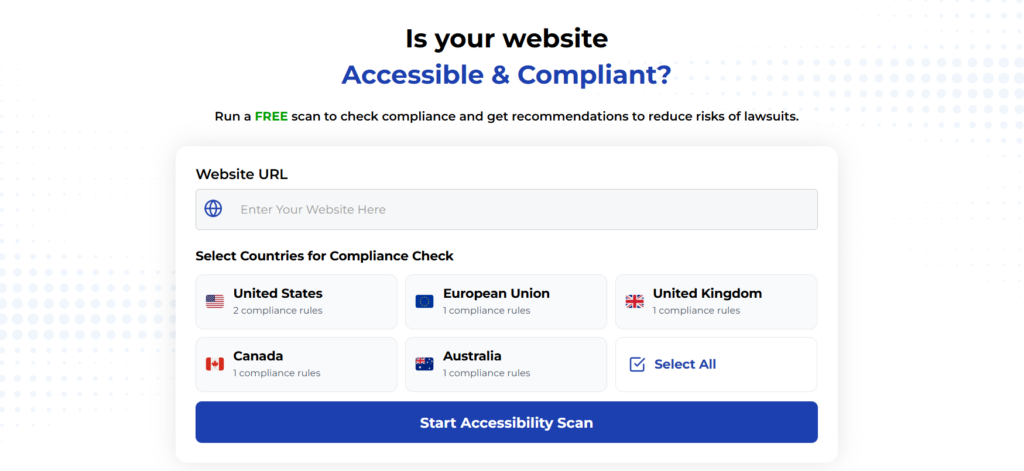
Automated testing tools provide a fast way to identify many common accessibility issues. They can quickly scan your website and point out problems that might be difficult for people with disabilities to overcome.
Visit Our Tools Comparison Page!
Run a FREE scan to check compliance and get recommendations to reduce risks of lawsuits
Final Thoughts
Ready to see where you stand? Use the free EAA compliance checker on Accessibility-Test.org, or reach out to our team for a quick review. Don’t put your business at risk; make accessibility part of your brand advantage today.
Start your compliance journey, update your accessibility statement, and keep EAA top of mind in every project going forward.
Commit to accessibility testing today. The sooner you start, the sooner everyone can benefit from your content and services; no exceptions.
Run a Free Scan to Find E-commerce Accessibility Barriers
Want More Help?
Try our free website accessibility scanner to identify heading structure issues and other accessibility problems on your site. Our tool provides clear recommendations for fixes that can be implemented quickly.
Join our community of developers committed to accessibility. Share your experiences, ask questions, and learn from others who are working to make the web more accessible.