



Are You Missing What Matters in Accessibility Testing?
You may have run an accessibility scan and resolved the issues found, but is your website truly accessible to everyone? Even in 2025, many organizations overlook basic yet critical accessibility points. The stakes are higher than ever, with over 1 billion people worldwide experiencing disabilities in some form. Poor digital accessibility can alienate customers and harm brand reputation, especially when web accessibility lawsuits are on the rise and search engines are prioritizing accessible content.
Automated tools only catch a portion of potential barriers. Relying solely on them will leave gaps; gaps that mean real people are excluded from using your site. Whether you’re a developer, designer, or business owner, understanding and correcting the most common accessibility testing mistakes is essential for creating a digital presence that’s compliant, usable, and inclusive.
Why Accessibility Testing Still Matters
Ensuring your site is accessible isn’t just about legal compliance (think ADA, Section 508, or the European Accessibility Act); it’s about reaching the widest possible audience and building trust. Accessibility overlaps with SEO best practices, helping your site rank higher and be found by more people. Fundamentally, it’s about providing equal access and a universally better experience for everyone; regardless of ability.
Why Relying Only on Automated Testing Is a Mistake
In 2025, automated accessibility checkers can detect more issues than ever, sometimes over half of common problems. However, they have limitations:
- They miss context-specific issues, like unclear navigation or confusing instructions.
- They cannot evaluate the real user experience, especially for those using assistive technology.
- They miss many aspects of cognitive accessibility.
Automated tools should always be combined with manual testing methods to catch what matters most to actual users.
Common Accessibility Testing Mistakes (And How to Fix Them)
1. Poor Semantic Structure
Many websites misuse or skip heading levels, using headings for decorative purposes rather than logical structure. This makes it difficult for screen readers and keyboard users to navigate content efficiently.
How to Fix It:
- Use headings in a logical order, never skipping levels.
- Reserve headings for structure, not style; use visual styling separately.
- Organize content using clear regions such as navigation, main content, and sidebars.
2. Vague or Missing Alt Text
Images without descriptive text can make content incomprehensible to those using screen readers. On the other hand, decorative images should not be announced at all.
How to Fix It:
Avoid redundancies and unnecessary words in your descriptions.
Provide concise, meaningful descriptions for all informational and functional images.
Mark decorative images so assistive technologies skip them.

3. Inadequate Color Contrast
Trendy color schemes can often lead to poor contrast, making text hard to read for many users; including those with perfect vision under different lighting conditions.
How to Fix It:
- Carefully check and improve foreground/background color combinations across your site.
- Ensure buttons, links, headings, and error messages all have adequate contrast.
- Strive for at least AA-level compliance for contrast ratios.
4. Skipped Heading Levels
Skipping from the main headline directly to a deeper sub-heading level; or repeating heading levels illogically; disorients those using screen readers, who often depend on headings to navigate.
How to Fix It:
- Always use headings to represent the outline of the content.
- Avoid skipping levels for visual effect; accept that structure is more important than font size.
5. Unlabeled or Mislabelled Forms
Form fields without explicit labels create confusion and can even prevent users from completing tasks like signing up or making purchases.
How to Fix It:
- Assign clear labels to every form element.
- Place instructions and help texts adjacent to the relevant form fields, not hidden in unclear places.
- Ensure every form field label is unique and specific.
6. Keyboard Traps and Navigation Gaps
If users can’t reach or activate important elements using only their keyboard, or if they get stuck in a modal and can’t tab out, your site isn’t accessible.
How to Fix It:
Eliminate any patterns or scripts that might hijack or disrupt the normal flow of keyboard navigation.
Regularly test all site features and flows using only the keyboard.
Make sure every link, button, and interactive component is accessible and visibly focusable.
7. Missing or Vague Error Messages
Nothing is more frustrating than submitting a form only to see a generic or missing error message, especially if you can’t determine what went wrong.
How to Fix It:
- Create detailed, specific error messages tied to individual fields; not just bland warnings.
- Place error messages clearly next to the relevant input.
- Make sure errors are announced to assistive technology users, not just visually present.
8. Non-descriptive Link Text
Links labeled as “Click here” or “More info” give no context to users of assistive tech, who often navigate by scanning all links on a page.
How to Fix It:
- Make sure link text is unique and accurately describes the destination or action.
- Avoid repetitive or identical link texts pointing to different addresses.
9. Ignoring Mobile and Touch Users
Tiny buttons and inaccessible mobile layouts can exclude a large segment of your audience; especially as most users now access sites on their phones.
How to Fix It:
Test layouts in different orientations and with zoom enabled to catch layout breaks early.
Make touch targets large and well spaced.
Verify all mobile interactions work with accessibility tools like VoiceOver (iOS) or TalkBack (Android).
How the Latest Tools Help (and Where They Fall Short)
Modern accessibility testing tools (like axe-core, WAVE, Pa11y, and UserWay) can:
- Identify missing basics such as alt text, color contrast failures, or labels.
- Integrate into development workflows to catch issues earlier.
However, even the latest tools cannot assess:
- Whether your content flow makes sense to a real user.
- Usability of navigation and interactive elements for those using screen readers or only keyboards.
- The effectiveness of error messages and guidance.
Always combine automated scans with a robust manual review process.
Manual Testing: Your Secret Weapon
The human approach uncovers what technology misses. Here’s how to test:
- Invite real users, especially those with disabilities, to share honest feedback.
- Use a popular screen reader to go through daily website tasks.
- Navigate your site from start to finish using only the keyboard.
- Increase zoom levels and activate high-contrast mode; check all major features.
- Test your site on mobile devices with built-in accessibility features.

Real-World Examples: What Goes Wrong and What Works
Example 1: A retail site replaced standard buttons with custom graphics. Automated tools found nothing wrong, but screen reader users couldn’t add items to their cart due to missing accessible labels. Adding descriptive text and proper interactive elements fixed the issue.
Example 2: A recruitment site had no “Skip to Main Content” link, forcing keyboard-only users to tab through every menu item. After adding this feature, site usability improved dramatically for all users.
Example 3: Dashboard table headers used trendy colors with low contrast, making them unreadable for many. Simple changes to color contrast led to fewer customer complaints and lower abandonment rates.
Expert Insights: What Accessibility Leaders Say for 2025
Automated testing grows stronger each year, but nothing can truly replace manual testing and feedback from users with disabilities. Companies are now embedding accessibility checks into every code review, not just after a product launch.
To make a real difference, design for people, not just for regulatory compliance.
Accessibility Testing and SEO: The Overlap
Accessible sites are easy for both people and search engines to understand. Benefits include:
- Strong page structure helps with both search engine crawling and screen reader navigation.
- Descriptive alt text supports visually impaired users and strengthens image SEO.
- Better structure and clarity improve both usability and user satisfaction, which are increasingly important for search ranking.
Your Action Plan: Steps to Find and Fix Common Accessibility Issues
- Run automated scans with tools like axe, WAVE, or Pa11y to surface obvious technical errors.
- Test all major workflows using only the keyboard.
- Listen to your website with a screen reader.
- Check color contrast and layout at high zoom levels.
- Review heading order and structure for every page.
- Ensure every form field has a clear, unique label.
- Submit forms incorrectly to see if your error messages are helpful and easy to locate.
- Review all links for clear, specific text.
- Conduct hands-on tests using mobile devices with assistive tech enabled.
- Gather feedback from actual users, particularly those using assistive technologies.
Frequently Asked Questions
Why perform manual testing if automated tools are so advanced?
Manual testing reveals barriers that automated tools miss; especially issues that real users face in everyday workflows.
Will accessibility improvements slow down development?
Initial learning might take time, but accessible design creates long-term efficiencies and prevents costly rework and legal trouble.
Will accessible design compromise visual branding or creativity?
Not at all. Good accessible design is elegant and flexible; it often leads to a cleaner, stronger brand presence.
Are accessibility overlays or widgets enough?
No. Overlays may patch superficial problems but don’t resolve deep-rooted issues, especially those affecting users of assistive technologies.
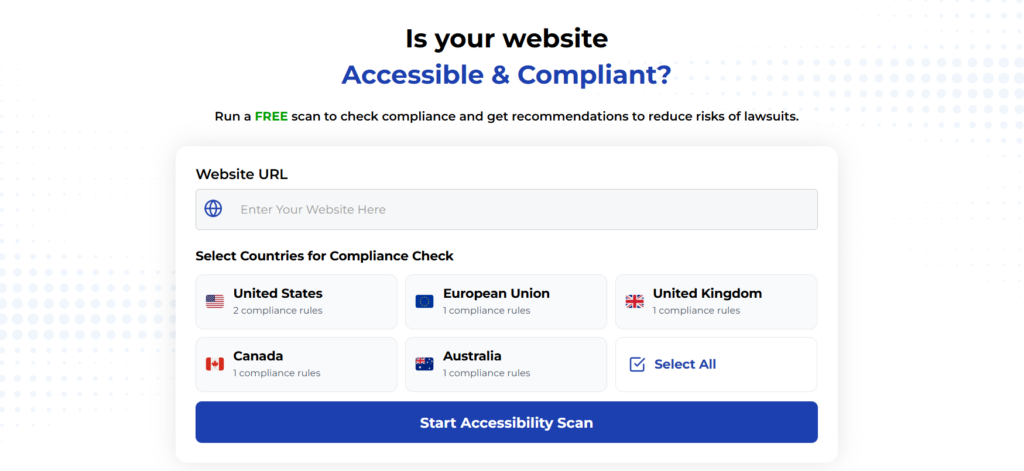
Using Automated Tools for Quick Insights (Accessibility-Test.org Scanner)
Automated testing tools provide a fast way to identify many common accessibility issues. They can quickly scan your website and point out problems that might be difficult for people with disabilities to overcome.
Visit Our Tools Comparison Page!
Run a FREE scan to check compliance and get recommendations to reduce risks of lawsuits
Final Thoughts
Every user deserves an accessible web experience. Don’t leave accessibility as an afterthought or depend only on checklists and automation. Test your site, get feedback, and put yourself in your users’ shoes. For more detailed guidance and tools, explore Accessibility-Test.org, where you’ll find the latest checklists, tutorials, and updates on digital inclusion.
Commit to accessibility testing today. The sooner you start, the sooner everyone can benefit from your content and services; no exceptions.
Run a Free Scan to Find E-commerce Accessibility Barriers
Want More Help?
Try our free website accessibility scanner to identify heading structure issues and other accessibility problems on your site. Our tool provides clear recommendations for fixes that can be implemented quickly.
Join our community of developers committed to accessibility. Share your experiences, ask questions, and learn from others who are working to make the web more accessible.