



Why AI Isn’t the Final Answer for Web Accessibility
Artificial intelligence is everywhere. It promises to make our lives easier, and in many ways, it delivers. From suggesting what to watch next to helping doctors diagnose diseases, AI is a powerful assistant. It’s no surprise that many in the tech world look to AI as a magic button for complex problems, including web accessibility. The idea of running a tool that automatically finds and fixes every accessibility issue on a website is certainly appealing.
But here’s the reality: while AI-powered accessibility tools are valuable, they are not a complete solution. They’re more like a diligent assistant than a seasoned expert. True web accessibility; the kind that allows everyone, regardless of disability, to use your website effectively; requires human judgment, empathy, and real-world testing. Relying solely on automation can create a false sense of security, leaving both your business at risk and your users frustrated.
This article will break down what AI accessibility tools do well, where they fall short, and how you can create a truly accessible website by blending automated efficiency with human-centered practices.
What AI-Powered Accessibility Tools Get Right
Let’s start with the positives. Automated tools, often powered by AI, have an important place in any accessibility effort. When used correctly, they can save time, catch common errors, and set a baseline for your accessibility work.
Catching the Low-Hanging Fruit: Automated Checks
AI-powered checkers are fantastic at spotting clear-cut technical problems that violate Web Content Accessibility Guidelines (WCAG). These are issues with a clear “yes” or “no” answer, making them perfect for a machine to identify. For example, a good accessibility checker can instantly scan your entire website and flag things like:
- Low color contrast: An automated tool can mathematically determine if your text and background colors have enough contrast to be readable for people with visual impairments .
- Missing alternative text: A tool can immediately tell you if an <img> tag is missing its alt attribute .
- Empty links or buttons: It can find links that don’t have any text, which would be confusing for a screen reader user.
- Heading structure errors: It can detect if you’ve skipped heading levels, like going from an <h1> to an <h3>, which disrupts the page’s outline for screen reader users .
The main advantage here is speed and scale. An automated tool can perform these checks on thousands of pages in minutes, something that would take a human tester weeks to accomplish .
Consistency in Repetitive Audits
Another area where automation shines is in maintaining consistency. Once you’ve fixed a set of accessibility problems, you don’t want them creeping back in. Automated accessibility tests can be built into your development process, much like other software tests.
This means every time a developer updates the website, an automated check can run in the background to ensure no new, basic accessibility errors have been introduced. This continuous checking helps you maintain a baseline level of technical compliance and prevents your team from making the same mistakes over and over. It turns accessibility from a one-time fix into an ongoing practice.
The Critical Gaps: Where AI Tools Stumble
If automated tools are so good at finding problems, why isn’t that enough? The answer lies in one word: context. Web accessibility is about human experience, and AI, for all its power, doesn’t understand context or experience like a person does. Research from WebAIM has consistently shown that even the homepages of the world’s top one million websites have an average of over 50 accessibility errors each, demonstrating how widespread these issues are even with automation available .
The Problem of Context and Meaning
Many accessibility rules aren’t just about technical presence; they’re about meaning. This is where AI struggles. A perfect example is alt text for images. An automated tool can confirm that an image has an alt attribute . But it can’t tell you if the text inside that attribute is actually helpful. An alt tag that says alt=”image” or alt=”graphic-123.jpg” is technically present but utterly useless to someone using a screen reader.
The same goes for link text. A tool might not flag a link that just says “Click Here,” but a human tester knows this is a problem . Screen reader users often bring up a list of all the links on a page to navigate quickly. A list of twenty “Click Here” links provides no information about where each link goes. A descriptive link, like “Read our guide to accessible forms,” is meaningful. AI often can’t tell the difference.
Understanding User Experience and Logic
Websites are more than just a collection of elements; they’re interactive experiences. An AI tool can check the individual parts, but it can’t easily understand the complete journey a user takes. For instance, keyboard navigation is a critical part of accessibility for users with motor disabilities .
An automated tool might be able to confirm that every button and link can be reached with the “Tab” key. But it can’t tell you if the order you tab through the page makes sense. Does it follow a logical flow, or does it jump from the header to the footer and back to the middle of the page? Even worse, does a pop-up window trap the keyboard user, making it impossible for them to return to the main page? Only a human testing with a keyboard can spot these frustrating usability problems.
The Nuances of Screen Reader Compatibility
Making a website screen reader compatible is one of the most important parts of accessibility, but it’s also one of the hardest to test automatically . Screen readers like NVDA, JAWS, and VoiceOver interpret a website’s code and read the content aloud for users who are blind or have low vision .
Automated tools can check for technical markers that help screen readers, like ARIA (Accessible Rich Internet Applications) attributes. But they can’t tell you what the final experience sounds like. Is the screen reader output clear and concise, or is it a confusing mess of repeated words and unhelpful announcements? Sometimes, developers trying to be helpful can add too much ARIA, making the experience even worse. The only way to truly know if your site works well with a screen reader is to listen to it with one.
Over-Reliance on Automation: A Risky Business
Because of these limitations, depending only on automated tools is a dangerous strategy. It can lead to a false sense of security and may not protect you from legal action or, more importantly, may not provide a usable site for people with disabilities.
The False Sense of Security
One of the biggest risks of focusing only on automated testing is developing a false sense of security. Many website owners run a free accessibility checker, see a high score, and think their job is done. This is a common and dangerous myth . Experts generally agree that automated tools can only catch about 30-40% of all potential accessibility barriers .
The remaining 60-70% of issues are the ones that require human understanding of context, usability, and logic. If you only fix the problems your automated tool finds, your website may be technically compliant in a few areas but still completely unusable for many people with disabilities. This is not just bad for users; it’s bad for business.
The Dangers of “Accessibility Overlays” and Widgets
The promise of a quick, automated fix has led to the rise of “accessibility widgets” or “overlays.” These are tools that you add to your site with a single line of code, and they promise to magically make your website compliant. They often add a button to the site that lets users change things like colors and font sizes.
However, these widgets are controversial in the accessibility community for a reason. While they might provide some minor adjustments, they rarely fix the deep, structural problems in your website’s code . A widget can’t rewrite your confusing form or fix your illogical heading structure. Even worse, these overlays can sometimes interfere with the assistive technology that a user already has and knows how to use. The consensus among accessibility experts is that accessibility should be built into your website from the ground up, not bolted on as an afterthought.
The Human-in-the-Loop: A Better Approach
So, if AI alone isn’t the answer, what is? The best approach is one that combines the efficiency of automation with the irreplaceable insight of human beings. This “human-in-the-loop” model gives you the best of both worlds.
Combining Automated Scanning with Manual Testing
Think of accessibility testing as a two-step process. The first step is to run a good automated tool, like an accessibility scanner, across your entire site . This gives you a quick, broad overview of the most common technical errors. It’s the perfect starting point to fix accessibility issues that are easy to identify .
The second, and more important, step is manual testing. This is where a human tester, preferably an accessibility expert, goes through your website’s key user journeys. They will use only a keyboard to get around, use a screen reader to listen to the content, and check for all the contextual and usability issues that automated tools miss . This dual approach ensures you catch both the simple and the complex problems.
The Irreplaceable Value of User Testing
Manual testing by an expert is great, but the gold standard of accessibility testing is getting feedback from people with disabilities. This is known as user testing, and it’s where you will find the most valuable information. You can hire individuals with different disabilities to try to complete tasks on your website and tell you where they get stuck.
Their lived experience will uncover barriers you might never have thought of. For example, you might think your online shopping cart is perfectly designed. But a user with a cognitive disability might tell you that the checkout process has too many steps and is confusing. A screen reader user might find that the “submit payment” button doesn’t announce itself properly, leaving them unsure if their order went through. This kind of direct feedback is priceless for making a website that is truly usable for everyone.
Training Your Team: Building an Accessibility Mindset
Ultimately, accessibility shouldn’t be a checklist you go through at the end of a project. It should be a core part of how your team works every single day. The most effective way to achieve this is by training your entire team; designers, developers, content writers, and project managers; on accessibility principles.
When your designer understands how color contrast affects readability, they’ll choose accessible color palettes from the start. Your developer knows how to write semantic HTML, they’ll build pages that are naturally easy for screen readers to understand . When your content writer knows how to write clear headings and descriptive links, they make the content more understandable for everyone. Creating this shared understanding turns accessibility from a burden into a team-wide commitment to quality.
Practical Steps for Integrating AI and Human Testing
Knowing you need to combine AI and human testing is one thing; putting it into practice is another. Here’s a practical way to structure your efforts for WCAG compliance and genuine usability .
Structuring Your Accessibility Audit
A good accessibility audit is the foundation of your work . It should include several layers to be effective.
- Start with an automated scan. Use a trusted accessibility testing tool to get a baseline report of your site’s technical health . This will give you an initial list of issues to work on.
- Identify key user journeys. What are the most important things a user needs to do on your website? This could be signing up for an account, purchasing a product, filling out a contact form, or finding key information.
- Manually test those journeys. Have a tester go through each key journey using only a keyboard and then again using a screen reader. This targeted manual testing focuses human effort where it matters most.
- Document everything. Keep a clear record of all the issues found, noting whether they came from the automated scan or the manual test. This will be your roadmap for making fixes.
Prioritizing Fixes After an Audit
Once you have your list of issues, you need to decide what to fix first. Not all accessibility barriers are created equal. A good prioritization strategy, especially if you are responding to legal pressure for ADA compliance, might look like this :
- Blockers first. Fix anything that completely stops a user from completing a key task. An inaccessible login form or a broken checkout process should be at the top of your list .
- Address legal complaints. If you’ve received a lawsuit or demand letter, fix the specific issues mentioned in the complaint immediately. This shows you’re taking the matter seriously .
- Go for high-impact, low-effort wins. Next, tackle problems that are widespread but relatively easy to fix. For example, if you have hundreds of images with missing alt text, fixing them all provides a big improvement for a manageable amount of work .
Making it a Continuous Process
Finally, remember that accessibility is not a one-and-done project. Your website is constantly changing, with new content and features being added all the time. Your accessibility efforts need to keep up.
The best way to do this is to make it a continuous process. Integrate automated accessibility checks into your development pipeline so that new code is checked before it goes live. Then, schedule regular, full manual audits and user testing sessions; perhaps once or twice a year; to catch any new issues and ensure your site remains usable. This creates a culture of ongoing improvement and reduces your long-term risk.
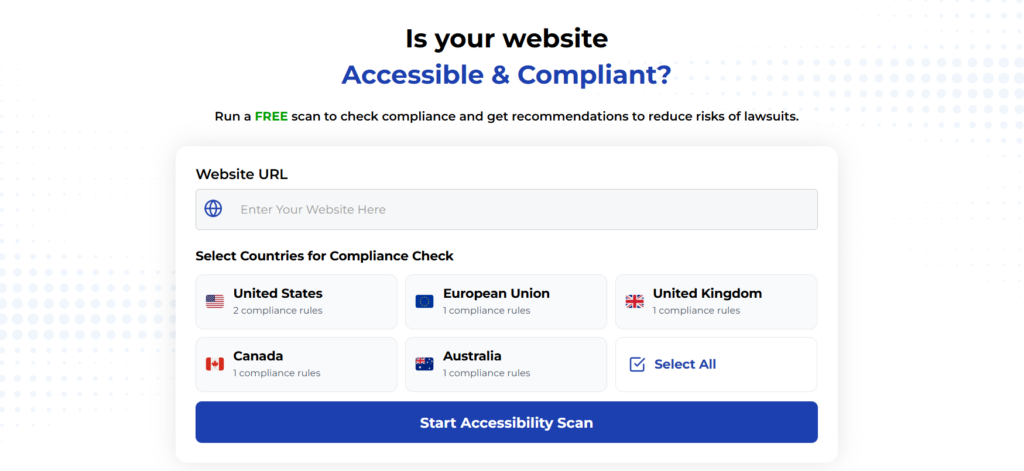
Using Automated Tools for Quick Insights (Accessibility-Test.org Scanner)
Automated testing tools provide a fast way to identify many common accessibility issues. They can quickly scan your website and point out problems that might be difficult for people with disabilities to overcome.
Visit Our Tools Comparison Page!
Run a FREE scan to check compliance and get recommendations to reduce risks of lawsuits
Final Thoughts
AI is a fantastic assistant in the world of web accessibility. It’s fast, efficient, and great at spotting a certain class of technical problems. But it’s just that; an assistant. It lacks the understanding of human experience, context, and logic that is the heart of true accessibility. The future of web accessibility isn’t about choosing between automated tools and human testers. It’s about creating a smart partnership between them. By using AI to handle the repetitive, clear-cut tasks, you free up your human experts to focus on the complex usability issues that make the biggest difference to real people.
How does your team currently balance automated tools and human expertise in your accessibility efforts?
Ready to see where your website stands? Start by conducting an accessibility audit using our free website accessibility scanner to identify immediate improvement opportunities. Then, let’s talk about how a full, human-led audit can make your website work for everyone.
Run a Free Scan to Find E-commerce Accessibility Barriers
Curious about where your site stands? An automated scan is a great first step to identify potential accessibility issues on your e-commerce platform. Run a free scan on our website today to get an initial report on your site’s accessibility health.
Want More Help?
Try our free website accessibility scanner to identify heading structure issues and other accessibility problems on your site. Our tool provides clear recommendations for fixes that can be implemented quickly.
Join our community of developers committed to accessibility. Share your experiences, ask questions, and learn from others who are working to make the web more accessible.