



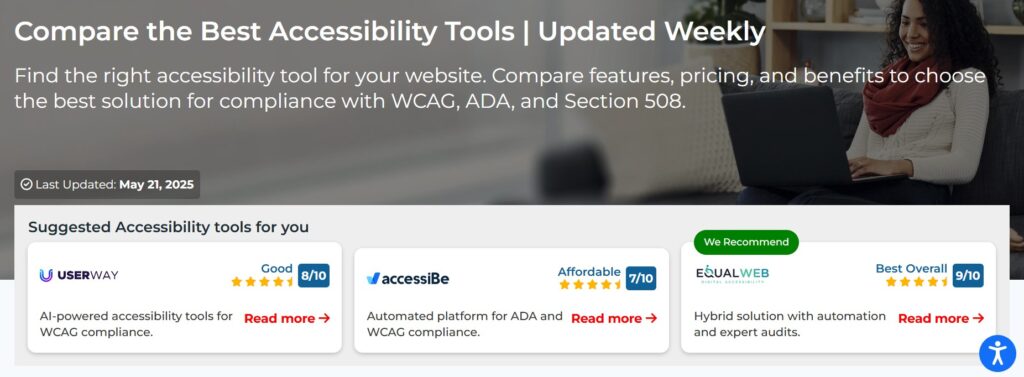
Comparing Accessibility Testing Tools in 2025
Choosing the right accessibility testing tool can feel like a major decision. With digital accessibility laws becoming more stringent and customer expectations higher than ever, you can’t afford to get it wrong. The market is filled with options, from free browser extensions to full-service platforms that cost thousands. So, how do you decide what’s right for your website, your team, and your budget?
This article cuts through the noise. We’ll look at the top free and paid accessibility testing tools available today. We’ll compare their features, explain who they’re for, and analyze the return on investment for businesses of different sizes. By the end, you’ll have a clear picture of your options and be ready to choose a tool that helps you build a more inclusive digital presence.
The Accessibility Testing Tool Scene in 2025
The conversation around web accessibility has moved from a niche technical topic to a mainstream business requirement. More companies are recognizing that making their websites usable for people with disabilities isn’t just about compliance; it’s good business. This has led to a surge in tools designed to help find and fix accessibility issues.
Market Growth and New Contenders
The digital accessibility market is expanding quickly. As demand grows, new companies are entering the space with fresh ideas, while established players are updating their offerings. You now have more choices than ever, ranging from simple color contrast checkers to AI-driven platforms that promise to monitor your entire website automatically. This competition is generally good for users, as it brings more features and better pricing. However, it also makes the selection process more complicated. It’s important to look past the marketing claims and understand what each tool actually delivers.
Free vs. Paid: What You Really Get
The most basic question many people ask is whether a free tool is good enough or if they need to pay for a premium one. The answer depends on your goals and resources.
Free tools are excellent for initial checks and for developers who want to catch problems early. They are often browser extensions that scan a single page at a time. They can find many common issues, like missing alt text on images or low-contrast text. However, they can’t see your whole website at once, don’t track your progress over time, and offer limited support. They put the responsibility entirely on you to interpret the results and know how to fix the problems.
Paid tools offer a more structured approach. These are typically subscription-based platforms that provide site-wide scanning, issue prioritization, and progress reports. They often include features for team collaboration, detailed repair guidance, and customer support. Some even offer help from accessibility experts. The main downside is the cost, which can be a barrier for smaller organizations.
Top Free Accessibility Testing Tools
Free tools are a great starting point for anyone new to accessibility or for developers who need to run quick checks during their workflow. They empower you to find and fix low-hanging fruit without any financial commitment.
WAVE: WebAIM’s Veteran Scanner
WAVE, developed by the accessibility experts at WebAIM, is one of the most well-known free tools. It’s a browser extension for Chrome, Firefox, and Edge that analyzes a single web page for accessibility errors. When you run WAVE, it injects icons and indicators directly into your page, giving you a visual representation of potential issues. It flags things like missing ARIA labels, structural problems with headings, and contrast errors. It’s a fantastic educational tool because it shows you exactly where the problems are in the context of your design. The main limitation is its one-page-at-a-time nature, making it impractical for auditing an entire website.
Axe DevTools: The Developer’s Ally
Axe DevTools is a favorite among developers for a reason. Created by Deque Systems, it’s designed to fit directly into the development process. Like WAVE, its browser extension is free and can find a significant number of common accessibility violations on any given page. Axe stands out because it categorizes issues by severity and provides links to detailed remediation advice. What makes it particularly powerful is its ability to avoid reporting false positives, which saves developers time and frustration. For more advanced needs, Axe has paid tiers that allow for automated testing across entire projects, but the free version remains a first-rate choice for individual developers.
Lighthouse: Google’s Built-in Audit
Lighthouse is built directly into Google Chrome’s developer tools, making it one of the most accessible testing options available. You can run an audit on any web page with just a few clicks, and it will generate a report that includes a score for accessibility, along with performance, and SEO. The accessibility audit checks for common problems and provides a list of failed checks with suggestions for fixing them. Because it’s made by Google, its recommendations align with modern web standards. However, Lighthouse only catches a subset of potential accessibility issues. It’s a good first-pass tool, but it should not be the only tool you rely on.
Premium Accessibility Solutions Compared
For organizations that need more power, automation, and support, a paid solution is often necessary. These platforms are designed to manage accessibility across large, complex websites and help teams work together effectively.
Siteimprove: Enterprise-Level Monitoring
Siteimprove is a feature-rich platform aimed at large organizations. It goes far beyond simple page scanning. Siteimprove continuously monitors your entire website for accessibility issues, broken links, and SEO problems. It provides a dashboard that gives you a high-level view of your site’s health and allows you to drill down into specific issues. Its reports are detailed, showing you exactly what the problem is and how it violates WCAG standards. The platform also helps you assign tasks to team members and track their progress. This level of automation and project management makes it a strong contender for enterprises with dedicated web teams and a need for ongoing governance.
AudioEye: Expert-Supported Automation
AudioEye combines automated scanning with support from human experts, offering a middle ground between pure software and manual audits. The platform scans your site, identifies issues, and in some cases, can apply automated fixes for common problems. For more complex issues, AudioEye provides access to a team of certified accessibility experts who can offer guidance and validation. This hybrid model appeals to businesses that want the efficiency of automation but also want the assurance that comes from human oversight. It aims to provide a path to compliance that is both fast and reliable.
UserWay: The AI-Powered Widget
UserWay is best known for its accessibility widget, an on-page tool that allows users to make adjustments like increasing font size, changing color contrast, or enabling a screen reader. The idea is to provide immediate accessibility improvements with minimal effort from the site owner. Alongside its widget, UserWay offers automated scanning and monitoring tools to help identify and fix underlying code issues. The widget-based approach is popular among small businesses looking for a quick and affordable solution. However, it’s a subject of debate among accessibility professionals, many of whom argue that widgets don’t fix the root problems and can sometimes interfere with a user’s own assistive technology.
AccessiBe: Automation-Focused Compliance
AccessiBe promotes a fully automated approach to web accessibility. Like UserWay, it uses a widget for front-end adjustments and an AI-powered backend process to scan and remap a website’s code for better screen reader compatibility. AccessiBe’s pitch is centered on simplicity and speed, claiming it can make a website compliant within 48 hours. This has made it a popular but also controversial choice. Critics argue that automation alone cannot address all accessibility nuances, particularly those requiring an understanding of context, and that it creates a separate experience for users with disabilities rather than fixing the core website for everyone.
Widget vs. Testing Tool: Knowing the Difference
The rise of accessibility widgets has created a fork in the road for many businesses. Do you install a simple overlay widget or invest in a true testing and remediation tool? They serve very different functions.
When Widgets Might Seem Appealing
Accessibility widgets, also known as overlays, are appealing because they promise a quick fix. You add a line of JavaScript to your site, and an icon appears, opening a menu of accessibility options for visitors. For a small business with no web developer and a tiny budget, this can seem like an ideal solution to show you’re making an effort. Widgets can provide some immediate benefits, like allowing a user with low vision to increase the text size. They are a surface-level adjustment, but they don’t change the underlying structure of your website.
Why Real Testing Tools Are Necessary
True accessibility can’t be achieved with a temporary patch. Testing tools; both free and paid; are necessary because they identify the root causes of accessibility barriers within your website’s code. An accessibility problem, like an image missing alternative text, needs to be fixed in the HTML. A widget can’t do that. Relying solely on a widget is like painting over a crack in a wall instead of fixing the foundation. For long-term legal safety and a genuinely good user experience for everyone, you need tools that help you find and permanently fix the underlying issues.
ROI Analysis: Cost vs. Value by Business Size
The value you get from an accessibility tool depends heavily on the size and complexity of your organization. What makes sense for a small startup is very different from what an enterprise needs.
Small Business (Under 50 employees)
For a small business, the budget is often the biggest constraint. Starting with free tools like WAVE and Lighthouse is a smart move. These tools allow a small team or a solo website owner to identify and fix the most common and glaring accessibility problems without any cost. If the business wants a bit more, an entry-level paid plan from a service like UserWay might seem attractive for its low cost and ease of installation. The primary goal at this stage is risk reduction and demonstrating good faith effort.
Mid-Market Companies (50-500 employees)
Mid-market companies have more complex websites and larger teams, so their needs are greater. Free tools are still useful for individual developers, but a centralized platform becomes much more important. A solution like Axe DevTools’ paid tiers or AudioEye makes sense here. These platforms offer a balance of automated scanning, developer-focused feedback, and team-based workflows. They help manage the remediation process across multiple people and departments. The investment is justified by the need to protect the brand’s reputation and manage legal risk more formally as the company’s public profile grows.
Enterprise Organizations (500+ employees)
Enterprises operate on a different scale. They often manage multiple websites with thousands of pages and have dedicated teams for development, marketing, and legal. For them, accessibility is a matter of corporate governance. A comprehensive platform like Siteimprove is built for this environment. It offers the automation, monitoring, reporting, and integration capabilities needed to enforce accessibility standards across the entire organization. The high cost is balanced by its ability to provide deep insights, protect against lawsuits, and ensure a consistent user experience that reflects the company’s brand values.
Integration and Workflow Considerations
A tool is only effective if your team actually uses it. When choosing an accessibility tool, think about how it will fit into your existing workflow. For development teams, tools that integrate with code repositories like GitHub or project management software like Jira are a huge plus. Axe DevTools, for instance, is designed specifically for this, allowing developers to catch issues before they ever get pushed to the live site. For content teams, a platform like Siteimprove that flags problems on newly published pages can be invaluable. The easier a tool is to adopt, the more likely it is that your organization will build a sustainable accessibility practice.
Making the Right Choice for Your Business
There is no single “best” accessibility testing tool. The right choice depends entirely on your specific circumstances; your budget, the size of your team, the complexity of your website, and your long-term goals.
Be thoughtful about overlay widgets. While they may seem like a quick fix, they are not a substitute for fixing the accessibility barriers in your website’s code.
If you’re just starting, begin with free tools like WAVE, Axe, and Lighthouse. They are powerful, educational, and cost nothing.
If you’re part of a larger team or need to manage accessibility more formally, look into paid platforms that offer site-wide scanning and workflow management.
Using Automated Tools for Quick Insights (Accessibility-Test.org Scanner)
Automated testing tools provide a fast way to identify many common accessibility issues. They can quickly scan your website and point out problems that might be difficult for people with disabilities to overcome.
Visit Our Tools Comparison Page!
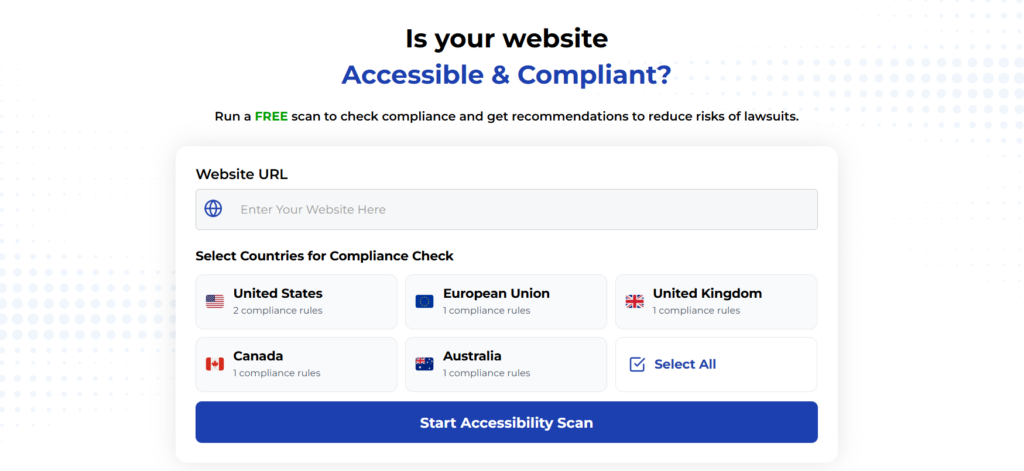
Run a FREE scan to check compliance and get recommendations to reduce risks of lawsuits
Final Thoughts
Have you considered how a visitor using a screen reader experiences your checkout process? Taking the time to test your site, whether with a free tool or a paid platform, is the first step toward answering that question. Explore some of the tools we’ve mentioned, and start making your corner of the web a more welcoming place for everyone.
Start your compliance journey, update your accessibility statement, and keep EAA top of mind in every project going forward.
Commit to accessibility testing today. The sooner you start, the sooner everyone can benefit from your content and services; no exceptions.
Run a Free Scan to Find E-commerce Accessibility Barriers
Want More Help?
Try our free website accessibility scanner to identify heading structure issues and other accessibility problems on your site. Our tool provides clear recommendations for fixes that can be implemented quickly.
Join our community of developers committed to accessibility. Share your experiences, ask questions, and learn from others who are working to make the web more accessible.