




Accessibility Widgets in 2025
Choosing a web accessibility tool can feel like a major decision, and it is. You’re not just buying software; you’re investing in a more inclusive experience for your users and protecting your business from legal risks. Accessibility widgets, often called “overlays,” promise a quick fix for website accessibility issues. They work by adding a layer of code to your site that attempts to automatically correct problems and provide a user-facing menu for adjustments.
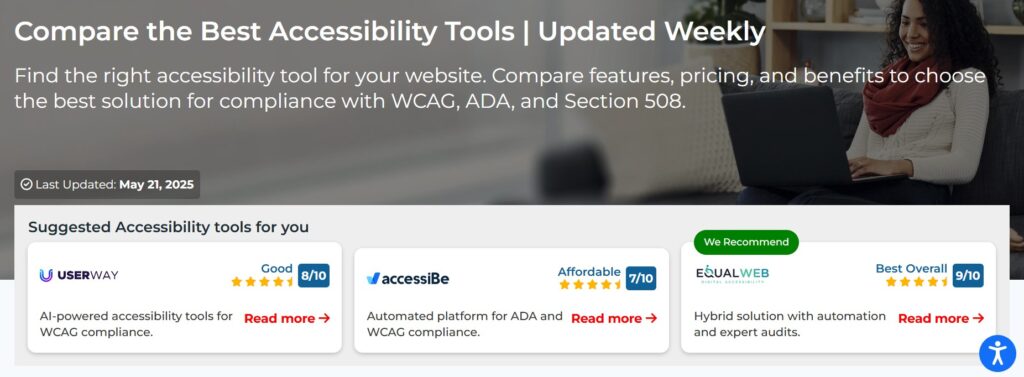
But how effective are these one-click solutions? In this article, we’ll look at three of the biggest names in the accessibility widget market: UserWay, AccessiBe, and EqualWeb. We’ll examine their features, compare their claims to reality, and give you the information you need to determine if a widget is the right fit for your website’s accessibility strategy. We’ll also discuss the important difference between using a widget and performing accessibility testing.
Widget vs. Testing Tool: Understanding the Critical Difference
Before we compare the widgets themselves, it’s important to understand what they do and, more importantly, what they don’t do. People often confuse accessibility widgets with accessibility testing tools, but they serve very different purposes. A widget is designed to be an automated remediation tool, it finds and tries to fix issues on the fly. In contrast, an accessibility testing tool is for diagnostics. It helps you find accessibility problems so a human developer can fix them in the website’s source code.
Think of it like this: a testing tool is like getting a diagnostic report from a mechanic that lists everything wrong with your car. A widget is like a product that claims it can automatically fix those problems as you drive. One identifies the issues at their source; the other applies a temporary patch over them. Both have their place, but they are not interchangeable. Failing to understand this distinction is where many website owners go wrong, often leading to a false sense of security about their site’s ADA and WCAG compliance.
When Widgets Actually Work Well
So, are widgets ever a good idea? Yes, in certain situations, they can offer some limited benefits. For small businesses or nonprofits with minimal budgets and no access to development resources, a widget can be a starting point. It can address some of the most basic accessibility issues, like adding focus indicators for keyboard users or allowing users to increase font size. These adjustments can offer a better experience than a completely inaccessible site.
They can also serve as a temporary stopgap. For instance, if you’ve just completed an accessibility audit and have a long list of fixes for your development team, a widget might be used in the interim to patch a few of the easier-to-fix problems while the more complex remediation work is underway. However, it’s a band-aid, not a cure. The goal should always be to fix the underlying code. The widget is just there to offer some minimal support in the meantime.
Why Testing Tools Remain Essential
No matter which widget you use, accessibility testing tools are non-negotiable for any serious compliance effort. Automated widgets can only detect and fix a fraction of all possible WCAG issues, studies often put the figure between 30% and 50%. Issues requiring human context, like ensuring alt text for an image is meaningful or that page structure is logical, are beyond the scope of AI.
An accessibility checker or a full accessibility audit performed by experts will uncover the deep, structural problems that widgets miss. These tools, combined with manual testing (using screen readers, keyboard-only navigation, etc.), are the only way to get a true picture of your site’s accessibility. The fixes identified through proper testing are made in your site’s actual code. This means the accessibility is built-in and permanent, not dependent on a third-party script. It’s the only way to truly work toward WCAG compliance and create a genuinely usable site for people with disabilities.
UserWay Analysis: AI-Powered Features and Limitations
UserWay is one of the most visible players in the accessibility widget market. It offers a free widget with basic features and several paid tiers that add more powerful AI-driven capabilities. Its main selling point is its AI-powered remediation, which automatically scans a site and applies fixes for issues related to contrast, headings, links, and more.
The platform is designed to be easy to install, often just a single line of JavaScript, making it attractive to website owners who lack technical expertise. But does its performance live up to its promises? The answer is complicated. While UserWay can indeed catch and fix some common accessibility errors, its reliance on automation means it shares the same fundamental limitations as all other widgets. It can’t understand context, so its fixes can sometimes miss the mark or even create new problems.
Automated Accessibility Adjustments
UserWay’s Pro Widget scans your site’s code and makes real-time adjustments. For example, it might identify a link that says “Click Here” and try to add more descriptive information for screen reader users based on the surrounding text. It can also automatically add alt text to images using image recognition technology and fix some ARIA attribute issues.
These automated fixes sound great in theory, but their effectiveness varies wildly. AI-generated alt text is notoriously hit-or-miss. It might correctly identify a “dog in a park” but miss the nuance that the dog is a guide dog, which is critical information. Similarly, its attempts to fix broken ARIA roles can sometimes misinterpret the intended function of an element, leading to a more confusing experience for screen reader users than if nothing had been done at all.
User Customization Options
Where UserWay provides more consistent value is in its user-facing customization menu. This is the icon that appears on the site, allowing visitors to make their own adjustments. Users can:
- Increase font sizes and text spacing.
- Change color contrast to a high-contrast mode or a monochrome scheme.
- Highlight links and headings to make them more apparent.
- Stop animations and moving content.
- Use a “screen reader” feature, though this is a text-to-speech tool and not a replacement for a real screen reader like JAWS or NVDA.
These options can be helpful for some users with low vision or cognitive disabilities. Giving users control over their experience is a positive step. However, these features do not fix underlying accessibility issues. For example, allowing a user to increase font size is helpful, but it doesn’t solve the problem if the website’s layout breaks when the text is enlarged.
Pricing Tiers and Value Assessment
UserWay’s pricing model is based on monthly or annual subscriptions that scale with page views.
- Free Widget: Offers basic user-triggered adjustments like resizing text and changing contrast. It does not include the AI-powered remediations.
- Pro Widget: This is their main offering, starting at around $49/month for sites with up to 100,000 monthly pageviews. It includes the AI remediations and more customization options.
- Large-Scale Plans: For sites with millions of pageviews, custom enterprise pricing is required.
Is it a good value? If you have zero budget and no other options, the free widget is better than nothing. However, the paid Pro Widget presents a tricky value proposition. For $600 a year, you get automated fixes that are incomplete and can’t guarantee ADA compliance. That same money could be better spent on a professional accessibility audit to identify the core problems on your site, giving you a clear roadmap for permanent fixes that will actually lead to compliance.
AccessiBe Review: Claims vs. Real-World Performance
AccessiBe is arguably the most aggressive marketer in the accessibility widget space, with bold claims about its ability to make websites fully compliant within 48 hours. The company’s core product, accessiBe, relies on two components: a user-facing interface for adjustments and a background AI process that scans and remediates code.
The company has faced considerable criticism from accessibility advocates and users with disabilities, many of whom argue that the tool often fails to fix problems correctly and can even make websites harder to use. The controversy stems from the conflict between AccessiBe’s marketing, which positions the widget as a complete compliance solution, and the reality of its on-the-ground performance. Let’s look at the technology and the user experience.
IRIS Technology Effectiveness
AccessiBe’s AI is named IRIS, which it claims can understand context like a human to fix complex accessibility issues. It’s designed to handle everything from writing alt text for images to fixing ARIA attributes for dropdown menus and forms. For example, if you have a form without proper labels, IRIS will analyze the nearby text to figure out what each field is for (e.g., “First Name,” “Email Address”) and apply the necessary code for screen readers.
However, the real-world effectiveness of this technology is a point of major debate. Accessibility experts have published numerous articles and videos demonstrating how AccessiBe can misinterpret content. For example, it might incorrectly label a search button as something else, or it might generate nonsensical alt text for a complex infographic. Because the fixes happen on the fly, they can be inconsistent and unreliable, and they can’t fix any issues that require changes to the server or database.
Background Processing Capabilities
One of AccessiBe’s selling points is that its AI works in the background. After the initial 48-hour scan and remediation process, it rescans the website every 24 hours to catch new content and apply fixes. This is meant to ensure that as your site is updated, it remains accessible.
This sounds appealing to businesses with dynamic websites, like blogs or e-commerce stores. The idea of “set it and forget it” compliance is tempting. Unfortunately, this automated process can’t account for new types of content or unique layouts. If you add a new, custom-coded interactive module to your site, the AI may not understand how to make it accessible. It’s trained on common patterns, and anything outside of that can cause it to fail. This is why a human-led web accessibility testing process is so important, especially for complex and evolving websites.
Customer Support and Legal Protection
AccessiBe heavily promotes its litigation support package. The company claims that if you are sued for accessibility issues while using their product, they will help you with the legal process. They also issue a “Statement of Accessibility” that you can post on your site, which is meant to show your commitment to accessibility.
However, many legal experts and disability rights advocates have warned that relying on a widget does not provide foolproof legal protection. There have been numerous cases where companies using AccessiBe and other widgets have still been sued, and lost. The reason is simple: if the website is still not usable for people with disabilities, it doesn’t matter what tool you have installed. The statement of accessibility is only meaningful if the site is actually accessible. The best legal protection is to make your website truly usable for everyone by fixing the source code.
EqualWeb Approach: Human Expertise + Technology Hybrid
EqualWeb takes a slightly different approach compared to UserWay and AccessiBe. While it also offers an automated accessibility widget, its core philosophy seems more aligned with a “hybrid” model that combines AI with human oversight. The company advertises various plans, from a free, quick-install widget to a full-service managed offering that includes manual auditing and remediation by their team of experts.
This hybrid approach acknowledges a reality that many purely AI-driven solutions ignore: automation alone is not enough. By integrating human expertise into their process, EqualWeb aims to provide a more thorough and reliable path toward compliance. This makes their premium offerings more of a service than just a product, which could be a better fit for businesses that want a more hands-on solution.
Manual Audit Integration
EqualWeb’s key differentiator is the integration of manual audits. With their higher-tier plans, their accessibility experts will manually review your website, much like an independent accessibility consultant would. They use a combination of automated scanning tools and manual testing with assistive technologies to produce an audit report.
This report details the accessibility issues found on the site, from simple contrast errors to complex problems with keyboard navigation or form validation. For an additional fee, their team will then work to fix these issues. Some fixes are applied through their widget, while others may involve direct recommendations for your development team to change the source code. This two-pronged approach is much closer to the best practices recommended by accessibility professionals.
Documentation and Compliance Reporting
Another area where EqualWeb stands out is its focus on documentation. After the audit and remediation process, they provide a detailed compliance report. This document serves as a record of the accessibility work that has been done and can be a valuable asset if you ever need to demonstrate your compliance efforts.
The report typically outlines the standards your site was tested against (e.g., WCAG 2.1 AA), the methodology used, and a summary of the findings and fixes. For businesses in regulated industries or those facing legal scrutiny, this level of documentation is far more valuable than the simple “Statement of Accessibility” offered by some competitors. It shows a good-faith effort to not just install a tool but to engage in a proper accessibility process.
Full-Service Model Benefits
The main benefit of EqualWeb’s full-service model is accountability. Instead of just giving you a tool and leaving you to figure it out, they partner with you to achieve compliance. This is especially useful for companies that lack an in-house accessibility team. The combination of their automated widget for basic issues and their manual team for complex ones can cover more ground than a widget alone.
However, this model comes at a price. Their full-service plans are significantly more expensive than a standalone widget from UserWay or AccessiBe. The cost can run into thousands of dollars, depending on the size and complexity of your site. At that price point, you are essentially paying for accessibility consulting services, and it’s worth comparing their offering to what an independent accessibility agency might provide.
Side-by-Side Feature Comparison Matrix
To make things clearer, here’s a breakdown of how the three widgets compare across several important features.
| Feature | UserWay | AccessiBe | EqualWeb |
| Core Technology | AI-powered automated remediation and user-facing toolbar. | AI-driven background remediation and a user-facing interface. | AI widget plus optional manual auditing and remediation services. |
| Manual Auditing | Not included. Focus is on automation. | Not included as a standard feature. | Included in higher-tier, full-service plans. |
| User Adjustments | Yes (contrast, font size, stop animations, etc.). | Yes (profiles for different disabilities, content adjustments). | Yes (navigation, color, and content adjustments). |
| Compliance Claim | Helps work toward compliance but without a full guarantee. | Claims to achieve compliance within 48 hours. | Aims for compliance through a hybrid AI + human model. |
| Legal Support | Offers some resources but no explicit litigation package. | Offers a “Litigation Support Package” as a key feature. | Provides compliance documentation and certification. |
| Pricing Model | Free version available. Paid plans start at $49/month. | Starts at $49/month for small websites. | Free widget available. Full-service plans are custom-priced and more expensive. |
ROI Analysis by Business Size and Industry
When considering an accessibility widget, the return on investment (ROI) isn’t just about avoiding lawsuits. It’s also about expanding your market, improving user experience, and strengthening your brand’s reputation. However, the calculation looks different depending on the size of your business.
Widgets are often marketed as a cost-effective solution, but true ROI comes from genuine accessibility, not just the appearance of it. A website that is actually usable for the 1 in 4 adults in the U.S. with a disability opens up a significant new customer base. Furthermore, many accessibility best practices, like clear headings and good color contrast, overlap with SEO best practices and general usability, benefiting all users.
Small Business Implementations
For a small business, like a local restaurant or boutique shop, a $50/month subscription for a widget can seem like a lot. The primary driver for considering it is often fear of an ADA demand letter. In this context, a free widget like UserWay’s basic offering might seem like a no-brainer. It provides a few user-facing tools and shows a good-faith effort for almost no cost.
However, the ROI of a paid widget is questionable. Spending $600+ per year on a tool that doesn’t guarantee compliance might not be the best use of a limited budget. A better investment could be to use that money to hire a freelance developer for a few hours to fix the most critical issues found by a free accessibility scanner. This approach addresses the root cause of the problems and provides a more lasting benefit. Have you considered what a few targeted hours of development could do for your site’s core structure?
Enterprise-Level Considerations
For large enterprises, the ROI calculation is entirely different. The cost of a widget is negligible, but the risk of a lawsuit is immense and can run into tens or hundreds of thousands of dollars, not to mention the damage to public image. At this scale, relying solely on an automated widget is a massive gamble.
Most large corporations that are serious about accessibility invest in internal accessibility teams, regular manual audits from third-party firms, and ongoing training for their developers and content creators. In this environment, a widget is almost never seen as the primary solution. Some may use a widget as a supplementary tool or on a legacy system that is scheduled to be replaced, but it’s not the foundation of their strategy. The ROI for an enterprise comes from building accessibility into their processes from the ground up, which reduces legal risk, improves brand loyalty, and ensures their products reach the widest possible audience.
Implementation Recommendations Based on Specific Needs
There is no one-size-fits-all answer to the question of which accessibility solution to use. Your choice should depend on your budget, resources, risk tolerance, and long-term goals.
If you are a large enterprise: Your focus should be on building a sustainable, in-house accessibility program. This includes hiring or training accessibility experts, integrating automated testing into your development pipelines, conducting regular manual audits, and fostering a culture of inclusive design. A widget should not be a central part of this strategy.
If you have no budget and no technical staff: Start with UserWay’s free widget. It’s a very small step, but it’s better than doing nothing. At the same time, use free accessibility scanning tools to learn about your site’s biggest problems so you can prioritize them if you ever get a small budget for development.
If you are a small business with a modest budget: Avoid spending your entire accessibility budget on a recurring widget subscription. Instead, invest in a one-time professional accessibility audit. This will give you a concrete list of issues. You can then hire a developer to fix the most critical ones. This provides a much better long-term value and actually makes your site more compliant.
If you are a mid-sized company with some resources: The hybrid model from a provider like EqualWeb could be a good fit. Their combination of automated scanning and manual review provides a more thorough solution than a widget alone. However, you should also compare their costs to hiring an independent accessibility firm for an audit and remediation project.
Measuring Widget Effectiveness with Testing Tools
If you do decide to use a widget, you must not take its claims at face value. It’s your responsibility to verify whether it’s actually working. The only way to do this is by using independent accessibility testing tools.
Here’s a simple process you can follow:
Conduct manual testing. This is the most important step. Navigate your site using only your keyboard. Then, try using a screen reader like NVDA (which is free) to go through your key user flows. Can you fill out a form? Complete a purchase? Can you understand the content?
Scan your site before activating the widget. Use an automated tool like Accessibility-Test.org‘s free scanner, WAVE, or ARC Toolkit to get a baseline report of the number and type of issues on your site.
Install and activate the widget. Let it run its automated remediation process (for AccessiBe, this means waiting 48 hours).
Scan your site again. Run the exact same tests with the same tools. Compare the “before” and “after” reports. Did the number of errors go down?
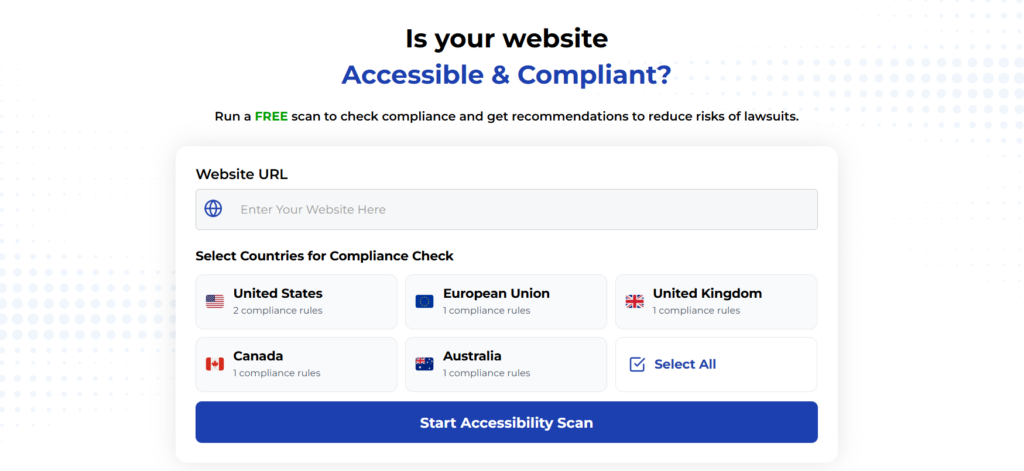
Using Automated Tools for Quick Insights (Accessibility-Test.org Scanner)
Automated testing tools provide a fast way to identify many common accessibility issues. They can quickly scan your website and point out problems that might be difficult for people with disabilities to overcome.
Visit Our Tools Comparison Page!
Run a FREE scan to check compliance and get recommendations to reduce risks of lawsuits
Final Thoughts
This process will give you a real, evidence-based understanding of the widget’s impact. You will likely find that while some issues were resolved, many others, especially those requiring human logic, remain. This information is critical for understanding your true level of risk and for deciding on your next steps toward making your site truly accessible to everyone.
Start your compliance journey, update your accessibility statement, and keep EAA top of mind in every project going forward.
Run a Free Scan to Find E-commerce Accessibility Barriers
Want More Help?
Try our free website accessibility scanner to identify heading structure issues and other accessibility problems on your site. Our tool provides clear recommendations for fixes that can be implemented quickly.
Join our community of developers committed to accessibility. Share your experiences, ask questions, and learn from others who are working to make the web more accessible.