



Accessible Content Delivery with a Headless CMS
In today’s digital world, content isn’t just for websites anymore. It’s on your phone, your watch, and maybe even your smart fridge. Businesses use headless Content Management Systems (CMS) to push content to all these places from a single source. This approach is flexible and modern, but it introduces a big question: how do you make sure that content is accessible to everyone, everywhere?
A headless CMS separates your content’s “body” (the text, images) from its “head” (the website design, the mobile app layout) . This gives developers freedom to build whatever they want, but it also means that accessibility isn’t built-in. You have to plan for it from the very beginning. Getting it right involves more than just checking a few boxes; it requires a thoughtful approach to how you structure your content, deliver it through an API, and build your front-end experiences.
Headless CMS Content Structure for Accessibility
The foundation of an accessible experience starts long before a user ever sees it. In a headless CMS, it starts with the content model—the blueprint for your information. If your blueprint doesn’t include accessibility, you’ll be trying to add it on later, which rarely works well.
Decoupling Content from Presentation
Traditional CMS platforms mix content and design together. A headless CMS does the opposite, focusing only on the content itself . Think of it like a recipe. The headless CMS holds the ingredients (text, images, data) and the instructions, but it doesn’t bake the cake. Your website, mobile app, or other device is the baker, taking those ingredients and presenting them.
This separation is powerful because it allows you to optimize the presentation for different devices and users. A screen reader user on a laptop needs a different experience than a sighted user on a smartwatch . By decoupling the content, you give your developers the raw materials to build a properly accessible front-end for each context. But the raw materials have to be good.
Modeling Content with Accessibility in Mind
A content model defines all the parts of a piece of content. For an article, you might have fields for a headline, an author, a publication date, and the body text. Accessibility, you need to add more. For example, when you create a model for an image, you shouldn’t just have a field for the image file itself. You must also include a field for its alternative text .
Here’s the important part: you can often make these accessibility-related fields mandatory . By requiring content creators to fill in the alt text field before they can publish an image, the CMS itself promotes good habits . You’re making accessibility a non-negotiable part of the content creation process. This can be extended to other elements, too. If you use iframes, you can create a required title field to explain what the iframe contains .
Have you considered how your current CMS encourages or discourages accessible content creation? It’s often these small, structural decisions that have the biggest impact.
The Importance of Semantic Structure
Semantic structure gives meaning to your content. It’s the difference between a random list of words and a well-organized document with headings, subheadings, and lists. This structure helps assistive technologies understand the hierarchy and relationships within your content .
In a headless system, your content model must capture this structure. For example, instead of having one giant text block for an article, you could break it down into structured sections, each with its own heading level. The CMS stores this information not as visual styling, but as meaningful data. When the front-end requests this content, it receives the structure along with the text, allowing it to generate the correct HTML heading tags (<h1>, <h2>, etc.). This preserves the logical order for screen reader users and search engines alike.
API Design Patterns for Accessible Content Delivery
If the content model is the blueprint, the Application Programming Interface (API) is the delivery truck. It’s responsible for transporting your carefully structured content from the CMS to the front-end. How your API is designed directly affects whether that content arrives in a way that can be made accessible.
An API as an Accessibility Contract
Think of your API as a contract between your content repository and your front-end developers. This contract should clearly state that accessibility information is part of the deal. If your API only sends the URL for an image, it has broken the contract. A well-designed API will also send the required alt text that your content creators so carefully wrote .
This approach puts accessibility at the center of your technical architecture. API-based testing tools can even check for accessibility issues as part of your development pipeline, ensuring that what you’re delivering meets compliance standards . The API becomes a checkpoint for quality and accessibility.
Delivering Structured, Not Flat, Content
Some APIs deliver content as a pre-formatted block of HTML. This is often a mistake in a headless architecture. It forces the front-end to use the markup as-is, removing the flexibility that is the main benefit of going headless.
A better approach is to deliver content as structured data, usually in a format like JSON . Instead of sending <h2>My Heading</h2>, the API sends something like { “type”: “heading”, “level”: 2, “text”: “My Heading” }. This gives the front-end developer complete control. They can use this data to generate the correct, semantic HTML for a website, or they could use it to populate a native heading component in a mobile app. This flexibility is what allows for true multi-channel accessibility.
Frontend Implementation Strategies for Headless Content
With a headless CMS, the front-end developer has immense responsibility. The CMS delivers the structured content and accessibility data, but it’s the developer’s job to turn it into a usable and accessible experience . This is where the rubber meets the road.
Using Semantic HTML for Headless Content
The single most important job for a front-end developer working with a headless CMS is to use semantic HTML. The API delivers the “what” (an image, a headline, a list), and the developer provides the “how” (the <img> tag with its alt attribute, the <h1> tag, the <ul> and <li> tags) .
This is why delivering structured data via the API is so important. It gives the developer the information they need to choose the right HTML element for the job. Without it, they are left guessing, and users of assistive technology pay the price.
Managing Keyboard Navigation and Focus
Modern web experiences, especially those built as single-page applications (SPAs), often change content on the screen without a full page reload. In these situations, managing keyboard focus is absolutely necessary for accessibility. When a new piece of content is loaded from the headless CMS and displayed, the developer must programmatically move the user’s focus to the new content.
This ensures that a keyboard-only user doesn’t get lost on the page. Similarly, all interactive elements—buttons, links, form fields—must be reachable and operable using only a keyboard . Proper keyboard navigation testing is not optional; it’s a fundamental part of building an accessible interface .
Progressive Enhancement in a Headless World
Progressive enhancement is the idea of starting with a simple, functional base and then adding more advanced features on top . This philosophy works beautifully with a headless CMS. The base layer is the raw, structured content delivered from the CMS. It should be accessible and usable on its own.
From there, developers can layer on styling, interactive scripts, and other enhancements. This ensures that the core content is available to everyone, even those on slow connections or older devices that might not support all the fancy features . It’s a user-first approach that naturally leads to more resilient and accessible products.
Content Management Workflow Accessibility Considerations
An accessible website is created by people, and those people need accessible tools to do their jobs. It’s not enough for the final product to be accessible; the entire content management workflow needs to support accessibility from start to finish.
Is Your CMS Accessible to Your Team?
This is a question that’s too often overlooked. The administrative interface of your CMS must be accessible to content creators with disabilities . If a member of your marketing team is blind and uses a screen reader, can they log in and write a blog post? Can a content editor who cannot use a mouse navigate the interface with a keyboard?
An accessible CMS backend should have good color contrast, full keyboard support, and proper labeling for all form fields and controls so screen readers can interpret them correctly . Drupal, for example, has made significant improvements to its admin interface to meet these needs . When choosing a CMS, don’t just evaluate its features for delivering content—evaluate the accessibility of its authoring environment.
Training Content Creators on Accessibility
Providing accessible fields in the CMS is just one part of the equation. Your content team needs to understand why those fields are there and how to use them correctly. Writing good alt text is a skill. Understanding how to structure an article with proper headings is a skill.
Integrations with tools that check for readability and grammar can also help authors create content that is easier for everyone to understand, especially people with cognitive disabilities . Regular training and clear guidelines are needed to ensure the whole team is contributing to your accessibility goals.
Integrating Accessibility Checks into the Workflow
The best time to catch an accessibility issue is before it gets published. Many modern platforms allow you to integrate automated accessibility checks directly into the content management workflow . For example, a developer could build a plugin that runs an axe-core scan on the content before the “publish” button is enabled .
These checks can flag common problems like missing alt text, insufficient color contrast, or improper heading structure right inside the CMS . This gives content creators immediate feedback, helping them learn and preventing simple mistakes from making it to the live site. It turns accessibility from an afterthought into an active part of the creation process.
Multi-Channel Content Delivery Accessibility Standards
The primary reason many organizations choose a headless CMS is to deliver content to multiple channels simultaneously . This is a huge advantage, but it also means your accessibility strategy has to extend beyond your website.
Beyond the Website | Mobile Apps and IoT
When your content appears on a native mobile app, it needs to follow the accessibility guidelines of that platform (iOS or Android). This includes supporting mobile screen readers like VoiceOver and TalkBack, ensuring touch targets are large enough to be easily tapped, and respecting the user’s text size settings .
A headless architecture makes this easier because the core content is separate from the presentation. The same article content can be fetched from the API and rendered as an accessible webpage or as an accessible screen in a mobile app. The key is that the teams building each of those front-ends must be knowledgeable about the accessibility requirements for their specific platform.
Consistency Across Channels
Your goal should be to provide a consistently accessible experience for your users, regardless of how they access your content . A headless CMS is a great tool for this because it provides a single source of truth for your content. When an image’s alt text is updated in the CMS, that update propagates out to the website, the mobile app, and any other connected channel. This helps maintain consistency and ensures that accessibility improvements are applied everywhere.
Staying Current with Evolving Standards
Web accessibility standards are always evolving. For example, WCAG 2.2 introduced new requirements for things like touch target size and enhanced focus visibility . Because a headless architecture decouples your front-end from your back-end, it can be easier to adapt to these changes.
Your development team can update your website’s front-end to meet the new focus visibility guidelines without needing to make any changes to the content in the CMS. This agility is a major benefit for long-term compliance and ensures you can keep providing an accessible experience as technology and standards change.
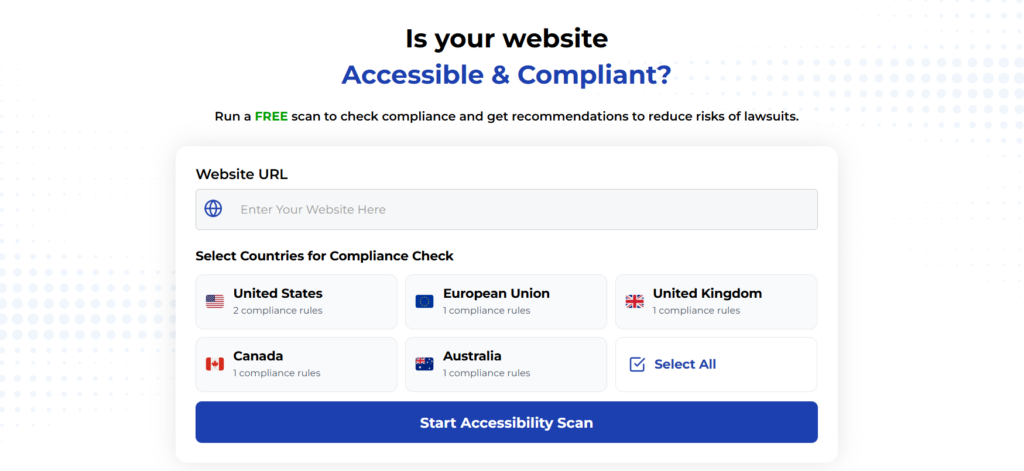
Using Automated Tools for Quick Insights (Accessibility-Test.org Scanner)
Automated testing tools provide a fast way to identify many common accessibility issues. They can quickly scan your website and point out problems that might be difficult for people with disabilities to overcome.
Visit Our Tools Comparison Page!
Run a FREE scan to check compliance and get recommendations to reduce risks of lawsuits
Final Thoughts
A headless CMS offers incredible flexibility for delivering content in a multi-channel world. However, this flexibility comes with the responsibility to design for accessibility at every step. By building accessibility into your content models, API design, front-end development, and authoring workflows, you can ensure that your content is truly available to everyone, without barriers.
Ready to see how your current site measures up? A good first step is to identify existing barriers. You can start by running a free scan with our accessibility checker to get an initial look at your website’s accessibility.
Want More Help?
Try our free website accessibility scanner to identify heading structure issues and other accessibility problems on your site. Our tool provides clear recommendations for fixes that can be implemented quickly.
Join our community of developers committed to accessibility. Share your experiences, ask questions, and learn from others who are working to make the web more accessible.