




Creating Inclusive Gaming Platforms for Everyone
Gaming is bigger than ever. It connects people from all walks of life, creating communities and shared experiences. But what happens when someone can’t participate because the game itself puts up barriers? For millions of players with disabilities, this is a frequent reality. A game might demand button-mashing that’s impossible for someone with a motor disability or use color-coded puzzles that a player with color vision deficiency can’t solve. Creating an accessible gaming platform isn’t just about meeting standards; it’s about inviting everyone to play.
When we design games and platforms with accessibility in mind from the start, we don’t just help players with disabilities. We often create a better experience for everyone. Think about subtitles; they’re essential for players who are deaf or hard of hearing, but they also help people playing in a noisy room or with the sound turned down low. Good design is inclusive design. This article breaks down what it takes to build accessible gaming experiences, from the web-based platforms that host them to the in-game mechanics themselves.
Web-Based Gaming Accessibility Implementation
Many games, especially casual and browser-based titles, live on the web. This means their launchers, menus, and even the games themselves must follow web accessibility principles. If a player can’t even navigate the sign-up form or the game’s main menu, the fun stops before it ever begins. Applying web accessibility standards here is the first step toward a genuinely inclusive gaming environment.
Making Keyboard-Only Navigation Work
Not everyone uses a mouse. Many players with motor disabilities rely entirely on a keyboard or keyboard-emulating devices to navigate. For them, a website or game menu that can’t be fully controlled with a keyboard is a dead end. The first rule is that every single interactive element; buttons, links, form fields, sliders; must be reachable and usable with the Tab key.
As a player tabs through the interface, there must be a clear visual indicator showing what’s currently selected. This is called a “focus indicator,” and it’s often a bright outline around the element. Without it, the user is navigating blind. It’s also important that the tab order is logical. It should follow the visual flow of the page, usually from top to bottom and left to right. Have you ever tried tabbing through a form, only to have the cursor jump from the first field to the last, then back to the middle? That’s a frustrating experience we need to avoid.
Screen Reader Support in Game Menus
For players who are blind or have low vision, screen readers are their way of interacting with digital content. These tools read the text and elements on a screen aloud. For a game menu to be screen reader compatible, every button and control needs a proper label. A button that just looks like a gear icon to a sighted user must have text associated with it that a screen reader can announce, like “Settings.”
This applies to all parts of the interface. Sliders for audio volume should announce their purpose and current value, such as “Music Volume, 75%.” Checkboxes for options like “Show Subtitles” should clearly state their function and whether they are checked or unchecked. Without these labels, a screen reader user hears a jumble of “button,” “checkbox,” “unlabeled graphic,” which makes it impossible to configure or start the game. Making your menus work with screen readers opens your game to a whole new audience.
Applying WCAG to In-Game Interfaces
The Web Content Accessibility Guidelines (WCAG) are the global standard for web accessibility, and their principles are highly relevant to gaming, especially for web-based games. Think about the in-game heads-up display (HUD) or inventory screen. Do they follow WCAG compliance principles? For instance, WCAG has specific requirements for color contrast. Text on the screen, like ammo count or quest objectives, must have enough contrast against its background to be readable for players with low vision.
Another WCAG principle is resizable text. Players should be able to increase the size of text in menus and dialogue boxes without it breaking the layout or becoming unreadable. This is a common feature in applications but is often overlooked in games. By applying these foundational ideas from WCAG 2.2 guidelines, you make your game’s interface more usable for a much wider range of players.
Ensuring Compatibility with Mobile Accessibility Features
More and more gaming happens on phones and tablets. Mobile accessibility is its own important field. Game developers need to ensure their products work with the built-in accessibility features of iOS and Android. This includes support for screen readers like VoiceOver and TalkBack, which have their own unique gesture controls.
It also means supporting features like Switch Control, which allows users with very limited mobility to control their device using one or more “switches” (which can be anything from a button to a sip-puff device). Games shouldn’t override standard mobile features like dynamic text sizes or pinch-to-zoom gestures, which players rely on to make content readable. A game that takes over the whole screen but ignores these built-in tools can lock out many mobile gamers.

Adaptive Gaming Control Interface Design
The standard controller or mouse-and-keyboard setup is the default for most games, but it doesn’t work for everyone. Players have different body types, motor skills, and preferences. Designing an adaptive control interface means giving players the power to customize how they interact with the game, making it playable and comfortable for them.
Why Remappable Controls Are a Non-Negotiable
Imagine being told you have to play a game, but you can’t use your right hand. For many players with physical disabilities, a situation like this is their everyday reality. That’s why fully remappable controls are one of the most requested accessibility features. Every single action in the game, from moving and jumping to opening menus and using items, should be assignable to any button, key, or axis on a controller or keyboard.
This isn’t just about swapping two buttons. It’s about letting a player completely redesign the control scheme to fit their body and their equipment. A player who uses a one-handed controller needs to be able to map all essential functions to one side. A player who uses their feet with a custom controller needs to assign actions to the inputs they can comfortably reach. Forcing players into a single, rigid control scheme is one of the fastest ways to make a game unplayable.
Support for Alternative Input Devices
The world of accessibility testing tools and hardware is vast. There are dozens of alternative input devices designed to help people with disabilities play games. The Xbox Adaptive Controller, for example, is a hub that allows players to plug in a huge variety of switches, buttons, and joysticks to create a custom setup. Other players might use eye-tracking hardware to aim or voice command software to execute actions.
Game developers should design their games to recognize a wide range of inputs, not just standard gamepads or keyboards. This means allowing multiple input devices to be used at once. For instance, a player might use an analog stick on a controller for movement with their left hand and a mouse for aiming with their right. Or they might use a standard controller alongside a set of foot pedals for acceleration and braking in a racing game. Flexible input support is a cornerstone of adaptive design.
Designing On-Screen Controls for Touch Devices
For mobile games, the screen is the controller. But poorly designed on-screen controls can be a nightmare for usability. Players with motor disabilities or even just large hands might struggle with small, tightly packed virtual buttons. Good on-screen control design offers customization.
Players should be able to resize and reposition virtual buttons to fit their hand size and grip. They should also be able to adjust the transparency, so the controls don’t block too much of the action. Providing options for different control layouts, like a virtual D-pad versus a floating joystick, can also make a big difference. The goal is to let the player build an interface that works for their body and play style.
Sensitivity and Dead-Zone Adjustments
Fine motor control can be a challenge for many players. They might have tremors that cause unintentional joystick movement or have difficulty making small, precise adjustments. This is where sensitivity and dead-zone settings come in. Sensitivity settings let players adjust how much the in-game camera or cursor moves in response to their physical input.
Dead-zone settings are just as important. A joystick’s “dead zone” is the small area around the center where movement is ignored. A larger dead zone is helpful for players with tremors, as it prevents shaky hands from causing unwanted character movement. Conversely, some players may want a very small dead zone for more immediate responsiveness. Giving players control over these settings allows them to fine-tune the game to their specific motor abilities.

Audio and Visual Gaming Accessibility Features
Games are a sensory experience, full of sights and sounds that bring their worlds to life. But if a player can’t perceive certain visual or audio information, they can miss out on critical gameplay cues, story details, or warnings. Good accessibility design presents important information in multiple ways, ensuring no one is left in the dark.
Subtitles and Captions Done Right
Subtitles are a standard feature in most games today, but their quality varies wildly. For a player who is deaf or hard of hearing, subtitles are not just a convenience; they are essential. Good subtitles are more than just a transcription of dialogue. They need to be readable. This means giving players options to change the font size, the color, and the background. A simple, semi-transparent black box behind the text can make it readable against any background, from a bright snowy landscape to a dark dungeon.
Good captions also identify who is speaking, especially when the character is off-screen. They should also include descriptions of important non-speech sounds, like [ominous music swells] or [glass shatters nearby]. These audio cues are part of the experience, and captions ensure that players who can’t hear them don’t miss out on the atmosphere or critical warnings.
Supporting Players with Color Vision Deficiency
About 1 in 12 men and 1 in 200 women have some form of color vision deficiency (CVD), often called color blindness. If a game uses color as the only way to convey information, these players will be at a disadvantage. Imagine a puzzle where you have to match red and green gems, or an enemy that glows red just before it attacks. For a player with red-green CVD, these cues can be impossible to distinguish.
The solution is to never rely on color alone. Use symbols, patterns, text, or shapes in addition to color. For example, instead of just a red and a green team icon, make one a circle and the other a square. Many games now include dedicated “colorblind modes” that shift the game’s color palette to be more distinguishable for people with different types of CVD. This is a great feature, but the foundational principle of not relying solely on color is even better.
High-Contrast Modes for Better Visibility
For players with low vision, being able to clearly distinguish game elements from the background is critical. A high-contrast mode can make a game much more playable. A good high-contrast mode is more than just a simple filter; it’s a thoughtfully designed feature that highlights important interactive elements.
This might mean rendering enemies in a bright, solid color, making collectibles glow, or putting a dark, high-contrast outline around the player character. This helps players track important information in a visually “busy” scene. Giving players control over the intensity of these effects allows them to find a setting that works for their specific visual needs without making the game visually unpleasant for them.
Using Audio for More Than Just Atmosphere
Sound design is an art, but it can also be a powerful accessibility tool, especially for players who are blind or have low vision. Distinct audio cues can provide a huge amount of information. For example, a unique sound for each type of enemy can let a player know what kind of threat they’re facing without needing to see it. A subtle humming sound that gets louder as a player gets closer to a hidden collectible can guide them to secrets.
Spatial audio, or 3D sound, is particularly useful. With a good pair of headphones, it can tell a player the precise direction of a threat, an NPC, or an objective. When sound is designed with this kind of informational purpose in mind, it transforms from mere background noise into a primary way of navigating and understanding the game world.
Visual Cues for Critical Sound Information
Just as audio cues can help players with vision impairments, visual cues are essential for players who are deaf or hard of hearing. If a game relies on an audio cue to warn the player of an off-screen enemy, a player who can’t hear it is at an unfair disadvantage.
Many modern games now include options for visualized sound effects. This might take the form of on-screen indicators that point in the direction of important sounds, like enemy footsteps, gunfire, or nearby vehicles. This feature presents the same information that a hearing player gets from spatial audio, but in a visual format. It’s a perfect example of providing information in multiple ways to ensure all players have access to it.
Gaming Community Accessibility Standards
The push for better accessibility in gaming isn’t just happening inside development studios. It’s a movement driven by players, advocates, and community organizations. These groups have created resources, established guidelines, and championed the cause of disabled players, changing the industry for the better.
What are the Game Accessibility Guidelines (GAAG)?
The Game Accessibility Guidelines (GAAG), developed by a group of developers, specialists, and gamers, serve as a living reference for accessible game design. The site gathers a huge list of design patterns that address specific barriers faced by players with various disabilities. It breaks down accessibility into basic, intermediate, and advanced fixes, giving developers a clear path to making improvements.
The guidelines cover everything from control schemes and visual design to audio and chat features. For example, they offer specific advice on how to fix accessibility issues related to text size, color contrast, and control remapping. Because it’s a community-driven resource, it stays current and reflects the real-world needs of players. It’s an invaluable starting point for any developer looking to make their game more inclusive.
Learning from Industry Leaders and Advocates
Several amazing organizations are dedicated to making gaming accessible for everyone. Groups like AbleGamers and SpecialEffect work directly with players with disabilities, creating custom hardware setups and providing accessibility consulting to game studios. They review games, award certifications, and publish a wealth of information on best practices.
Following the work of these groups provides deep awareness of the challenges disabled players face and the solutions that work. Their websites and social media channels are full of stories that show the profound impact of accessible design. They remind us that behind every accessibility feature is a person who can now join in on the fun. Listening to these experts is one of the best ways to stay informed and motivated.
The Role of Player Feedback in Design
You can’t design for a community without talking to them. The most effective way to ensure a game is accessible is to involve players with disabilities throughout the development process. This goes beyond just late-stage accessibility testing. It means bringing in players for feedback on early concepts, prototypes, and alpha builds.
These players are the experts in their own lived experience. They can spot barriers that developers might never have considered. Did you know that some players with cognitive disabilities find complex crafting menus overwhelming? Or that rapid screen-shaking effects can trigger vestibular issues for others? This kind of feedback is gold. It leads to more effective, user-centered design and helps you create a game that people truly love to play.
Accessibility Information on Storefronts
An important part of digital accessibility compliance is transparency. It’s not enough to build accessible features; players need to know they exist before they buy a game. Increasingly, digital storefronts like the Xbox store, PlayStation Store, and Steam are allowing developers to tag their games with detailed accessibility information.
These tags can list features like “Full Keyboard Support,” “Customizable Subtitles,” “Colorblind Mode,” and “Remappable Controls.” This allows players to see at a glance whether a game is likely to be playable for them. It empowers them to make informed purchasing decisions and saves them the frustration of buying a game they can’t play. This practice is becoming a new standard, and it shows a studio’s commitment to its entire audience.
Gaming Performance Optimization for Assistive Technologies
For some players, the game isn’t the only piece of software they’re running. Many people with disabilities rely on assistive technologies that run in the background. These applications, like screen readers, voice control software, or magnification tools, all use system resources like CPU and RAM. A game that hogs every last bit of processing power can cause these essential tools to lag or even crash, making the game unplayable.
Reducing CPU Load to Support Background Apps
Developers should be mindful of their game’s CPU usage, especially during non-intensive moments like being in a menu or a loading screen. A game that runs the CPU at 100% just to display a static menu can interfere with a player’s screen reader, making it impossible for them to navigate the options.
One way to address this is to cap the frame rate in menus. There’s no need to render a menu at 200 frames per second. Capping it at 60 or even 30 frees up valuable CPU cycles for the assistive technology that a player depends on. This small technical adjustment can make a world of difference for usability.
Windowed and Borderless Fullscreen Modes
Many games default to an exclusive fullscreen mode, which takes complete control of the display. While this can sometimes offer a slight performance edge, it can be problematic for players who need to switch back and forth between the game and another application, like a communication aid or a magnification program.
Offering windowed and borderless fullscreen modes is a simple but effective accessibility feature. These modes allow other applications to run more smoothly alongside the game and make it much easier to Alt-Tab out of the game without it crashing or taking a long time to minimize and restore. It’s a quality-of-life feature for many, but a necessity for some.

Preventing Input Lag from Alternative Devices
When supporting a wide range of input devices, it’s important to test them to ensure they don’t introduce significant input lag. A player using a complex adaptive controller or voice command software is already dealing with a unique setup. If the game adds a noticeable delay between their action and the in-game response, it can make gameplay feel sluggish and frustrating.
Testing with different types of hardware, including the Xbox Adaptive Controller and other third-party devices, can help identify and fix accessibility issues related to input processing. Ensuring your game’s input loop is efficient helps make the experience feel fair and responsive for everyone, regardless of what hardware they use.
The Impact of Animations on Cognitive Load
Game animations can bring a world to life, but some effects can be problematic for players with cognitive, vestibular, or photosensitivity disorders. Intense screen shake, motion blur, and rapid camera movements can be disorienting and even trigger physical symptoms like nausea or seizures.
Providing options to reduce or disable these effects is a critical accessibility feature. Let players turn off camera shake, reduce motion blur, and control head-bobbing animations. For games with flashing lights, it’s important to both warn players beforehand and provide a mode that reduces the intensity and frequency of those flashes. This makes the game safer and more comfortable for a wider audience.
Starting Your Accessibility Audit for Gaming Platforms
Building an accessible game is an ongoing process. Once you’ve added features, how do you know they work as intended? An accessibility audit is a systematic review of your game or platform to identify barriers for players with disabilities. It’s a necessary step to ensure your efforts are effective.
Manual Testing is Irreplaceable
While an automated accessibility scanner can be a good first step for a web-based platform, it can’t understand the context of a game. Automated tools can’t tell you if a puzzle is solvable without color vision or if the controls feel comfortable for someone with limited motor control. There is no substitute for manual testing by real people.
The most effective testing involves recruiting players with a range of disabilities. Their firsthand experience is the only way to truly understand how your game’s design affects them. They will find issues you never would have thought of and provide the most meaningful feedback for improvement.
Finding the Right Accessibility Testing Company
If you don’t have the resources to recruit and manage a diverse group of testers yourself, partnering with an accessibility testing company is a great option. These firms specialize in accessibility and have panels of experienced testers with various disabilities.
When looking for a partner, ask about their testing process. Do they only provide a list of bugs, or do they offer detailed feedback and accessibility remediation advice? A good accessibility consulting service will work with you to understand the problems and find practical solutions that fit within your development cycle.
Using Automated Tools for Quick Insights (Accessibility-Test.org Scanner)
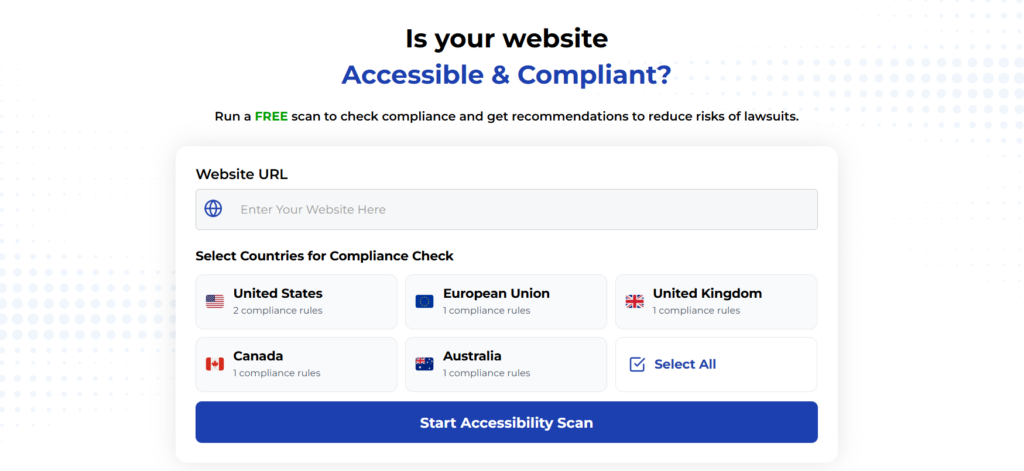
Automated testing tools provide a fast way to identify many common accessibility issues. They can quickly scan your website and point out problems that might be difficult for people with disabilities to overcome.
Visit Our Tools Comparison Page!
Run a FREE scan to check compliance and get recommendations to reduce risks of lawsuits
Final Thoughts
An audit will likely produce a list of issues. Trying to fix everything at once can be overwhelming. The next step is to create a remediation plan. This involves prioritizing the issues based on their severity and impact. A bug that completely prevents a player from starting the game is more critical than a minor text contrast issue in a rarely seen menu.
Work with your team to estimate the effort required to fix each issue and create a realistic roadmap. Communicate your plans to your players. Many studios now maintain public accessibility statements or blog posts detailing their ongoing efforts. This transparency builds trust and shows your community that you are committed to inclusion.
Gaming is for everyone. By thoughtfully designing our platforms, controls, and in-game experiences, we can break down barriers and open up our virtual worlds to millions more players. It’s a challenge worth undertaking, and the rewards; for both players and developers; are immense.
Ready to see where your platform stands? Start by running a check with our free accessibility scanner to identify initial improvement opportunities on your website or game launcher.
Want More Help?
Try our free website accessibility scanner to identify heading structure issues and other accessibility problems on your site. Our tool provides clear recommendations for fixes that can be implemented quickly.
Join our community of developers committed to accessibility. Share your experiences, ask questions, and learn from others who are working to make the web more accessible.