



The Real Cost of Ignoring Accessibility
Many business owners think about website accessibility only after a legal demand letter arrives. Suddenly, terms like ADA compliance and WCAG are no longer abstract concepts but urgent, expensive problems. The truth is, the cost of ignoring accessibility starts accumulating long before a lawsuit. It shows up in lost sales, missed market opportunities, and a tarnished brand reputation.
This isn’t about just checking a compliance box. It’s about understanding the real-dollar impact of having a digital presence that excludes people. We’re going to break down the numbers; from lawsuit settlements and hidden legal fees to the massive market you might be turning away. More importantly, we’ll show you how investing in an accessible website isn’t an expense, but a direct path to business growth.
Quantifying the Obvious Costs | Lawsuits and Fines
The most visible threat of non-compliance comes from legal action. It’s a growing problem that affects businesses of all sizes, and the financial hit can be staggering.
The Rising Tide of ADA Lawsuits
If you think web accessibility lawsuits are only a problem for large corporations, think again. The legal landscape has shifted, and small businesses are increasingly in the crosshairs. In the first half of 2024 alone, more than 1,400 web accessibility lawsuits were filed against small businesses. Industries like lifestyle, fashion, and food services are particularly popular targets, with hundreds of cases filed.
This trend isn’t slowing down. As our world becomes more digital, the legal expectation is that online “places” must be just as accessible as physical ones. This makes your website a primary point of legal risk. Failing to meet ADA website requirements is no longer a risk you can afford to ignore, no matter the size of your company.
What Does a Lawsuit Actually Cost?
Receiving a complaint is just the beginning of a costly process. Most businesses choose to settle rather than face a long, public court battle. But settling isn’t cheap. For a small business, a typical settlement for an ADA web accessibility case falls between $10,000 and $75,000. And that’s before you factor in your own attorney’s fees, which can easily double the total cost.
For larger organizations, the numbers can climb into the six-figure range or even higher, depending on the scale of the violations. These figures don’t account for the internal resources spent managing the lawsuit, which pulls your team away from focusing on growing the business. A single lawsuit can seriously disrupt your cash flow and budget for years to come.
It’s Not Just an American Problem | The European Accessibility Act (EAA)
If you do business in the European Union; or even just sell to customers there; you face another layer of regulation. The European Accessibility Act (EAA) has a compliance deadline of June 28, 2025, and it comes with serious teeth.
Unlike the ADA, the EAA directs member states to set their own penalties, which must be “effective, proportionate, and dissuasive”. The fines can be severe:
- In Germany, penalties can reach up to €500,000.
- France can issue fines of up to €250,000.
- Italy can penalize a company up to 5% of its annual turnover.
- Spain’s fines can range from €30,000 to €1,000,000 for serious violations.
This shows a clear global trend: governments are enforcing digital inclusion, and the financial consequences for failing to comply are growing. Meeting EU accessibility requirements is now a standard cost of doing business internationally.
The Hidden Legal Costs You Don’t See Coming
The financial pain doesn’t always end when you sign a settlement check. Many settlement agreements come with long-term obligations that carry their own costs. You might be required to conduct regular accessibility audits with a third-party vendor, provide ongoing accessibility training for your staff, and submit to monitoring to prove you’re maintaining compliance.
These aren’t one-time fixes. They represent a continuous operational expense. Furthermore, the entire process, from receiving a demand letter to finalizing a settlement, can take months or even more than a year. That’s a long time for your business to operate under a cloud of legal uncertainty, diverting attention and resources that should be focused on your customers.
The Hidden Expense | Lost Revenue and Market Exclusion
While legal fees are easy to quantify, the money you’re losing every day from an inaccessible website might be an even bigger number. You’re effectively putting up a “closed” sign to a huge segment of the population.
You’re Turning Away Paying Customers
How big is the market you’re ignoring? It’s enormous. Globally, people with disabilities and their families control an estimated $13 trillion in annual disposable income. In the United States alone, the spending power of people with disabilities is around $490 billion. To put that in perspective, about 1 in 4 Americans lives with some form of disability, many of whom rely on the internet for shopping and services.
When your website isn’t accessible, you’re not just failing to serve this community; you’re actively sending them to your competitors who have done the work to be inclusive. This isn’t a niche audience. It’s a market larger than the combined populations of China and the European Union. Can your business afford to ignore them?
How an Inaccessible Website Kills Sales
It’s easy to see how this happens in practice. Imagine a user who is blind and relies on a screen reader to browse the web. If your product images lack descriptive alt text, they have no idea what you’re selling. If your “Add to Cart” button isn’t properly coded, they can’t buy anything. Or consider a user with limited mobility who can’t use a mouse. If they can’t navigate your checkout form with a keyboard, that’s another lost sale.
These are not minor inconveniences; they are hard stops that prevent a transaction. Research shows that accessible ecommerce sites have shopping cart abandonment rates that are approximately 15% lower than their non-accessible competitors. Every barrier on your site is a potential sale walking out the digital door.
The Ripple Effect on Your Brand Reputation
The damage extends beyond direct revenue loss. A lawsuit for discrimination can cause lasting harm to your brand’s reputation. In an age where consumers value corporate responsibility, being seen as an exclusionary business is a bad look.
And it’s not just people with disabilities who notice. Their friends and family; an additional 3.4 billion potential consumers globally ;often make purchasing decisions based on which brands are inclusive. A negative reputation for accessibility can drive away loyal customers and make it harder to attract new ones, even those without disabilities. People want to support businesses that do the right thing.
Shifting from Cost to Investment | Building the Business Case
What if you stopped thinking about accessibility as a compliance chore and started seeing it as a business strategy? The data shows that organizations prioritizing accessible design don’t just avoid costs; they create new avenues for growth.
Why ‘Compliance’ is the Wrong Mindset
Focusing only on WCAG compliance misses the bigger picture. The changes you make to welcome users with disabilities almost always improve the experience for everyone. Clear navigation, logical content structure, and intuitive forms benefit all your customers.
The numbers back this up. Studies have shown that accessible websites tend to see 37% lower bounce rates and 25% higher conversion rates compared to sites that aren’t accessible. When your website is easier to use, more people use it successfully. It’s that simple. By making your site screen reader compatible and keyboard-navigable, you are creating a better user experience for all.
The Jaw-Dropping ROI of Accessible Design
The financial return on accessibility investments can be incredible. A landmark study by Forrester Research found that for every $1 a business invests in web accessibility and user experience, it gets an average return of $100. That’s not a typo. The return on investment is massive because the benefits touch so many parts of the business.
Furthermore, companies that lead in accessibility outperform their competitors by 28% across revenue growth, customer retention, and market reach. This isn’t just about social good; it’s a competitive advantage. Businesses that make inclusive design a priority report an average revenue increase of 23%.
Real-World Wins | Brands That Grew with Accessibility
Many well-known companies have seen remarkable success by making accessibility a core part of their strategy.
- Microsoft shifted its approach to see accessibility as a source of innovation, not just a requirement. This led to product improvements that benefited all users and strengthened its market position.
- Tesco, a major grocery retailer, overhauled its online platform to be more accessible. The result was increased web traffic and a measurable rise in customer loyalty.
The benefits are just as clear for smaller businesses. One clothing retailer saw its checkout completion rate jump by 25% after making basic accessibility fixes. A home goods store saw a 23% increase in mobile sales after improving things like touch target sizes and form labels; changes that helped everyone, especially on smaller screens.
Calculating the Long-Term Financial Payoff
The benefits of accessibility aren’t just immediate. They create long-term value by making your business more efficient, resilient, and profitable.
Reducing Costs Across the Board
Fixing accessibility problems after your website is built is always more expensive than planning for them from the start. Rushing to perform accessibility remediation after receiving a demand letter often involves high-priced emergency work and can disrupt your operations.
A smarter approach is to integrate accessibility into your regular workflow. By using accessibility testing tools during the development process, companies can reduce post-launch accessibility bugs by 60-80%. This “shift-left” approach saves a huge amount of money on fixes down the road. It also leads to fewer user complaints and reduces the burden on your customer support team, since the site is simply easier for everyone to use.
Enhancing Your SEO and Marketing Efforts
Many of the practices that make a website accessible also make it easier for search engines to understand. Things that are fundamental for accessibility are also loved by Google:
- A logical heading structure (accessible headings) helps screen reader users navigate a page, and it also helps search crawlers understand your content hierarchy.
- Alt text accessibility for images gives context to visually impaired users, and it tells search engines what your images are about.
- Descriptive link text helps users know where a link is going, and it provides search engines with valuable anchor text.
By focusing on accessible design, you’re often improving your SEO without any extra effort or budget. It’s a two-for-one benefit that can lead to better search rankings and more organic traffic.
How to Budget for Accessibility
Getting started doesn’t have to break the bank. You can approach it as a scalable investment. A professional accessibility audit for a small business website typically costs between $1,500 and $5,500. Automated accessibility monitoring services can start as low as $49 per month.
When you compare these figures to a potential $50,000 lawsuit, the investment is easy to justify. These proactive steps aren’t just costs; they are insurance against much larger legal and financial risks. Think of it less as an expense and more as a line item for growth and risk management.
Creating a Phased Approach to Manage Costs
You don’t have to fix everything overnight. A smart strategy is to start with the parts of your site that have the highest impact and the highest risk. Begin by focusing on your core user journeys: your homepage, key product or service pages, contact forms, and the checkout process.
This phased approach allows you to address the most critical issues first while managing costs over time. Once those primary pages are in good shape, you can expand your efforts to secondary content like blog posts and resource pages. This lets you see the benefits quickly without feeling overwhelmed.
Getting Started | Your First Steps Away from Risk and Toward Growth
The message is clear: being proactive about accessibility is one of the smartest business decisions you can make. It protects you from legal trouble and opens up new pathways for growth. Here’s how to begin.
Don’t Wait for a Demand Letter
The worst time to start thinking about accessibility is when you’re forced to. Acting now, before you’re in a defensive position, gives you control over the timeline, the cost, and the process. Reactive fixes are always more stressful and expensive than proactive improvements.
Run an Initial Accessibility Scan
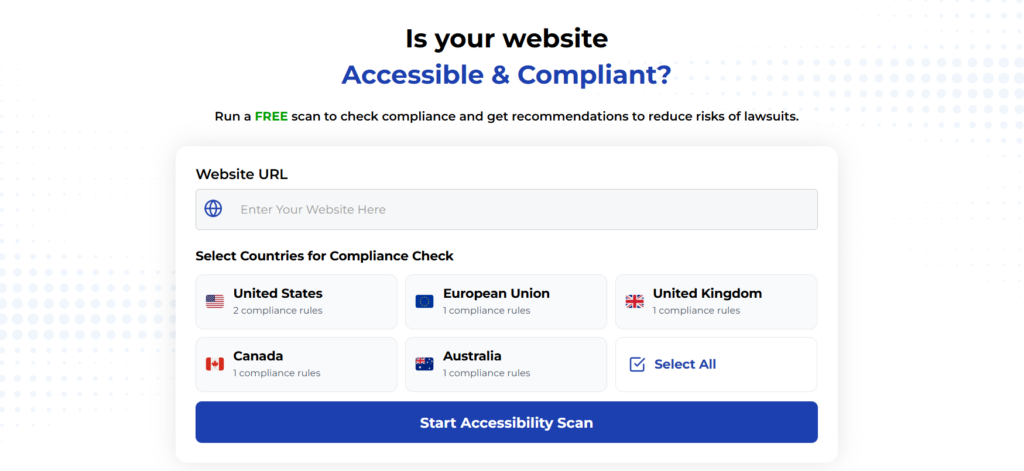
A great first step is to use an automated accessibility checker to get a quick snapshot of your site’s health. An accessibility scan won’t catch every issue; no automated tool can; but it will identify low-hanging fruit and give you a baseline to work from. It’s a quick and easy way to see where your biggest problems might be.
Using Automated Tools for Quick Insights (Accessibility-Test.org Scanner)
Automated testing tools provide a fast way to identify many common accessibility issues. They can quickly scan your website and point out problems that might be difficult for people with disabilities to overcome.
Visit Our Tools Comparison Page!
Run a FREE scan to check compliance and get recommendations to reduce risks of lawsuits
Final Thoughts
While tools are helpful, they can’t replace human expertise. To truly understand your legal risk and create a solid plan, you need a professional accessibility audit. An expert can identify the nuanced issues that automated tools miss and provide you with a clear roadmap for accessibility remediation, prioritized by what matters most to users and your business.
Ready to stop leaving money on the table? The cost of non-compliance is clear, but so is the opportunity. Investing in accessibility is an investment in your customers, your brand, and your bottom line.
Have you considered how many customers might be unable to use your website right now?
Start by running a free website accessibility scan to identify your biggest risks and opportunities for growth.
Want More Help?
Try our free website accessibility scanner to identify heading structure issues and other accessibility problems on your site. Our tool provides clear recommendations for fixes that can be implemented quickly.
Join our community of developers committed to accessibility. Share your experiences, ask questions, and learn from others who are working to make the web more accessible.