



International Accessibility Standards – EU, Canada, Australia Compliance Guide
Business owners operating across international markets face an increasingly complex web of accessibility regulations that extend far beyond US ADA requirements . The European Accessibility Act enforcement beginning June 28, 2025, combined with Canada’s AODA standards and Australia’s Disability Discrimination Act, creates a regulatory environment where understanding multiple compliance requirements isn’t just beneficial—it’s essential for market access and legal protection .
European Accessibility Act 2025 Implementation Timeline
The European Accessibility Act represents the most significant shift in digital accessibility requirements for businesses selling products or services in EU markets . Unlike previous regulations that primarily targeted public sector organizations, the EAA extends accessibility requirements to private companies across multiple industries, creating new compliance obligations that could affect thousands of businesses operating in Europe.
Understanding the June 2025 Deadline
The EAA enforcement date of June 28, 2025, marks when all covered entities must meet accessibility standards mandated by the legislation. This deadline applies to businesses in sectors including e-commerce platforms, banking services, transportation companies, and telecommunications providers operating within EU countries. What makes this deadline particularly challenging is that many EU countries missed the 2022 deadline for implementing national EAA legislation, compressing the timeline for business compliance.
The legislation doesn’t impose detailed technical solutions for compliance, but it acknowledges WCAG guidelines as a valid solution to meet EAA requirements. This means businesses familiar with WCAG 2.1 AA standards have a starting point for EAA compliance, though additional requirements specific to EU markets may apply.
EAA Penalties and Enforcement Mechanisms
European enforcement mechanisms add serious financial consequences for non-compliance that vary significantly by country. Germany imposes fines up to €500,000, while Italy can penalize organizations up to 5% of their annual turnover for serious violations . Some sources indicate penalties reaching up to €250,000 in certain countries, making proactive accessibility testing essential for affected businesses .
The enforcement structure places responsibility on designated national authorities in each member state to monitor EAA compliance . These authorities have sufficient powers and resources to enforce corrective actions and impose other enforcement mechanisms, with penalties required to be “effective, proportionate and dissuasive” .
Products and Services Covered Under EAA
The EAA targets specific business sectors that the EU identified as most important for persons with disabilities while being most likely to have diverging accessibility requirements . E-commerce platforms must provide accessible websites that address the needs of users with varying disabilities, including features such as text alternatives for images and screen reader compatibility .
Banking services face requirements to make their online banking systems and physical branches accessible, ensuring individuals with disabilities can access financial services without barriers . Technology manufacturers must design products with accessibility in mind, enabling users with disabilities to utilize these technologies effectively through compatibility with assistive technologies.
Transportation apps fall under EAA scope with objectives to make public transport systems more user-friendly. Developers should focus on integrating features that offer real-time updates, audible navigation prompts, and easy booking options to meet compliance requirements.
Timeline Extensions and Exceptions
Not all products and services face the same June 2025 deadline. Products and services already on the market before June 28, 2025, don’t need immediate compliance—they have until June 28, 2030, or their next update, whichever comes first. Emergency services have until June 28, 2027, to meet accessibility requirements.
Long-life self-service terminals receive the most generous timeline, with compliance required within 20 years of installation or by June 28, 2045, whichever comes first. However, this 5-year exception for existing products doesn’t apply in some countries, such as Portugal, making it essential to check local regulations specific to your market.
AODA Compliance Requirements for Canadian Markets
The Accessibility for Ontarians with Disabilities Act presents a different regulatory structure than the EAA, with requirements that apply specifically to Ontario-based organizations but affect any business serving Canadian markets. AODA compliance means adhering to standards set forth by legislation designed to create a fully accessible Ontario by 2025.
Who Must Comply with AODA Standards
AODA requirements apply to Ontario-based organizations that are either designated public sector entities or businesses and non-profit organizations with 50 or more employees. The organization that controls the website—either directly or through a contractual relationship—must meet accessibility requirements. These requirements only apply to websites and web content published after January 1, 2012.
The legislation creates different compliance tiers based on organization size and type. Large private sector organizations and public sector organizations with specific employee thresholds must ensure accessibility of any web content they own. Additionally, any content they don’t own but have control over as a third party must also be accessible.
AODA Web Accessibility Standards
AODA standards relevant to digital accessibility are captured under the Information and Communication Standards, which are primarily based on WCAG guidelines. As of 2024, Ontario-based organizations should aim to conform with WCAG 2 .0 Level AA standards .
Public websites and web content posted after January 1, 2012, must meet WCAG 2 .0 Level AA success criteria, with exceptions for live captions and pre-recorded audio descriptions. Organizations don’t need to make parts of websites accessible if doing so is “not practicable”—for instance, if no tools or software are commercially available to make an element accessible.
AODA Penalty Structure
Businesses that don’t prioritize accessibility face significant penalties under AODA legislation. The maximum penalties include substantial fines that can reach considerable amounts for non-compliance. Businesses with 20 or more employees, as well as all public sector organizations, need to file AODA accessibility compliance reports.
Practical AODA Implementation Requirements
AODA compliance centers around four accessibility principles that mirror WCAG standards. Perceivability ensures content is presented in ways that all users can perceive, including those who rely on screen readers or require alternatives to audio and visual content. Operability makes navigation and interaction possible for users with different abilities.
The legislation requires accessibility statements that organizations must develop and maintain. If someone requests content in an accessible format and you cannot provide this, you must explain why the information is unconvertible and provide a summary of the unconvertible content.
Australia’s Disability Discrimination Act Web Standards
Australia’s approach to web accessibility through the Disability Discrimination Act creates obligations that differ from both EU and Canadian models. The DDA was created to protect people with disabilities from discrimination across areas of work, accommodation, leisure, education, and goods and services.
DDA Coverage and Business Impact
The DDA affects businesses of all sizes across Australia, with 1 in 5 Australians living with some form of disability—that’s over 2 million Australians of working age alone. Close to 5 million Australians don’t have access to certain products and services because of poor design, meaning non-compliant websites lose out on billions worth of potential revenue annually.
Unlike the prescriptive timelines of the EAA or specific employee thresholds of AODA, the DDA applies more broadly to any organization providing goods or services to the public. The Act states that persons with disabilities are entitled to the same equality and rights as persons without disabilities.
Technical Standards Under DDA
The DDA is based on WCAG guidelines, which serve as the benchmark for web accessibility in Australia. The Australian Human Rights Commission’s guidelines assist organizations in meeting their obligations under the DDA when providing digital goods and services. These guidelines update previous advisory notes to reflect changes in technology and national and international standards.
The guidelines are issued under section 67(1)(k) of the Disability Discrimination Act and section 11(1)(n) of the Australian Human Rights Commission Act 1986. While not legally binding, they should be read in conjunction with the Disability Discrimination Act.
DDA Enforcement and Legal Precedents
DDA enforcement differs from the structured penalty systems seen in EU and Canadian legislation. The Act aims to eliminate discrimination as far as possible against people with disability and recognizes that people with disability have the same rights as others. Organizations that fail to provide accessible digital services face potential discrimination claims rather than fixed penalty amounts.
The legal precedent for web accessibility under DDA was established in the Bruce Lind case, which demonstrated how the courts interpret digital accessibility requirements. This case-by-case approach means businesses must be particularly careful about accessibility implementation rather than relying on minimum compliance standards.

Comparing International Accessibility Standards
Understanding how these three major accessibility frameworks differ helps businesses operating in multiple jurisdictions develop appropriate compliance strategies . Each system takes a different approach to enforcement, technical requirements, and business obligations .
Technical Standard Alignment
All three jurisdictions reference WCAG guidelines as their technical foundation, but with different implementation requirements . The EAA acknowledges WCAG as a valid solution while also referencing EN 301 549 standards that include additional specifications for hardware interfaces, mobile applications, and digital services. This means traditional web accessibility scanners may miss certain compliance gaps specific to EAA requirements.
AODA specifically requires WCAG 2.0 Level AA compliance for content created after January 1, 2012. The legislation includes specific exceptions for live captions and pre-recorded audio descriptions that don’t apply in other jurisdictions.
Australia’s DDA takes a more flexible approach, using WCAG as a benchmark without specifying particular versions or conformance levels. This flexibility can be both an advantage and a challenge, as it requires businesses to stay current with evolving standards rather than meeting fixed requirements.
Enforcement Mechanism Differences
The enforcement approaches vary significantly across jurisdictions. EU member states must establish effective, proportionate, and dissuasive penalties, with some countries imposing fines up to €500,000 or 5% of annual turnover. This creates a predictable but severe penalty structure for businesses.
AODA enforcement includes structured penalty amounts and mandatory compliance reporting for organizations above certain employee thresholds. The system includes both financial penalties and public accountability through required accessibility reports.
DDA enforcement relies on individual discrimination claims rather than regulatory penalties. This approach can result in case-by-case legal action but lacks the predictable penalty structure seen in other jurisdictions.
Business Size and Coverage Differences
Each jurisdiction applies different criteria for determining which businesses must comply. The EAA focuses on specific industry sectors regardless of business size, though small businesses with fewer than 10 employees or specific turnover thresholds may qualify for exemptions.
AODA requirements depend on organization size and type, with different compliance obligations for businesses with 50+ employees versus smaller organizations. This creates clear thresholds that businesses can evaluate for compliance planning.
The DDA applies broadly to any organization providing goods or services to the public without specific size exemptions. This universal coverage means even small businesses must consider accessibility obligations when serving Australian customers.
Multi-Jurisdiction Compliance Strategies
Businesses operating across EU, Canadian, and Australian markets need strategies that address overlapping requirements while minimizing compliance complexity. The most effective approach often involves meeting the highest standard across all jurisdictions rather than implementing separate compliance systems for each market.
Unified Technical Standards Approach
Since all three jurisdictions reference WCAG guidelines, businesses can use WCAG 2.1 AA compliance as a foundation for multi-jurisdiction accessibility. However, this baseline approach requires supplementation with jurisdiction-specific requirements, particularly for EU markets where EN 301 549 standards include additional specifications.
Automated accessibility testing tools can help identify common compliance issues across all three jurisdictions. Tools like Axe DevTools provide coverage of technical requirements that apply across different regulatory frameworks. However, businesses should understand that automated testing typically identifies only 30-50% of accessibility barriers, requiring manual testing to ensure complete compliance.
Website accessibility services that specialize in international compliance can help businesses understand jurisdiction-specific requirements while maintaining consistent accessibility standards across all markets. These services often include ongoing accessibility monitoring to ensure compliance doesn’t deteriorate over time.
Risk-Based Compliance Prioritization
Different markets present different risk profiles for accessibility non-compliance. EU markets with high penalty amounts and structured enforcement may warrant priority attention, particularly for businesses in covered EAA sectors. Canadian markets with AODA requirements create moderate risk with predictable penalty structures and clear compliance timelines.
Australian markets present different risk profiles where individual discrimination claims rather than regulatory penalties create the primary compliance concern. Businesses should evaluate their customer base and market exposure in each jurisdiction to prioritize compliance investments appropriately.
The June 2025 EAA deadline creates immediate urgency for EU market compliance, while AODA and DDA requirements operate on ongoing compliance schedules. This timing difference allows businesses to address EAA requirements first while planning longer-term improvements for other markets.
Documentation and Monitoring Systems
International compliance requires documentation systems that address the different reporting requirements across jurisdictions. AODA requirements include mandatory compliance reporting for qualifying organizations . EAA compliance requires accessibility statements that clearly outline how organizations meet accessibility standards .
DDA compliance benefits from proactive accessibility documentation even though specific reporting isn’t mandated. This documentation can help defend against potential discrimination claims while demonstrating good faith accessibility efforts.
Accessibility monitoring services that track compliance across multiple standards can help businesses maintain ongoing compliance without manual oversight. These systems can identify when updates or changes create new accessibility barriers that might affect compliance in any jurisdiction.
Staff Training and Organizational Preparation
Multi-jurisdiction compliance requires staff training that addresses the different accessibility requirements and cultural considerations across markets. EU accessibility training should include understanding of EN 301 549 standards and EAA industry-specific requirements.
Canadian market training should focus on AODA compliance procedures and the specific requirements for organizations serving Ontario customers. Australian market preparation should emphasize understanding DDA obligations and best practices for avoiding discrimination claims.
Accessibility training programs should include both technical implementation skills and legal compliance understanding. Staff who understand why accessibility matters for business protection and market access are more likely to maintain compliance standards over time.
Documentation Requirements for Global Accessibility
Each jurisdiction requires different documentation approaches that businesses must understand and implement to demonstrate compliance and protect against legal challenges.
EAA Documentation Standards
The European Accessibility Act mandates accessibility statements that must clearly outline how organizations comply with accessibility standards. These statements should detail any aspects that may not fully meet requirements while providing transparency about available support and resources.
EAA accessibility statements should be frequently updated to reflect changes in accessibility practices and ensure ongoing compliance. The statements must be easily found by customers and should include information about alternative formats or assistance available for users who encounter accessibility barriers.
Ongoing monitoring and testing protocols represent another essential component of EAA documentation requirements. Organizations must implement regular assessments to identify potential barriers that may hinder access for users with disabilities. This proactive approach should involve real users with diverse disabilities to ensure feedback reflects actual experiences.
AODA Documentation Requirements
AODA compliance requires specific documentation for organizations meeting employee thresholds or serving as public sector entities. Accessibility compliance reports must be filed regularly, and organizations must maintain records of accessibility improvements and barrier removal efforts.
AODA documentation should include records of staff training on accessibility requirements and procedures for handling accessibility-related requests from customers or employees. Organizations must also document any situations where accessibility cannot be achieved and explain the reasoning behind these limitations.
If someone requests content in an accessible format and the organization cannot provide this, documentation must include explanations of why the information is unconvertible and summaries of the unconvertible content. This documentation protects organizations while ensuring users receive alternative access to information.
DDA Documentation Best Practices
While the DDA doesn’t mandate specific documentation requirements, maintaining accessibility records helps protect against discrimination claims and demonstrates good faith efforts to provide equal access. Documentation should include accessibility assessments, improvement plans, and records of accommodations provided to users with disabilities.
DDA documentation should demonstrate ongoing efforts to identify and remove accessibility barriers rather than one-time compliance checks. Regular accessibility audits and user feedback collection show commitment to maintaining accessible services over time.
Businesses should document their accessibility policies and procedures for staff, including training records and guidance for handling accessibility-related requests. This documentation can be valuable if discrimination claims arise and helps ensure consistent accessibility support across the organization.
International Compliance Documentation Systems
Managing documentation across multiple jurisdictions requires systems that capture the different requirements while avoiding duplication of effort . Centralized accessibility documentation can address multiple compliance needs while ensuring consistency across all markets .
Documentation systems should track accessibility testing results, remediation efforts, and ongoing monitoring across all international markets . This approach helps businesses demonstrate compliance progress while identifying areas where additional attention may be needed.
Regular documentation review ensures that accessibility statements and compliance records remain current with changing standards and business operations. As WCAG 2.2 requirements and other standards evolve, documentation must reflect current compliance status and planned improvements.

Third-Party Accessibility Certification
Some businesses benefit from third-party accessibility certification that provides independent verification of compliance across multiple jurisdictions. Accessibility auditing services can provide documentation that supports compliance claims while identifying areas for improvement.
Professional accessibility consulting can help businesses understand the specific documentation requirements for each jurisdiction while developing efficient systems for maintaining compliance records. These services often include template accessibility statements and compliance tracking systems.
Accessibility training programs that include certification can provide documentation of staff competency in accessibility implementation and maintenance. This training documentation supports compliance efforts while demonstrating organizational commitment to accessibility .
Using Automated Tools for Quick Insights (Accessibility-Test.org Scanner)
Automated testing tools provide a fast way to identify many common accessibility issues. They can quickly scan your website and point out problems that might be difficult for people with disabilities to overcome.
Visit Our Tools Comparison Page!
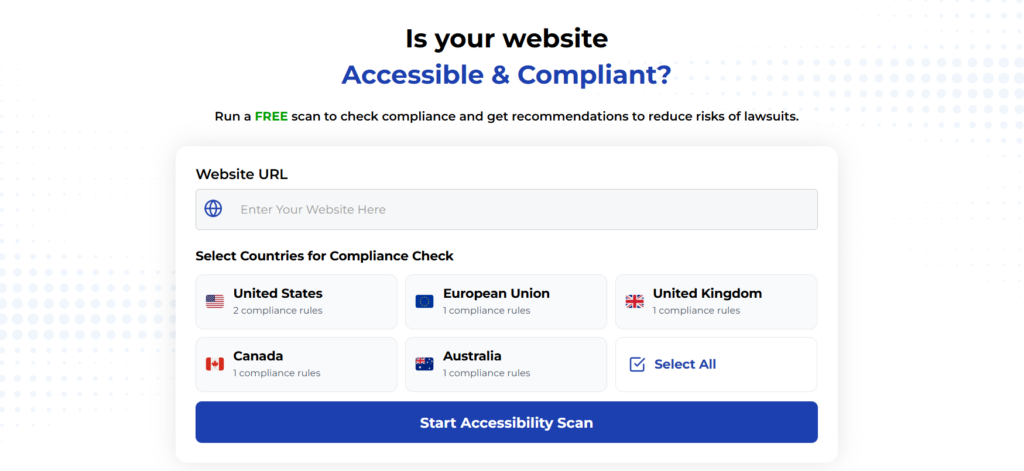
Run a FREE scan to check compliance and get recommendations to reduce risks of lawsuits
Final Thoughts
Documentation requirements extend beyond initial compliance to include ongoing monitoring and improvement processes. Accessibility monitoring services can provide regular compliance assessments that support documentation requirements across all three jurisdictions.
Regular accessibility testing should be documented to show continuous compliance efforts rather than one-time assessments. This approach helps businesses maintain compliance as their products and services evolve while demonstrating good faith accessibility efforts.
User feedback collection and response documentation shows how businesses address accessibility concerns raised by customers with disabilities. This documentation can be particularly valuable for DDA compliance where individual user experiences may become the basis for discrimination claims.
International accessibility compliance isn’t just about meeting legal requirements—it’s about creating digital experiences that work for everyone while protecting your business from legal challenges and market access restrictions. The convergence of EAA enforcement in June 2025, ongoing AODA requirements, and DDA obligations creates both challenges and opportunities for businesses willing to prioritize accessibility .
Ready to assess your website’s compliance with international accessibility standards? Start by conducting an accessibility audit using our website accessibility testing tools to identify improvement opportunities across EU, Canadian, and Australian requirements . Don’t wait until enforcement deadlines create urgent compliance pressure—begin your international accessibility improvements today .
Want More Help?
Try our free website accessibility scanner to identify heading structure issues and other accessibility problems on your site. Our tool provides clear recommendations for fixes that can be implemented quickly.
Join our community of developers committed to accessibility. Share your experiences, ask questions, and learn from others who are working to make the web more accessible.