




Using W3C Tools
Picking the right accessibility testing tool can feel like a high-stakes decision. With dozens of options on the W3C’s evaluation tools list, it’s easy to get lost in feature comparisons and sales pitches. But here’s a secret: the “best” tool isn’t the one with the most features. It’s the one your team will actually use.
The goal isn’t just to buy software; it’s to build a process that consistently catches and fixes accessibility issues. This means selecting tools that fit your team’s existing skills, workflows, and budget. A command-line tool might be perfect for a team of developers but useless for a content team that works in a CMS. An expensive enterprise platform can offer detailed reports, but if no one has time to read them, it’s just shelfware.
This article offers a practical approach to selecting accessibility tools. We’ll look at how to use the W3C’s own categories to understand what different tools do, create a simple rubric for making decisions, and design a pilot plan to test your choices in the real world. By the end, you’ll be able to assemble a small, effective toolkit that gives you the right coverage for your needs.
Why Tool Selection Matters More Than Features
When teams start thinking about web accessibility, they often focus on the tools first. They’ll spend weeks comparing automated scanners, browser extensions, and enterprise platforms, creating detailed spreadsheets of features and pricing. While due diligence is important, this feature-first approach often misses the point. The most significant factor in a tool’s success is how well it integrates into your team’s daily work.
Avoiding Shelfware and False Confidence Traps
“Shelfware” is the term for software that gets purchased but never used. It happens when a decision is made based on a tool’s potential rather than its practicality. A powerful accessibility platform with all the bells and whistles might seem like a great investment, but if it requires extensive training or a dedicated person to manage, it can quickly be abandoned in the face of deadlines and competing priorities. The result is a wasted budget and no actual improvement in accessibility.
Another common trap is false confidence. An automated scanner might report that a page has “zero errors,” leading the team to believe their work is done. However, automated tools can only detect a fraction of WCAG issues. They can’t tell you if your link text is descriptive, if your content is easy to understand, or if a user can complete a complex task using only a keyboard. Relying solely on automation can create a dangerous blind spot, leaving you with a site that passes a scan but is still unusable for people with disabilities.
Matching Tools to Team Skills and Workflows
The most effective accessibility testing setups match the tool to the user. A developer who spends all day in a code editor will get the most value from a tool that integrates directly into their development environment, like Axe DevTools. A designer working in Figma will benefit from a plugin like Stark that checks color contrast in real-time. A content editor who isn’t familiar with code will find a browser extension like WAVE more intuitive, as it visually overlays issues on the page.
Consider your team’s existing workflow. Do you use a CI/CD pipeline for automated deployments? If so, a command-line tool like Pa11y can be integrated to run scans automatically before code is merged. Does your QA team perform manual testing before a release? Give them the tools and training to include accessibility checks in their process. The key is to make accessibility a natural part of everyone’s job, not an extra task that gets tacked on at the end. By choosing tools that meet your team where they are, you’re not just buying software; you’re building a sustainable culture of accessibility.
W3C Tool List Categories and What They Mean
The W3C maintains a list of web accessibility evaluation tools to help people find software that meets their needs. While the list itself is long and can be a bit overwhelming, it’s organized into categories that can help you understand the different types of tools available. Knowing what these categories mean is the first step in figuring out which tools are right for your team.
Evaluation vs. Repair Tools: When to Use Each
The W3C’s original documentation on evaluation and repair tools makes a distinction between tools that find problems and tools that fix them. While modern tools often do a bit of both, it’s a helpful way to think about their primary purpose.
Evaluation tools are scanners. They analyze a web page and report on potential accessibility issues. These can range from free browser extensions to paid enterprise platforms. Their main job is to identify problems and provide information to help you understand them. WAVE and Accessibility Insights are great examples of evaluation tools. They’re most useful at the beginning of an accessibility audit or as a quick check during development.
Repair tools go a step further by offering to fix the issues they find. This can be as simple as suggesting the correct code or, in some cases, automatically applying fixes to the site. Some content management systems have built-in accessibility checkers that will prompt you to add alt text to an image before you can publish it. Tools like AudioEye and EqualWeb offer a hybrid model, combining automated fixes with expert review. Repair tools are best used when you have a clear understanding of the problem and are confident that the suggested fix is appropriate for your specific situation.
Browser Extensions vs. Command Line vs. Enterprise Platforms
Within the world of evaluation tools, there are three main types you’ll encounter:
- Browser Extensions: These are small programs you add to your browser, like Chrome or Firefox. They’re typically used to check one page at a time and are great for quick, on-the-fly testing. Tools like WAVE, Axe DevTools, and Accessibility Insights are popular choices. They’re perfect for developers, designers, and content creators who want to check their work as they go. Because they’re usually free and easy to use, they’re a great entry point for any team.
- Command-Line Tools: These are tools that you run from a terminal or command prompt. They don’t have a graphical user interface, which can make them intimidating for non-developers. However, their power lies in automation. Tools like Pa11y and axe-core can be integrated into your development workflow to run scans automatically every time you commit new code. This makes them an excellent safety net for catching issues before they ever make it to your live site.
- Enterprise Platforms: These are comprehensive, paid solutions that offer site-wide scanning, monitoring, and reporting. Services like Siteimprove, UserWay, and accessiBe fall into this category. They can scan your entire website on a regular schedule, track your progress over time, and provide detailed reports that can be shared across the organization. Enterprise platforms are best for larger organizations that need to manage accessibility across multiple teams and websites and require documentation for compliance purposes.
Short Selection Rubric Teams Can Actually Use
Once you understand the different types of tools, it’s time to decide which ones are the right fit for your team. Instead of getting bogged down in a feature-by-feature comparison, you can use a simple rubric to guide your decision. This isn’t about finding the “perfect” tool but about making a conscious, informed choice that aligns with your team’s reality. A good selection process focuses on two key trade-offs: budget versus coverage and learning curve versus time-to-value.
Budget vs. Coverage Tradeoffs That Matter
Accessibility tools range in price from free to thousands of dollars a month. While it’s tempting to think that a more expensive tool is automatically better, that’s not always the case. The right budget depends on the level of coverage you need and the resources you have available to act on the findings.
For a small team or a single project, a set of free browser extensions might be all you need to get started. They provide excellent page-level analysis and can help developers and designers catch many common issues during their normal workflow. The trade-off is that they don’t provide site-wide scanning or historical tracking. You’ll need to manually check each page, which can be time-consuming for large sites.
An enterprise platform offers much broader coverage. It can scan your entire site, identify trends, and show you how your accessibility posture is changing over time. This is invaluable for large organizations that need to demonstrate compliance and manage risk. The trade-off is the cost, which can be substantial. Before investing in an enterprise solution, be sure you have a team in place to manage the tool, interpret the results, and drive the remediation efforts. A fancy dashboard is useless if no one is acting on the data.
Learning Curve vs. Time-to-Value Considerations
Every new tool comes with a learning curve. Some are simple and intuitive, while others require significant training and practice to use effectively. When selecting a tool, you need to consider how much time your team can realistically dedicate to learning it.
A tool with a steep learning curve might be incredibly powerful, but if it takes weeks to get the hang of, its time-to-value is low. Your team might become frustrated and abandon it before they ever see the benefits. On the other hand, a tool that’s easy to pick up and provides immediate, actionable feedback has a high time-to-value. It’s more likely to be adopted and integrated into your team’s daily habits.
For example, a browser extension like WAVE is easy for anyone to use. You click a button, and it instantly shows you issues on the page. The time-to-value is very high. A command-line tool like axe-core requires some technical knowledge to set up and run, but for a development team, it can be integrated into their existing workflow and provide value within a day or two. An enterprise platform might have the highest learning curve, requiring you to learn how to configure scans, build reports, and manage user permissions. However, for a large organization, the long-term value of centralized monitoring and governance can be well worth the initial investment.
2-Week Tool Pilot Plan with Success Criteria
Once you’ve narrowed down your choices to one or two tools, it’s time to put them to the test. A short, focused pilot program is the best way to see how a tool will work for your team in the real world. Instead of relying on a sales demo, you get to see how the tool performs on your actual website with your actual team. A two-week pilot is usually long enough to get a good feel for a tool without a major commitment.
Testing Real Pages with Real Content
The first rule of a good pilot is to test with your own content. Don’t rely on the tool’s sample pages or a “perfect” test environment. Pick a few key pages from your website that represent a variety of layouts and functionalities. A good mix would include:
- Your homepage
- A content-heavy page, like a blog post or an article
- An interactive page with a form, like a contact or sign-up page
- A page with multimedia content, like videos or an image gallery
Have your team use the tool to scan these pages and document the results. This will give you a much more realistic picture of the types of issues the tool will find on your site. It will also highlight any potential challenges, such as how the tool handles dynamic content or single-page applications.
Measuring Impact on Team Velocity and Error Detection
The goal of an accessibility tool is to help your team find and fix issues more efficiently. A successful pilot should measure the tool’s impact in two key areas: team velocity and error detection.
For team velocity, ask your team to track the time it takes to run scans, interpret the results, and implement fixes. Does the tool slow them down, or does it fit neatly into their existing workflow? Is the feedback it provides clear and actionable, or does it send them down a rabbit hole of false positives and confusing documentation? The goal is to find a tool that makes accessibility work easier, not harder.
For error detection, compare the results from the pilot tool to any other testing methods you’re currently using. Does the new tool find issues that your current process is missing? Does it catch more critical errors? You can also compare the results of two different pilot tools to see which one provides more comprehensive coverage for your specific site. At the end of the two weeks, gather feedback from your team. Would they be happy to continue using this tool? Their buy-in is the single most important factor in the tool’s long-term success.
Combining 2-3 Tools for the Right Coverage
There is no single accessibility tool that can do it all. Automated scanners are great at catching common code-level issues, but they can’t tell you if your site is truly usable. Manual testing is essential for understanding the real-world user experience, but it can be time-consuming to perform on every page. The most effective approach is to combine a few different tools to create a layered testing strategy. This allows you to get the broad coverage of automation with the deep insights of manual testing.
Developer Scanner + Visual Checker + Manual Process
This is a great, low-cost setup for smaller teams or those just getting started with accessibility. It provides good coverage without requiring a large budget or extensive training.
- Developer Scanner: Start with a developer-focused browser extension like Axe DevTools. This tool can be run directly in the browser’s developer tools and provides clear, actionable feedback with links to remediation advice. It’s perfect for developers who want to check their work as they build it. Integrating it into the development process helps catch issues early when they’re easiest and cheapest to fix.
- Visual Checker: Add a visual tool like WAVE. While Axe is great for developers, WAVE is more intuitive for designers, content creators, and project managers. It overlays icons directly on the page, providing a visual representation of the accessibility information. This makes it easier to understand issues related to heading structure, alt text, and ARIA labels without having to dig into the code.
- Manual Process: Finally, document a simple manual testing process. This doesn’t have to be complicated. It can be a short checklist that includes things like:
- Can you navigate the entire page using only the keyboard?
- Is the focus indicator always visible?
- Are all form fields clearly labeled?
- Is all text easy to read?
This three-part toolkit gives you automated checks, visual feedback, and a process for catching the issues that automation can’t.
Enterprise Platform + CI Safety Net + Screen Reader Checks
For larger organizations or teams with more mature accessibility practices, a more robust toolkit might be necessary. This setup provides broader coverage, better reporting, and a stronger safety net.
Screen Reader Checks: Formalize your manual testing process by including checks with actual screen readers. Tools like NVDA (Windows), JAWS (Windows), and VoiceOver (macOS) are used by many people with vision impairments. Testing with these tools is the only way to be sure that your site is truly usable for them. This type of testing requires more training but provides invaluable insights into the user experience.
Enterprise Platform: An enterprise platform like Siteimprove or AudioEye provides site-wide scanning, monitoring, and reporting. This gives you a high-level view of your site’s accessibility health and helps you track progress over time. These platforms are great for program managers and compliance officers who need to see the big picture and report on it to leadership.
CI Safety Net: Integrate a command-line tool like Pa11y or axe-core into your Continuous Integration/Continuous Deployment (CI/CD) pipeline. This acts as a safety net, automatically scanning code for accessibility issues before it gets deployed. If a major error is detected, the build can be failed, preventing the issue from ever reaching users. This is a powerful way to enforce accessibility standards at scale.
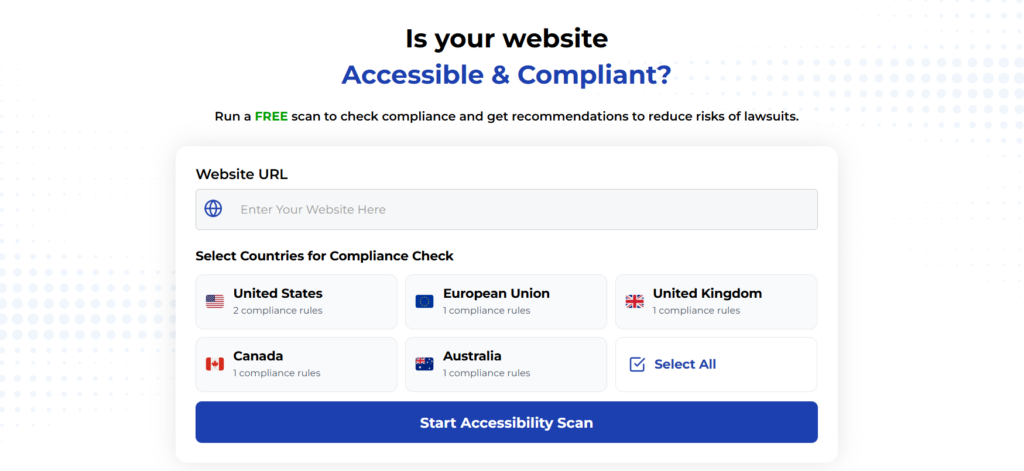
Using Automated Tools for Quick Insights (Accessibility-Test.org Scanner)
Automated testing tools provide a fast way to identify many common accessibility issues. They can quickly scan your website and point out problems that might be difficult for people with disabilities to overcome.
Visit Our Tools Comparison Page!
Run a FREE scan to check compliance and get recommendations to reduce risks of lawsuits
Final Thoughts
By combining tools, you can create a system of checks and balances that provides the right level of coverage for your team’s needs and budget. The key is to be intentional about your choices and build a process that your team will actually follow.
Start your compliance journey, update your accessibility statement, and keep EAA top of mind in every project going forward.
Run a Free Scan to Find E-commerce Accessibility Barriers
Want More Help?
Try our free website accessibility scanner to identify heading structure issues and other accessibility problems on your site. Our tool provides clear recommendations for fixes that can be implemented quickly.
Join our community of developers committed to accessibility. Share your experiences, ask questions, and learn from others who are working to make the web more accessible.