



Publishing Accessible Social Content
Your brand’s social media is a front door to your business. For millions of people, it’s the first interaction they’ll have with you. But what if that door is locked? When social media posts don’t include features like alternative text for images or captions for videos, that’s exactly what it feels like for users with certain disabilities. You’re unintentionally leaving a huge part of your audience out of the conversation.
This isn’t just about ticking a compliance box. It’s about people. It’s about making sure your message, your brand, and your community are open to everyone. The good news is that social media scheduling tools are finally starting to offer features that help teams publish more inclusive content. Two of the biggest names in the game are Hootsuite and Buffer.
So, how do they stack up? We’re going to look at the specific features each tool offers for creating accessible content. We’ll compare their workflows for adding alt text, managing video captions, and setting up team processes that make accessibility a natural part of your routine, not an afterthought. This will help you decide which platform is the right fit for making your social media presence truly welcoming to all.
Why Social Media Accessibility Matters for Reach
Thinking about social media accessibility often brings rules and regulations to mind, but its real effect is on your audience and engagement. When your content is accessible, more people can interact with it, which grows your reach and strengthens your community. It’s a simple equation: more accessible content leads to a bigger, more engaged audience. This is not just about including people with disabilities; it’s about making your content better for everyone.
Alt Text Impact on Engagement and Inclusion
Alternative text, or alt text, is the description of an image that screen readers announce to users with visual impairments. But its function goes far beyond that. Search engines also use alt text to understand what an image is about, which can give your content a little SEO boost. When you post an image without alt text, it’s like hanging a blank frame on the wall. For someone using a screen reader, the post is silent and the message is lost. They might hear “image” and then nothing else, leaving them completely out of the loop.
Adding descriptive alt text makes your content meaningful to them. It’s a small effort that shows you value every member of your audience. Beyond inclusion, well-written alt text can add context and personality that all users appreciate. It’s a space to reinforce your brand voice and add another layer to your storytelling. Considering that millions of people use screen readers, ignoring alt text means you’re overlooking a large segment of your potential audience.
Video Captions That Help Everyone, Not Just Users with Disabilities
Video content is huge on social media, but how many people actually watch with the sound on? A large number of users watch videos in public places, at work, or late at night without audio. Captions make your videos understandable to them. They also support people who are deaf or hard of hearing, who rely on captions to access video content.
But the benefits don’t stop there. Captions can help non-native English speakers follow along more easily, and they can improve comprehension for everyone, especially when the video contains complex information or unfamiliar accents. Social media platforms know this; videos with captions often see higher engagement rates and watch times. By not including them, you’re missing an opportunity to hold your audience’s attention and make your message stick. It’s a feature that serves a wide range of needs and preferences, making your content more effective for all viewers.
Hootsuite Accessibility Feature Breakdown
Hootsuite is one of the most popular social media management platforms, used by brands to schedule posts across multiple networks. As awareness around digital inclusion has grown, Hootsuite has added features to help teams create more accessible content. The platform focuses on integrating accessibility into the existing content creation workflow, aiming to make it a standard step rather than a special task.
Their tools are designed to support teams in consistently adding image descriptions and managing them at scale. Let’s look at how Hootsuite handles these essential accessibility functions.
Alt Text Templates and Team Reminder Systems
One of Hootsuite’s most helpful features is the ability to add alt text to images when scheduling posts for LinkedIn, X (formerly Twitter), and Facebook. The process is built directly into the post composer. When you upload an image, you’ll see an option to “Edit image details” where you can add your alt text. This straightforward integration means it’s hard to miss.
For teams, consistency is everything. Hootsuite doesn’t have “templates” for alt text in a formal sense, but it does allow organizations with enterprise plans to set up custom approval workflows. In these workflows, a manager could establish a rule that a post cannot be approved unless the alt text field is filled out. This acts as a reminder system, creating a checkpoint that ensures no image goes out without a description. This turns a best practice into a mandatory step, which is one of the most effective ways to build lasting habits within a team.
Bulk Media Description Workflows
For social media managers handling a high volume of content, efficiency is a must. Hootsuite’s content library allows you to store and manage your media assets, including their associated alt text. When you upload an image to the library, you can add the alt text right away. This means the description is saved with the image and automatically applied every time that image is used in a post.
This “write once, use many times” approach is a huge time-saver. If you have a set of brand images or product shots you use repeatedly, you only need to write the descriptions once. This is especially useful for campaigns where the same images might be scheduled across different days or networks. While Hootsuite doesn’t currently offer a way to edit alt text for multiple images simultaneously in a “bulk action” menu, storing images with pre-written alt text in the content library serves a similar purpose, making large-scale accessible posting much more manageable.
Buffer’s Approach to Accessible Publishing
Buffer is another major player in the social media scheduling space, known for its clean interface and user-friendly design. Like Hootsuite, Buffer has recognized the importance of accessibility and has integrated features to help users create content that is open to everyone. Buffer’s philosophy seems to be centered on making accessibility features simple, intuitive, and seamlessly part of the publishing flow.
The platform provides tools for adding alt text and encourages its use through a straightforward interface. Let’s examine how Buffer supports accessible content creation and how it helps teams collaborate on these efforts.
Image Description Integration and Team Collaboration
Buffer supports adding alt text for posts on LinkedIn, X, Facebook, and Pinterest. When you add an image to a post in the Buffer composer, a small “ALT” button appears on the image thumbnail. Clicking this button opens a simple text box where you can type your image description. The placement of the button is subtle but clear, making it an easy step to incorporate into your routine.
For teams, Buffer’s approval workflows can also be used to enforce accessibility practices. A common team strategy is to have one person draft a post and another approve it. The approver can be tasked with double-checking for alt text before the post goes live. While Buffer doesn’t have a hard-and-fast rule you can toggle on to require alt text, building it into the team’s checklist for approval is a strong cultural way to ensure it gets done. The simplicity of the feature means there’s a low barrier to training team members to use it consistently.
Caption Upload and Auto-Generation Features
When it comes to video accessibility, Buffer’s approach is a bit different from its image features. Currently, Buffer does not support uploading caption files (like .SRT files) directly through its platform. If you want to add closed captions to your videos, you need to upload them to the social media platform (like Facebook or YouTube) first, add your captions there, and then use Buffer to schedule the post.
Furthermore, Buffer does not offer any auto-generation features for captions. This means that teams need to have a separate process for creating caption files before they even get to the scheduling stage. While this is a limitation, it also forces content creators to be more intentional about their video production workflow. They must plan for captioning from the start, which can lead to higher-quality and more accurate captions in the long run. However, for teams looking for an all-in-one solution, this extra step is an important consideration.
Alt Text Checklist for Brand Teams
Writing good alt text is both an art and a science. It’s not just about saying what’s in an image; it’s about conveying its purpose and meaning within the context of the post. For brand teams, consistent and high-quality alt text is a part of the brand voice. It reflects your attention to detail and your commitment to inclusion. A shared checklist can help everyone on the team, from copywriters to social media managers, write descriptions that are truly helpful.
Here are some points to include in your team’s checklist to ensure your alt text is adding real value.
Writing Descriptions That Add Value vs. Repeating Visible Text
The best alt text gives context that a user might otherwise miss. It shouldn’t just repeat the caption of your social media post. Think about what information the image provides that the text does not. Is it an emotional reaction? The setting of an event? A specific detail on a product? Your goal is to create an equivalent experience for someone who cannot see the image.
For example, if your caption says, “We’re so excited to launch our new product today!”, bad alt text for a product shot would be “A picture of our new product.” Good alt text would be, “A sleek, black wireless headphone sits on a polished wooden desk next to a steaming mug of coffee.” This paints a picture and conveys the mood. Encourage your team to ask: “If the image were gone, what would a user need to know to understand this post fully?”
Handling Graphics with Text and Complex Visuals
Images that contain text, like infographics, promotional graphics, or inspirational quotes, pose a specific challenge. A common mistake is to write alt text that says, “A graphic with text about our new sale.” This is not helpful. The rule is simple: if the text in the image is important, it must be included in the alt text. You should write out the text from the image verbatim in the alt text field.
For more complex visuals like charts or graphs, you can’t describe every single data point. Instead, your alt text should summarize the key takeaway of the visual. For example, for a bar chart showing user growth, good alt text would be, “A bar chart showing user growth accelerating over the last three months, with January at 10,000 users, February at 15,000, and March at 25,000.” This gives the user the same conclusion they would draw from seeing the chart themselves.
Approval Workflows That Stop Silent Media Posting
You can have the best intentions, but without a solid process, things will fall through the cracks. On busy days, when deadlines are tight, accessibility can be the first thing to be forgotten. That’s why building checkpoints into your content approval workflow is so important. It moves the responsibility from a single person’s memory to a team-wide process that has safeguards built in.
An effective approval workflow doesn’t have to be complicated. It just needs to be consistent and mandatory. The goal is to create a system where posting an image without alt text or a video without a plan for captions is simply not an option.
Review Process Changes That Actually Stick
To make a new process stick, it has to be simple and non-negotiable. One of the most effective changes you can make is to add “Check for Alt Text” as a required item on your pre-publication checklist. Whether you use a project management tool like Asana, a team chat like Slack, or a simple shared document, this item must be ticked off before the post is scheduled.
Another powerful change is to assign a final “accessibility check” to one person in the approval chain. This person’s sole responsibility for that post is to review the alt text for quality and ensure videos have captions. By formalizing this role, you create accountability. The key is to make it a hard stop in the workflow. The post does not move forward until that check is complete. This might feel slow at first, but it quickly becomes a habit and prevents countless inaccessible posts from going live.
Training Team Members on Accessible Content Creation
A process is only as good as the people who use it. You can’t just tell your team to “do accessibility.” You need to show them why it matters and how to do it correctly. Regular training sessions are essential for keeping everyone aligned and up-to-date. These sessions should cover more than just the technical steps of adding alt text in your scheduling tool.
Start with the “why.” Share stories or examples of how accessible content helps real people. Explain the business case, including the expanded reach and improved brand perception. Then, move on to the “how.” Conduct workshops on writing good, descriptive alt text. Review examples of good and bad descriptions as a team. Discuss how to handle complex images like infographics or event photos. By investing in your team’s skills, you build a culture of accessibility where everyone feels confident and responsible for creating inclusive content.
The Business Case for Accessible Social Media
Investing in social media accessibility is more than just a kind gesture; it’s a smart business decision. In an increasingly crowded digital world, brands that prioritize inclusion stand out. Creating content that everyone can access is not only the right thing to do, but it also opens up new avenues for growth, strengthens your brand’s reputation, and mitigates legal risks.
Thinking about accessibility from a business perspective helps shift it from a cost center to a value driver. It’s an investment in your audience, your brand, and your company’s future.
Reaching a Wider Audience and Increasing Market Share
There are over one billion people in the world who live with some form of disability. This represents a huge, often-overlooked market segment with significant spending power. When your social media content is inaccessible, you are effectively closing your doors to this audience. By simply adding features like alt text and video captions, you make it possible for this group to engage with your brand, learn about your products, and become loyal customers.
This isn’t just about the disability community either. As we’ve seen, accessible design benefits everyone. A user watching your video on a noisy train, a non-native speaker trying to understand your message, and even a search engine trying to index your content all benefit from accessibility features. This wider usability translates directly into more views, more engagement, and ultimately, a larger market share.
Brand Reputation and Corporate Social Responsibility
In today’s market, consumers care about what a brand stands for. A public commitment to inclusion and social responsibility can be a powerful differentiator. When your social media feeds are consistently accessible, it sends a clear message that your brand values everyone. It shows that you are thoughtful, and that you care about the experience of all your users, not just the majority.
This builds a deep sense of brand loyalty and trust. Your audience sees you as a company that walks the talk. This positive reputation can attract not only customers but also talented employees who want to work for a company with strong values. In a world where brand authenticity is highly prized, demonstrating a genuine commitment to accessibility is one of the most powerful ways to build a positive and lasting brand image.
Making the Choice: Hootsuite or Buffer for Your Team?
Both Hootsuite and Buffer have made positive steps toward helping teams create more accessible content. Neither is perfect, but both offer solid features that can make a real difference in your workflow. The right choice for your team will depend on your specific needs, team size, and existing processes.
Before making a decision, it’s helpful to compare their features directly and ask your team some pointed questions about your priorities.
A Side-by-Side Feature Comparison
| Feature | Hootsuite | Buffer |
| Alt Text for Images | Yes (LinkedIn, X, Facebook) | Yes (LinkedIn, X, Facebook, Pinterest) |
| Alt Text in Content Library | Yes, can be saved with image | No, added at time of post |
| Video Caption Upload | No, must be added on the native platform | No, must be added on the native platform |
| Forced Alt Text Workflow | Yes, via custom approval rules (Enterprise) | No, must be enforced by team process |
| Ease of Use | Integrated into post editor | Simple “ALT” button on image |
Questions to Ask Your Team Before Deciding
What is our video content strategy? Since neither tool currently offers a complete solution for video captions, you will need a separate process regardless of your choice. Does this limitation affect your decision, or are you comfortable handling captions outside of your scheduling tool?
How important is a strict, enforced workflow? If you have a large or distributed team, Hootsuite’s ability to create a hard stop in the approval process for missing alt text might be a deciding factor. If your team is smaller and more nimble, Buffer’s process-driven approach might be sufficient.
How much repeat media do we use? If your team frequently re-uses the same images, Hootsuite’s content library feature that saves alt text with the image could be a major time-saver.
Which interface feels more intuitive to our team? The best tool is the one your team will actually use. Run a trial with both platforms and see which one feels more natural. Does Buffer’s simplicity win out, or does Hootsuite’s more detailed editor feel more powerful?
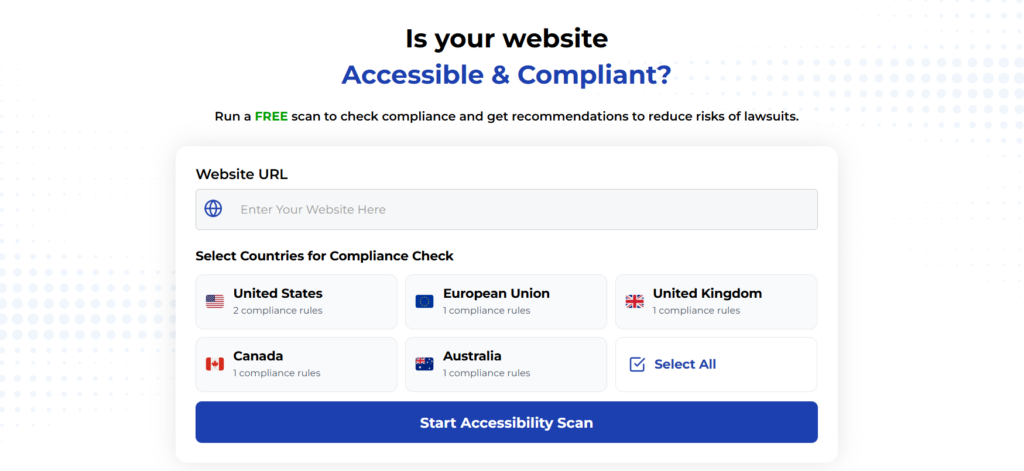
Using Automated Tools for Quick Insights (Accessibility-Test.org Scanner)
Automated testing tools provide a fast way to identify many common accessibility issues. They can quickly scan your website and point out problems that might be difficult for people with disabilities to overcome.
Visit Our Tools Comparison Page!
Run a FREE scan to check compliance and get recommendations to reduce risks of lawsuits
Final Thoughts
By answering these questions together, your team can make an informed decision that sets you up for success in creating a more accessible and inclusive social media presence.
Start your compliance journey, update your accessibility statement, and keep EAA top of mind in every project going forward.
Run a Free Scan to Find E-commerce Accessibility Barriers
Want More Help?
Try our free website accessibility scanner to identify heading structure issues and other accessibility problems on your site. Our tool provides clear recommendations for fixes that can be implemented quickly.
Join our community of developers committed to accessibility. Share your experiences, ask questions, and learn from others who are working to make the web more accessible.