



Structured Accessibility Testing
Automated accessibility checkers are a great first step, but they only catch a fraction of potential issues. Sooner or later, your team needs to dive into manual testing. But where do you start? Without a clear process, manual testing can feel disorganized and inconsistent, especially for teams where not everyone is an accessibility specialist. This is where guided accessibility testing tools come in. They create a bridge between simple automated scans and full, expert-led audits.
Two of the most effective tools in this space are Microsoft’s Accessibility Insights and the IBM Equal Access Checker. Both offer a structured, repeatable process that helps developers, QA testers, and product owners work together. They turn the abstract requirements of the Web Content Accessibility Guidelines (WCAG) into a series of straightforward checks. This article compares these two tools, looking at their features, workflows, and how they help teams build more accessible products.
Bridging Automation and Manual Testing Gaps
The biggest challenge with accessibility testing is often consistency. An automated tool will run the same checks every time, but it can’t understand context or user experience. A manual tester can, but their process might differ from a colleague’s. Guided testing tools solve this by providing a consistent framework for manual checks. They prompt testers with specific questions and instructions, making sure that nothing important gets missed.
This structured approach is a game-changer for teams. It means you don’t have to rely on a single accessibility expert to handle all the testing. Instead, the entire team can contribute, confident that they are following a sound process.
Why Guided Workflows Help Mixed Teams
In many organizations, the responsibility for accessibility doesn’t fall on just one person. Developers need to think about it while coding, QA analysts need to include it in their test plans, and product managers need to understand its impact. Guided workflows give these different roles a shared language and process.
For a developer, a guided tool can help them check their work before they even commit the code. For a QA analyst, it provides a ready-made test plan for accessibility. A product manager can use the reports from these tools to understand the current state of their product’s accessibility and prioritize fixes. Have you considered how a tool like this could streamline communication between your own teams? This shared foundation stops accessibility from being an afterthought and integrates it directly into the development cycle.
Structured Approaches That QA and Product Can Follow
The real strength of tools like Accessibility Insights and IBM Equal Access is the clarity they bring to the testing process. Instead of just getting a list of automated failures, your team is walked through a logical sequence of manual checks. For example, the tool might first ask you to confirm that all images have alternative text. Then, it will guide you through checking keyboard navigation, ensuring every interactive element is reachable and usable without a mouse.
This step-by-step method is perfect for QA and product teams. It creates a repeatable checklist that can be applied to new features or regression testing. The results are consistent, and because each step is documented, it’s easy to track progress over time. This structure turns accessibility testing from a specialized, complex task into a manageable part of your team’s standard quality assurance process.
Microsoft Accessibility Insights Features
Microsoft’s Accessibility Insights is a powerful set of tools designed to help developers find and fix accessibility issues. It comes in a few different forms: a browser extension for Chrome and Edge, and a desktop application for testing Windows apps. Its main goal is to make WCAG standards easy to understand and apply.
The tool is built around two main modes: “FastPass” and “Assessment.” Each serves a different purpose in the testing workflow, but together they provide a solid path from quick automated checks to in-depth manual verification. The visualizer tools are also incredibly helpful, allowing you to see things like tab stops, color contrast ratios, and heading levels directly on the page.
FastPass vs. Assessment Mode Usage
FastPass is your first stop. It’s a two-to-three-minute check that automatically scans for the most common accessibility issues. It identifies things like missing image alt text, insufficient color contrast, and incorrect ARIA attribute usage. The results are displayed directly on the page, showing you exactly where the problems are. Think of FastPass as a high-level health check.
The Assessment mode is where the “guided” part really shines. It takes you through a much more detailed series of tests that cover all applicable WCAG 2.1 AA success criteria. For each criterion, the tool explains what you need to check and asks a series of simple questions. For instance, to test keyboard access, it will instruct you to try and reach every interactive element using only the Tab key. You then mark each element as a pass or fail. This process generates a thorough report that documents your findings, complete with screenshots and notes.
Integrating with Windows Testing Workflows
A unique aspect of Accessibility Insights is its desktop version, which allows you to run the same kind of tests on native Windows applications, not just websites. This is a huge benefit for teams building software for the Windows ecosystem. The desktop tool can inspect the accessibility tree of an application, showing you the names, roles, and properties that are exposed to assistive technologies like screen readers.
Just like the browser extension, the Windows tool includes an automated checker and a guided manual testing workflow. This allows development teams to use a single, consistent toolset for testing both their web and desktop products. It helps unify the testing process and ensures that accessibility is considered across all platforms.
IBM Equal Access Checker Capabilities
The IBM Equal Access Checker is another excellent tool for integrating accessibility into the development process. Part of a larger suite of accessibility tools from IBM, the checker focuses on providing clear, actionable feedback to developers and testers. It is available as a browser extension and integrates with other development tools to automate checks within a continuous integration pipeline.
IBM’s tool is particularly well-regarded for its robust rule engine and the quality of its explanations. It doesn’t just tell you that something failed; it tells you why it failed and provides a link to the relevant accessibility requirement. This educational component is invaluable for helping teams learn as they go.
Rule Engine and Violation Explanations
At the heart of the IBM Equal Access Checker is its powerful rule engine. It contains a set of over 100 checks that are based on IBM’s own accessibility requirements, which align closely with WCAG and other standards. When the checker finds an issue, it categorizes it as a violation, a potential violation, or a recommendation.
This tiered approach helps teams prioritize their work. A “violation” is a clear failure that needs to be fixed. A “potential violation” is something the tool can’t be sure about and requires a manual check. The explanations are a key feature. For each issue, the tool provides a detailed description of the problem, the user impact, and a recommended fix. This level of detail helps developers not only fix the immediate issue but also understand the underlying principle so they can avoid it in the future.
Integration with Development Tools
IBM has put a lot of thought into how the Equal Access Checker fits into a modern development workflow. Beyond the browser extension, the checker’s engine can be integrated into automated build and testing systems. This means you can set up your development pipeline to automatically run an accessibility scan every time new code is submitted.
This proactive approach helps catch issues early, long before they reach production. By making accessibility checks a standard part of the development process, teams can make sure that accessibility is continuously monitored and maintained. It shifts the focus from finding problems at the end of the line to preventing them from happening in the first place.
Using Guided Flows for Form Validation Patterns
Forms are one of the most common sources of accessibility problems on the web. From missing labels to confusing error messages, a poorly designed form can be a major barrier for users with disabilities. This is an area where guided testing tools are particularly useful.
Both Accessibility Insights and the IBM Equal Access Checker include specific checks designed to validate form accessibility. They walk you through the process of checking for common issues, ensuring that your forms are usable for everyone. How often do you test your own forms from a keyboard-only perspective?
Error Message Testing That Maps to WCAG
When a user makes a mistake filling out a form, how is that error communicated? For a form to be accessible, error messages must be clear, easy to find, and programmatically associated with the field that has the error. Simply turning the border of an input field red is not enough.
Guided testing tools help you verify this. The tool will instruct you to intentionally trigger a validation error and then check several things: Is the error message itself easy to understand? Is it positioned near the input field? And most importantly, is it announced by a screen reader? The tool walks you through these checks, mapping each one to the relevant WCAG success criteria like 3.3.1 (Error Identification) and 4.1.2 (Name, Role, Value).
Input Field and Label Relationship Checks
Every input field on a form needs a label. This might seem obvious, but it’s a very common mistake. Without a properly associated label, a screen reader user won’t know what information they are supposed to enter into a field. The for attribute on a <label> element must match the id of its corresponding <input>.
The Assessment mode in Accessibility Insights and the manual checks in the IBM tool guide you to verify these relationships. The tool will highlight each input field and ask you to confirm that it has a visible, correctly associated label. It also prompts you to check for placeholder text that is used in place of a label, which is another common anti-pattern that causes accessibility problems.
Adding Screen Reader Verification
While guided tools are fantastic for finding many issues, they can’t fully replicate the experience of using a screen reader. At some point, you need to do some manual testing with an actual assistive technology device. The good news is that these guided tools help prepare you for this step, and their reports provide a great starting point.
A quick “smoke test” with a screen reader can catch issues related to reading order, context, and overall user flow that automated and guided tools might miss. It’s an essential final step to confirm that your website is not just technically compliant but also genuinely usable.
Logging Issues That Align with Success Criteria
When you find an issue, whether through a guided tool or a manual screen reader check, it’s important to log it in a way that is helpful for your development team. A good bug report should include what you did, what you expected to happen, and what actually happened.
Both Microsoft Accessibility Insights and the IBM Equal Access Checker excel at this. When you fail a check in one of their guided workflows, the tool helps you create an issue report. It automatically captures a screenshot, records the relevant HTML, and, most importantly, links the issue directly to the WCAG success criterion it violates. This gives developers the context they need to understand the problem and fix it correctly. When you log issues from your manual screen reader testing, you should follow this same pattern, connecting each finding back to a specific WCAG requirement.
NVDA and VoiceOver Smoke Test Procedures
You don’t have to be a screen reader expert to run a quick smoke test. The goal isn’t to perform an exhaustive audit but to check for major show-stopping issues. Using a free screen reader like NVDA on Windows or the built-in VoiceOver on a Mac, you can run through a few basic procedures.
First, try navigating the page using only the Tab key to move between links and form controls. Does the focus move in a logical order? Is the focus indicator always visible? Next, use the screen reader’s commands to navigate by headings. Does the heading structure make sense and provide a good outline of the page? Finally, have the screen reader read the page content from top to bottom. Does the reading order match the visual order? Answering these questions can quickly reveal significant usability problems.
Using Automated Tools for Quick Insights (Accessibility-Test.org Scanner)
Automated testing tools provide a fast way to identify many common accessibility issues. They can quickly scan your website and point out problems that might be difficult for people with disabilities to overcome.
Visit Our Tools Comparison Page!
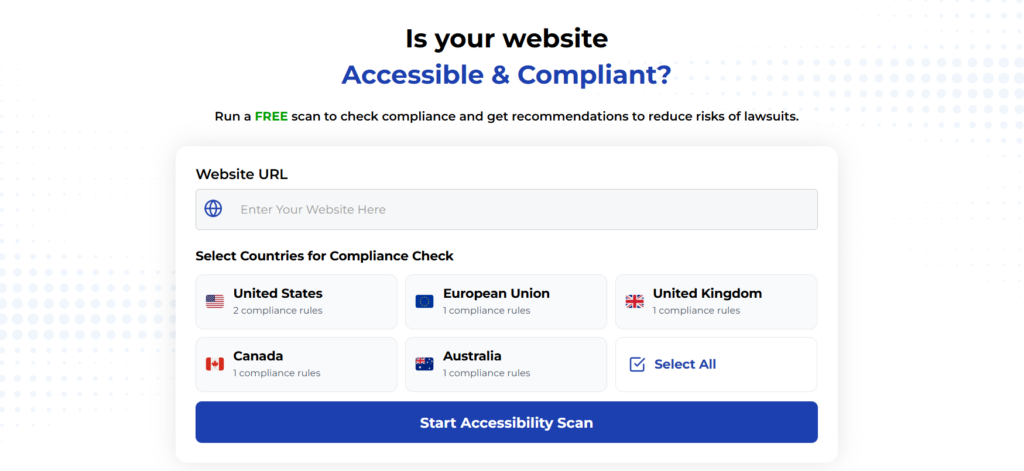
Run a FREE scan to check compliance and get recommendations to reduce risks of lawsuits
Final Thoughts
If your organization develops for Windows in addition to the web, Microsoft Accessibility Insights provides a unified toolset that is hard to beat. Its clear separation between the quick FastPass check and the deep Assessment mode gives teams a flexible way to approach testing.
On the other hand, the IBM Equal Access Checker stands out for its detailed explanations and strong focus on developer education. Its ability to integrate directly into a CI/CD pipeline makes it a great option for teams wanting to embed accessibility checks into their core development process.
Ready to see where your own site stands? Start by running a check with our free website accessibility scanner to get a quick snapshot of your most pressing issues.
Start your compliance journey, update your accessibility statement, and keep EAA top of mind in every project going forward.
Run a Free Scan to Find E-commerce Accessibility Barriers
Want More Help?
Try our free website accessibility scanner to identify heading structure issues and other accessibility problems on your site. Our tool provides clear recommendations for fixes that can be implemented quickly.
Join our community of developers committed to accessibility. Share your experiences, ask questions, and learn from others who are working to make the web more accessible.