



Database Design for Accessible Websites
When we talk about web accessibility, the conversation often centers on front-end design elements like color contrast, keyboard navigation, and ARIA labels. These are absolutely important. But what if the real source of a clunky, inaccessible user experience lies deeper? What if the very foundation of your website; its database; is creating barriers before a single pixel is ever drawn on the screen? A website’s database architecture is the unsung hero of digital inclusion. The way you structure, store, and retrieve content has a direct effect on page load speeds, the reliability of information delivered to assistive technologies, and your ability to maintain compliance over time.
This isn’t just a technical concern for your back-end developers; it’s a foundational issue that affects your entire organization’s ability to create and maintain a genuinely accessible digital presence. A poorly designed database can make it nearly impossible for content creators to add proper accessibility information. It can slow a site to a crawl, creating usability nightmares for people relying on screen readers or navigating with a keyboard. Getting this right from the start isn’t just a matter of good engineering; it’s a foundational step toward building a digital presence that meets standards like WCAG and ADA compliance.
Database Schema Design for Accessible Content
Think of a database schema as the blueprint for your website’s content library. It defines where every piece of information lives and how it relates to everything else. A messy, poorly planned schema is like a library with no catalog system; books are just thrown onto shelves randomly. For a person using a screen reader, navigating a site built on a chaotic schema can feel just like that: confusing and frustrating. A thoughtful schema, on the other hand, organizes content logically, making it easy for both your website and assistive technologies to find and present information clearly. This is the heart of creating truly accessible content.
Why Structured Content is Accessible Content
The first rule of an accessible schema is to store content in a structured, granular way. Instead of dumping an entire article into a single, massive text field in your database, you need to break it down into its logical parts. This means your database should have distinct fields for elements like page titles, main headings (H1), subheadings (H2, H3), paragraphs, image URLs, and most importantly, the alternative text for those images (alt_text).
When you store these elements separately, you make the content’s structure explicit and machine-readable. When a user requests a page, your system can assemble these pieces with the correct HTML tags, guaranteeing a logical heading order and proper labeling for non-text content. This is a huge win for screen reader compatible design, as users of these tools rely heavily on a proper heading structure to skip between sections and understand the page layout. Have you ever considered how your database presents content to a screen reader? A structured schema ensures the presentation is logical and useful.
Keeping Presentation Out of Your Data
A common mistake, often encouraged by older WYSIWYG (“What You See Is What You Get”) editors, is to store styling information directly within the database content. You might see database entries littered with raw HTML tags like <b>, <i>, or inline CSS styles. This practice creates major accessibility problems down the road. It hard-codes presentation, making it incredibly difficult to change your site’s design without manually editing thousands of database records.
A better approach is to store raw, unformatted text and data. The database should hold the what (the content itself), while your website’s templates and CSS files should handle the how (the visual presentation). This separation of content from presentation makes your information much more flexible. The same raw text can be styled for your main website, formatted differently for a mobile app, or read aloud by a voice assistant, with each platform applying its own accessible presentation layer. This is central to future-proofing your content.
A Quick Look at SQL vs. NoSQL for Accessibility
Your choice of database technology; be it a traditional relational database (like SQL) or a more flexible non-relational one (like NoSQL); also has implications. SQL databases enforce a rigid schema, which can be a good thing for accessibility. It forces you to define your content structure up front and stick to it, ensuring that fields for things like alt_text are always present. The downside is that it can be less flexible if your content needs change over time.
NoSQL databases offer more flexibility, allowing you to store data in a less structured way. This can be useful, but it also puts the responsibility on your application logic to enforce consistency. Without that discipline, it’s easy for content creators to add images without alt text or for the content structure to become inconsistent. Neither is inherently better, but you must consider how your team will maintain structural integrity, as it directly affects the accessibility of the final product.
Content Versioning and Accessibility Metadata Management
A website is never truly “finished.” Content gets updated, designs change, and accessibility standards evolve. Managing these changes effectively is another area where your database can either be a powerful ally or a significant hindrance. This is especially true when it comes to tracking accessibility-related information, often called metadata. Your database is the perfect place to manage this information systematically.
Creating an Audit Trail for Compliance
Content versioning is the practice of keeping a historical record of all changes made to your content. From an accessibility standpoint, this is incredibly useful. Imagine you’re undergoing an accessibility audit, and a question arises about when a specific form was made keyboard-accessible or when alt text was added to a batch of product images. With a versioning system in place in your database, you can pinpoint the exact date, time, and even the person who made the update.
This creates a clear and defensible audit trail. It can be invaluable for demonstrating ongoing efforts toward ADA compliance or Section 508 compliance. It shows that accessibility isn’t a one-time project for your organization but an ongoing commitment. Without versioning, proving historical compliance becomes a difficult, if not impossible, task. It moves your compliance from a matter of guesswork to a matter of record.
Your Database as the Central Hub for Accessibility Info
Your database should be the single source of truth for all accessibility metadata. This goes far beyond just alt text. It should include dedicated fields or related tables for information like:
- Captions and transcripts for video and audio content.
- Language attributes to identify the language of a page or even a specific phrase within a page.
- ARIA attributes that define the roles and states of custom interactive components.
- Long descriptions for complex images like charts and infographics.
When you store this information in dedicated database fields, it becomes manageable, reportable, and auditable. For example, you can easily run a query to find all videos in your media library that are missing a link to a transcript file. This turns a potentially massive manual review into a simple database task. It empowers your content creators to follow best practices by integrating accessibility directly into their workflow.
Making Metadata Easy for Content Creators
A well-designed database doesn’t just store accessibility data; it makes it easier for your team to use it. For instance, your content management system (CMS) interface can be designed to pull from the database and make fields like “Alternative Text” required for every image upload. If the field is a mandatory part of the database schema, the CMS can enforce its completion.
This takes the guesswork out of the content creation process. Instead of relying on a checklist or institutional memory, the system itself guides users toward creating accessible content. This is how you scale accessibility across a large organization. By building the requirements directly into the data structure, you make doing the right thing the easiest path for everyone.
The Critical Link Between Database Performance and Accessibility
Website performance is an accessibility issue. A slow-loading website can be frustrating for anyone, but for users relying on assistive technologies, it can render a site completely unusable. A screen reader might struggle to process a page that loads content slowly or inconsistently, leading to a disjointed and confusing experience. Much of this performance hinges on how efficiently your website can retrieve information from its database. Slow database queries are a direct cause of poor user experiences.
How Slow Queries Hurt Users with Disabilities
Slow page loads can cause a number of specific problems for users with disabilities. A page that takes too long to become interactive might cause a screen reader to time out or start announcing content before the user can interact with it. For users with cognitive disabilities, a sluggish, unresponsive interface increases cognitive load and makes it difficult to focus on and complete tasks.
WCAG itself contains performance-related considerations. While it doesn’t set specific speed metrics, the principles of Perceivable, Operable, Understandable, and Robust are all affected by performance. If content isn’t delivered to the user in a timely and predictable manner, it fails to be fully operable. Efficient database queries are a direct line to better performance and, therefore, a more accessible experience for everyone.
Practical Query Optimization Techniques
A database query is simply a request for information. How you write that request can have a massive impact on how quickly the database responds. Writing efficient queries is key to a snappy, responsive website. Instead of asking the database for all the data associated with a page and then having your website’s code filter it, you should write a specific query that asks for only the pieces you need.
Another powerful technique is indexing. A database index works just like the index at the back of a book; it allows the database to find specific information without having to scan through every single record. By creating indexes on frequently searched fields; like product IDs, user names, or even alt_text; you can dramatically speed up data retrieval times. This ensures that all content, including accessible content, is delivered to the user as quickly as possible.
The Impact of Lazy Loading on Assistive Tech
Lazy loading, the practice of loading images or other content only when they are about to enter the viewport, is a popular performance technique. It can be great for initial page load speed. However, if not handled carefully, it can be a problem for accessibility. A screen reader might read through the entire page’s structure on load, including references to images that haven’t loaded yet. If the image and its alt text aren’t loaded until the user scrolls, the screen reader user might miss them entirely.
The solution is to ensure your lazy-loading implementation still provides the necessary information to the accessibility tree from the start. This might mean including the image dimensions and an empty alt attribute initially, then populating the src and alt text when the image loads. Your database can support this by having all this information ready to serve quickly when requested by the loading script.
The Role of the CMS in Database Accessibility
For most content creators, the database is an abstract concept. They interact with it through a Content Management System (CMS). Therefore, the design of your CMS and how it connects to the database is a important part of the puzzle. A CMS can either expose the accessibility features of your database or hide them completely, directly affecting your team’s ability to maintain an accessible website.
Traditional vs. Headless CMS Architectures
Traditionally, a CMS like WordPress or Drupal was responsible for both managing content and rendering the front-end website. This is often called a monolithic or coupled CMS. While convenient, this approach can lead to the very problem we discussed earlier: content getting mixed up with presentation. The editor might save HTML directly into the database, making the content hard to manage and reuse.
A more modern approach is the “headless” CMS. In this model, the CMS is responsible only for managing and storing content. It provides that content via an API to any number of front-end applications; a website, a mobile app, a kiosk, etc. This architecture naturally enforces the separation of content and presentation. The database stores pure, structured content, and it’s up to each “head” to present it in an accessible way.
How a Headless CMS Promotes Accessible Content Structures
Because a headless CMS is built around structured content, it works hand-in-hand with an accessible database schema. When you define a content model in a headless CMS; say, for a “Team Member” profile; you create specific fields for “Name,” “Title,” “Biography,” and “Profile Picture Alt Text.” This structure is then mirrored in the database.
When a content creator fills out the form, they are guided to provide all the necessary information. There’s no big, empty text box where they can forget accessibility details. This makes maintaining a high standard of digital accessibility compliance much easier across a large team and a large volume of content. It systemizes the process of creating accessible content from the very beginning.
Executing a Content Migration That Protects Accessibility
Sooner or later, most websites undergo a major change, like moving to a new CMS or overhauling the site architecture. This process, known as content migration, is a high-risk moment for accessibility. All the carefully crafted accessibility metadata; alt text, transcripts, structured headings; can be easily lost or corrupted during the move if you don’t plan for it. A migration can undo years of hard work in an instant.
Common Pitfalls That Erase Accessibility Work
Without a specific plan to preserve accessibility data, a migration can be disastrous for inclusion. Many automated migration tools are not designed to recognize and transfer custom accessibility fields. They might move the main body of an article but discard the associated alt text for its images. The relationship between a video file and its caption file could be broken. Carefully structured content can be flattened into a single, unstructured block of text.
The result is a brand new, technically modern website that is far less accessible than the one it replaced. This not only creates a poor experience for users with disabilities but also puts your organization at immediate risk of falling out of WCAG compliance. It’s a common and completely avoidable mistake.
A Step-by-Step Plan for an Accessible Migration
To avoid these pitfalls, accessibility must be a central part of your migration strategy from day one. Don’t treat it as a clean-up task for after the launch.
- Audit and Map: Before you move a single piece of data, conduct a thorough accessibility audit of your existing content. Identify all the accessibility-related data that needs to be preserved. Create a detailed spreadsheet that maps each piece of old data (e.g., image_description field) to its corresponding field in the new system (e.g., alt_text field).
- Script and Test: Write custom scripts for your migration that use the map you created. Don’t rely on out-of-the-box tools unless you can configure them to handle your specific accessibility fields. Run your scripts on a small sample of content first and manually check the results.
- Validate After the Move: A migration is not complete once the data is moved. The final and most important step is to validate the new site. Use a combination of automated accessibility testing tools and manual testing with assistive technologies to confirm that all your accessibility information made it across intact and is functioning correctly.
Database Performance Monitoring for Ongoing Accessibility
Launching an accessible website is one thing; keeping it accessible is another. As your website grows and accumulates more data, database performance can degrade over time. Queries that were once fast can become slow, leading to the kind of performance issues that create barriers for users. This is why ongoing accessibility monitoring must extend all the way down to your database.
Why You Can’t “Set It and Forget It”
You can’t just assume your database will remain efficient forever. As new content is added, old content is archived, and user traffic patterns change, the demands on your database shift. Performance bottlenecks can appear unexpectedly. A new feature might introduce an inefficient query that slows down every page on your site.
Regularly monitoring your database’s performance allows you to catch these issues before they become serious problems for your users. It shifts you from a reactive mode (fixing barriers after users complain) to a proactive one (preventing barriers from forming in the first place). This is a much more effective way to maintain a high-quality, accessible user experience over the long term.

Key Metrics to Watch for Accessibility
When monitoring for accessibility, you should pay close attention to the performance of queries that retrieve accessibility-specific content. Don’t just look at overall page load time. Set up specific monitors for:
- The average time it takes to fetch a video along with its associated captions and transcript file.
- The performance of queries that retrieve alt text for pages with many images.
- The load time for ARIA attributes needed for complex interactive widgets.
By tracking these specific metrics, you can see if a performance problem is disproportionately affecting your accessibility features. This level of detail is needed for a truly mature accessibility program.
Setting Up Proactive Alerts
The goal of monitoring is not just to have nice dashboards; it’s to enable action. Set up automated alerts for your accessibility-related queries. If a query’s average response time suddenly degrades by more than 20%, your development team should be notified automatically via email or Slack.
This allows you to investigate and fix the underlying issue; perhaps by adding a new index, rewriting the query, or optimizing a table; long before it affects a real user. This proactive stance is the difference between a website that is merely compliant on launch day and one that remains truly usable and accessible for all your visitors, every day.
Using Automated Tools for Quick Insights (Accessibility-Test.org Scanner)
Automated testing tools provide a fast way to identify many common accessibility issues. They can quickly scan your website and point out problems that might be difficult for people with disabilities to overcome.
Visit Our Tools Comparison Page!
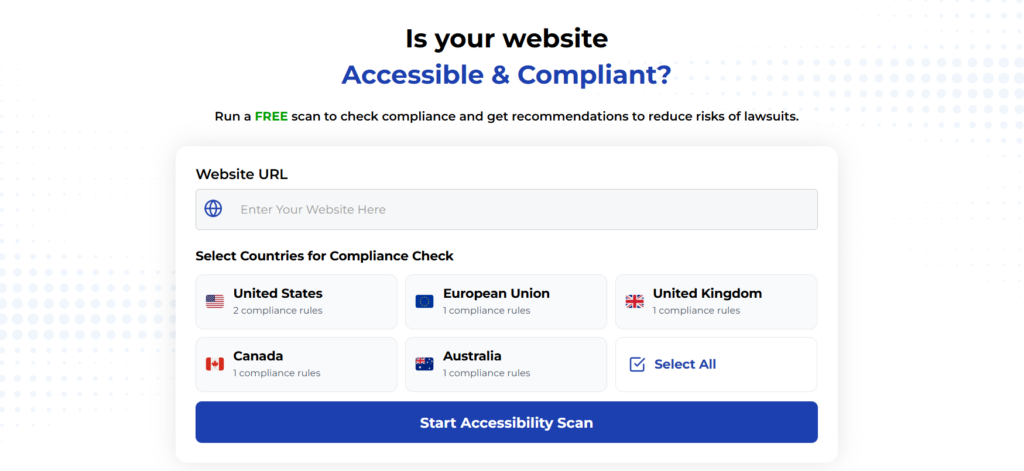
Run a FREE scan to check compliance and get recommendations to reduce risks of lawsuits
Final Thoughts
Thinking about your database as a part of your accessibility work might feel like a shift in perspective, but it’s a necessary one. A well-designed database architecture doesn’t just support an accessible front-end; it actively contributes to it by ensuring content is structured, manageable, and delivered with speed and reliability. It’s the invisible foundation upon which a genuinely inclusive digital experience is built.
Ready to see how your website’s foundation stacks up? Start by conducting an accessibility audit with our free website accessibility scanner to identify immediate improvement opportunities.
Want More Help?
Try our free website accessibility scanner to identify heading structure issues and other accessibility problems on your site. Our tool provides clear recommendations for fixes that can be implemented quickly.
Join our community of developers committed to accessibility. Share your experiences, ask questions, and learn from others who are working to make the web more accessible.