



Government Website Accessibility | Section 508 Deep Dive and Implementation
Government websites serve millions of Americans every day, and making them accessible isn’t just good policy—it’s the law . Section 508 of the Rehabilitation Act requires federal agencies and their contractors to ensure their digital properties work for everyone, including people with disabilities . With recent updates and stricter enforcement, getting Section 508 compliance right has never been more important for government organizations .
Think about the last time you visited a government website to renew a license, file taxes, or access public services. Now imagine trying to complete those same tasks while using a screen reader or navigating only with a keyboard. That’s the reality for millions of Americans with disabilities, and Section 508 exists to make sure they can access government services just like everyone else .
Understanding Section 508 Requirements and Compliance Timeline
Section 508 compliance means federal agencies must secure, maintain, and use Information and Communications Technology (ICT) that people with disabilities can access . This law doesn’t just apply to federal websites—it extends to any organization receiving federal funding and contractors working with government agencies .
The current Section 508 standards adopted WCAG 2 .0 Level AA as their technical foundation in 2018 . However, 2025 brings potential updates that may require compliance with WCAG 2 .2 or even WCAG 3.0 standards . These newer versions introduce enhanced requirements for mobile accessibility, cognitive disabilities, and improved focus visibility .
Government organizations need to understand that Section 508 applies to more than just websites . The law covers:
- Public-facing web pages and applications
- Internal software and tools used by federal employees
- Email communications and digital documents
- Mobile applications and responsive designs
- Training materials and educational content
- Employment application systems and HR portals
Timeline Considerations for 2025
Federal agencies working with WCAG 2.0 standards should prepare for potential updates . The European Union has been using WCAG 2.1 for five years, and the Department of Justice set WCAG 2.1 as the standard for state and local governments under ADA Title II . This trend suggests federal Section 508 requirements may follow suit.
Organizations that wait until official announcements risk scrambling to meet new deadlines . Smart agencies are already conducting accessibility audits against WCAG 2.1 and 2.2 standards to stay ahead of potential changes .
Government Accessibility Testing and Validation Protocols
Testing Section 508 compliance requires a multi-layered approach that goes beyond automated scanning tools . The Department of Homeland Security developed the Trusted Tester process specifically for government websites, and it’s become the gold standard for Section 508 validation .
The Three-Tier Testing Approach
Automated testing tools can quickly identify 30-40% of accessibility issues, but they miss many problems that require human judgment . These tools excel at finding missing alt text, color contrast violations, and structural markup problems. However, they can’t evaluate whether your content makes sense to screen reader users or if your forms are logically organized .
Manual testing fills the gaps that automated tools leave behind . This involves navigating your website using only a keyboard, checking that all interactive elements are properly labeled, and verifying that content flows logically for assistive technology users . The process takes more time but catches issues that could block real users from completing important tasks .
User testing with people who actually use assistive technologies provides the most accurate picture of your website’s accessibility . These sessions reveal practical barriers that technical testing might miss, like confusing navigation structures or unclear error messages that technically meet WCAG standards but still frustrate users.
DHS Trusted Tester Certification
The DHS Trusted Tester program offers free training and certification for government accessibility testing . This program teaches a standardized methodology that creates consistent results across different testers and organizations . Government contractors frequently require or prefer this certification for team members performing accessibility testing on federal projects .
Trusted Tester training covers five main areas: Section 508 fundamentals, testing tool installation, standards knowledge, practical training scenarios, and final certification . The program demands 40-80 hours of study for first-time certification, but provides hands-on experience with real accessibility testing situations .
Testing Tools and Methodologies
Government agencies should deploy multiple testing approaches to get complete coverage . Browser-based tools like axe-core, WAVE, and Lighthouse can scan pages quickly and identify obvious violations . Desktop applications provide more detailed analysis for complex content and can test documents that web-based scanners might miss.
Screen reader testing using NVDA, JAWS, or VoiceOver reveals how your content actually sounds to users who depend on these tools . This testing can’t be automated—it requires human testers who understand how screen readers work and what makes content easy or difficult to understand through audio alone.
Procurement Accessibility Standards and Documentation
Section 508 requirements must be woven into the entire procurement lifecycle, from initial planning through contract completion . The Federal Acquisition Regulation (FAR) enforces Section 508 through requirements that govern pre-award, award, and post-award phases .
Pre-Award Requirements
Before issuing any solicitation for ICT products or services, agencies must determine which Section 508 standards apply . This process involves working with your agency’s Section 508 program manager to identify applicable requirements and resolve any related issues .
The requiring activity must provide a clear statement about Section 508 applicability in the acquisition package . If Section 508 applies, the solicitation must include specific accessibility standards language in a separate, clearly designated section of the statement of work . Vague or incomplete Section 508 requirements can lead to contractor confusion and non-compliant deliverables.
VPAT and ACR Documentation
Vendors must provide Voluntary Product Accessibility Templates (VPATs) that detail how their products meet Section 508 standards . These documents, when completed properly, become Accessibility Conformance Reports (ACRs) that agencies can use to evaluate procurement options and demonstrate due diligence .
Creating accurate VPATs requires vendors to actually test their products against Section 508 standards, not just make claims about compliance . Agencies should look for VPATs that include detailed testing methodologies, specific success criteria results, and clear explanations of any limitations or exceptions .
The ACR title page must include company information, product details, report date, evaluation methods, and contact information . The main VPAT tables contain three columns: criteria (the specific Section 508 requirement), conformance level (supports, partially supports, does not support, or not applicable), and remarks explaining how the product meets or fails to meet each requirement .
Contract Language and Validation
Effective Section 508 contract language goes beyond simply referencing the standards . Contracts should specify exactly which accessibility requirements apply, how compliance will be validated, and what happens if deliverables don’t meet standards .
Contracting officers must verify that accessibility standards outlined in contracts are met before accepting deliverables . This might involve independent accessibility testing, review of vendor-provided documentation, or user testing with federal employees who use assistive technologies .
Public-Facing vs Internal System Accessibility Requirements
Section 508 creates different expectations for public-facing websites versus internal government systems, though both must meet accessibility standards . Understanding these distinctions helps agencies prioritize their accessibility efforts and allocate resources effectively .
Public-Facing Website Standards
Government websites that serve the general public face the highest level of scrutiny and the strictest compliance expectations . These sites must meet WCAG 2.1 Level AA standards, with some jurisdictions already moving toward WCAG 2.2 requirements .
Public-facing sites require more extensive testing because they serve diverse audiences with varying levels of technical sophistication and different assistive technologies . A veteran trying to access benefits online might use different tools than a small business owner researching procurement opportunities, and both experiences must work smoothly.
Error handling becomes especially important on public-facing sites because users can’t call IT support when something doesn’t work . Clear error messages, logical form validation, and alternative contact methods ensure that accessibility barriers don’t prevent citizens from accessing essential services.
Internal System Considerations
Federal employee-facing systems must also meet Section 508 standards, but agencies have more flexibility in how they achieve compliance . Internal systems might use specialized software that requires additional accessibility configuration or employee training rather than complete redesign.
Agencies can provide reasonable accommodations for employees with disabilities when internal systems don’t fully meet accessibility standards, as long as these accommodations provide equivalent access . This might include alternative workflows, modified interfaces, or assistive technology that makes inaccessible systems usable .
However, relying on accommodations instead of building accessible systems from the start creates ongoing costs and potential barriers . New employees with disabilities shouldn’t have to wait for special accommodations to do their jobs, and accessible design benefits all users, not just those with disabilities.
Mobile and Responsive Design Requirements
Government websites must work accessibly across different devices and screen sizes . Mobile accessibility presents unique challenges because touch interfaces require different considerations than desktop websites .
WCAG 2.2 introduced specific requirements for touch target sizes, requiring interactive elements to be at least 44 x 44 pixels . This helps users with motor impairments who might have difficulty tapping small buttons on mobile devices.
State and Local Government Accessibility Considerations
While Section 508 specifically applies to federal agencies, state and local governments face their own accessibility requirements under ADA Title II . Recent Department of Justice rules created specific deadlines and standards that mirror many Section 508 requirements.
ADA Title II Compliance Deadlines
State and local government entities serving populations of 50,000 or more must achieve WCAG 2.1 Level AA compliance by April 24, 2026 . Smaller entities serving populations under 50,000 have until April 26, 2027 . These deadlines aren’t suggestions—they represent legal requirements with potential financial and legal consequences for non-compliance .
The DOJ rule provides long-awaited clarity for digital accessibility requirements, but the implementation timeline is tight . Government organizations that haven’t started their accessibility efforts face significant challenges in meeting these deadlines .
Universities and other public entities have already begun adjusting their timelines to meet federal requirements . Iowa State University moved up their digital accessibility policy implementation by several months to align with the DOJ deadline, recognizing that federal rules supersede institutional policies .
Cost Planning and Resource Allocation
The Department of Justice recommends budgeting $2,000 per course or content area for the first year of accessibility implementation, plus a 10-year sustainability plan . The bulk of these costs represent employee hours to ensure compliance rather than expensive software or external services .
State and local governments should plan for both initial remediation costs and ongoing maintenance expenses . Creating accessible content from the start costs less than retrofitting inaccessible materials, making staff training and process changes important investments .
Enforcement and Legal Risks
Government organizations face real legal consequences for accessibility non-compliance . Several federal agencies have been sued for failing to meet Section 508 requirements, including the Department of Homeland Security, Department of Education, and Social Security Administration .
State and local governments aren’t immune from legal action either . With over 4,000 digital accessibility lawsuits filed in 2024, government entities must take compliance seriously to avoid costly litigation and settlement expenses .
Accessibility Conformance Reporting for Government Contracts
Government contracts require detailed documentation that proves accessibility compliance and provides a roadmap for ongoing maintenance . This documentation serves multiple purposes: legal protection, vendor evaluation, and continuous improvement tracking .
Documentation Requirements for Legal Protection
Legal-grade accessibility documentation goes beyond simple compliance checklists . Courts look for evidence of systematic accessibility efforts, ongoing monitoring, and good-faith attempts to address barriers when evaluating government liability .
Timestamped audit reports create chronological evidence of accessibility improvements and monitoring efforts . Legal teams value documentation that shows consistent attention to accessibility rather than reactive responses to complaints . This temporal aspect helps demonstrate proactive compliance efforts that courts view favorably .
WCAG compliance documentation serves as the foundation for most legal defenses, since courts frequently reference these international standards . However, technical compliance alone isn’t sufficient—organizations need evidence of user testing, remediation efforts, and ongoing monitoring to build strong legal positions .
VPAT Quality and Accuracy Standards
High-quality VPATs require thorough testing and honest reporting . Vendors who simply claim compliance without actual testing create liability for themselves and the government agencies that rely on their documentation .
Accurate VPATs include specific details about testing methodologies, identify any limitations or exceptions, and provide clear explanations of how products meet each accessibility requirement . Generic or template responses that don’t address the specific product being evaluated offer little value for procurement decisions .
Government procurement officials should look for VPATs that include references to actual testing results, screenshots or examples of accessible features, and contact information for follow-up questions . Vendors willing to discuss their accessibility testing process and results typically provide more reliable products than those who treat VPATs as paperwork exercises.
Ongoing Monitoring and Compliance Tracking
Section 508 compliance isn’t a one-time achievement—it requires ongoing attention as content changes and standards evolve . Government agencies need systems for tracking accessibility improvements over time and identifying new issues as they arise .
Accessibility monitoring tools can automatically scan government websites and alert administrators when new problems appear . These systems create evidence of systematic accessibility management that supports legal defenses and helps agencies maintain compliance as their digital properties grow and change .
Progress tracking features document remediation efforts over time, showing how agencies respond to identified accessibility barriers . This documentation helps demonstrate good-faith efforts to address accessibility concerns, which influences legal proceedings and public perception .
Training and Certification Programs
Government agencies benefit from having certified accessibility professionals on staff or under contract . The DHS Trusted Tester program provides free certification that validates practical testing skills for Section 508 compliance .
IAAP certifications like CPACC (Certified Professional in Accessibility Core Competencies) establish credibility for accessibility program management and strategic planning . These certifications help agencies demonstrate that their accessibility efforts are led by qualified professionals who understand both technical requirements and legal obligations .
Regular training ensures that government staff understand their roles in maintaining accessibility . Acquisition professionals need to know how to include Section 508 requirements in contracts, developers need to understand accessible coding practices, and content creators need to know how to write and format accessible materials .
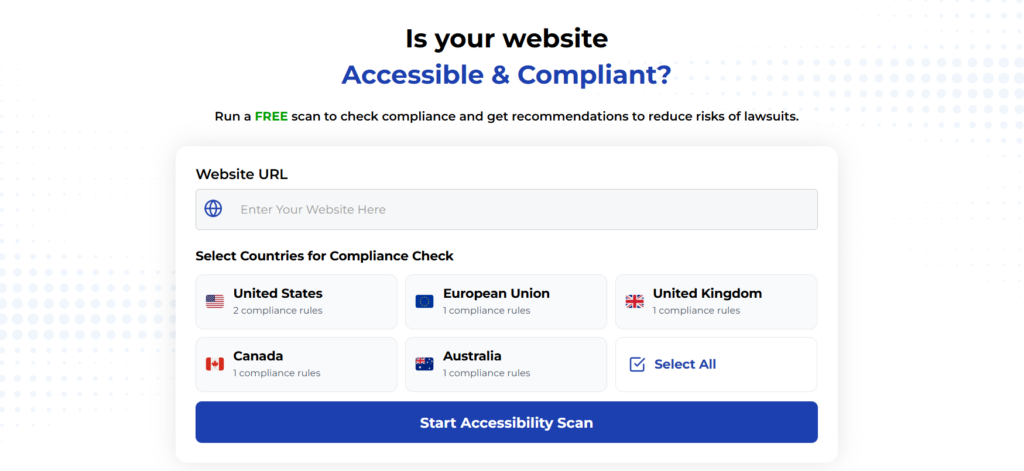
Using Automated Tools for Quick Insights (Accessibility-Test.org Scanner)
Automated testing tools provide a fast way to identify many common accessibility issues. They can quickly scan your website and point out problems that might be difficult for people with disabilities to overcome.
Visit Our Tools Comparison Page!
Run a FREE scan to check compliance and get recommendations to reduce risks of lawsuits
Final Thoughts
Government website accessibility under Section 508 requires more than technical compliance—it demands systematic approaches to testing, procurement, documentation, and ongoing monitoring. Federal agencies and their contractors must stay current with evolving standards while building internal capacity for long-term accessibility success .
The stakes are too high for a reactive approach . Citizens depend on government websites for essential services, and accessibility barriers can prevent people from accessing benefits, applying for jobs, or participating in civic life. By taking Section 508 seriously and implementing thorough compliance processes, government organizations can serve all Americans effectively while protecting themselves from legal and reputational risks. Ready to test your government website’s Section 508 compliance? Try our free accessibility scanner to identify potential barriers and get actionable recommendations for improvement. Don’t wait for problems to find you—take control of your accessibility compliance today.
Want More Help?
Try our free website accessibility scanner to identify heading structure issues and other accessibility problems on your site. Our tool provides clear recommendations for fixes that can be implemented quickly.
Join our community of developers committed to accessibility. Share your experiences, ask questions, and learn from others who are working to make the web more accessible.