



What is Alt Text, Really?
Let’s get one thing straight: alternative text, or “alt text,” isn’t just a technical fix or a minor detail for web developers. It’s a fundamental part of creating a web that works for people. At its core, alt text is a written description of an image that is read aloud by screen readers for users with visual impairments. It also appears in place of an image if the file fails to load and gives search engines important context about your page content.
Think of it this way: when you add an image to your website, you’re telling a visual story. But without good alt text, a whole segment of your audience misses the punchline. They’re left guessing, and that’s a frustrating experience. Have you ever listened to a podcast where the audio cut out right at a critical moment? That’s what navigating a website with missing or poorly written alt text feels like for millions of people.
I once worked with an e-commerce company that sold beautiful, handcrafted furniture. Their product pages were filled with stunning photography. The problem? The alt text for a gorgeous oak dining table simply said, “table.” A potential customer using a screen reader had no idea if it was a rustic farmhouse table or a sleek, modern one. They couldn’t tell what kind of wood it was made from or what the finish looked like. The sale was lost, not because the product was wrong, but because the description failed to create a connection. This is why getting alt text right matters so much. It’s about communication, inclusion, and, ultimately, better user experiences.
Why Does Meaningful Alt Text Matter So Much?
It’s easy to dismiss alt text as a low-priority task, but its impact is far-reaching. Getting it right helps your audience, your brand, and even your bottom line. Let’s break down the three main reasons why you can’t afford to ignore it.
First and foremost, it’s about accessibility for screen reader users. For people who are blind or have low vision, the web is primarily an auditory experience. A screen reader moves through the code of a webpage, reading out the text content. When it reaches an image, it looks for the alt attribute. If that attribute is descriptive, the user gets a clear picture of what’s happening. If it’s empty, generic, or just a filename, they hit a wall. Imagine trying to assemble a piece of furniture, but the instruction manual is missing all the diagrams. You’d probably give up. That’s the barrier that bad alt text creates.
SEO
Second, alt text is important for search engine optimization (SEO). Search engines like Google are incredibly smart, but they still can’t “see” images the way humans do. They rely on text-based cues to understand what a page is about. Alt text gives them valuable information about the content of your images, which helps them rank your page for relevant search queries. When your alt text is descriptive and includes relevant terms naturally, you’re not just helping users with disabilities; you’re telling search engines exactly what your content is about. This can lead to better visibility in both standard search results and image searches.
Finally, alt text serves as a failsafe for everyone. Have you ever visited a website on a shaky internet connection and seen those little broken image icons? Or maybe you’ve received an email where the images were blocked by default for security reasons. In these cases, the browser displays the alt text instead of the image. If the alt text is well-written, the user can still understand the message. If it’s missing, the content loses its meaning. It’s a simple backup that makes your website more dependable and user-friendly for every single visitor, regardless of their abilities or technical circumstances.
The Most Common Alt Text Mistakes I See Every Day
Writing good alt text is a skill, and like any skill, it takes a bit of practice. Unfortunately, many websites are filled with common mistakes that undermine the user experience. These aren’t just minor slip-ups; they can make a site confusing or downright unusable. Here are some of the most frequent errors I encounter during accessibility audits.
One of the worst offenders is keyword stuffing. This happens when someone tries to cram as many SEO keywords as possible into the alt attribute. For example, for an image of a red running shoe, the alt text might read: alt=”red running shoe sneaker footwear best running shoe for sale cheap.” A screen reader would read this entire string of words aloud, creating a nonsensical and annoying experience. It’s a classic case of prioritizing perceived SEO gains over real human users, and ironically, modern search engines are smart enough to penalize this kind of behavior.
Another frequent problem is being too vague. I often see alt text like alt=”picture” or alt=”graph”. This tells a user nothing. What is the picture of? What data is the graph showing? It’s the digital equivalent of pointing at something and saying, “Look at that thing over there.” It’s not helpful. The goal is to provide the same level of understanding that a sighted user would get from looking at the image.
Don’t Overdo It
On the flip side, some people go too far and describe every single detail. For a team photo, you don’t need to describe the color of everyone’s shoes or the pattern on the carpet. This level of detail is overwhelming and makes it hard for the user to grasp the main point of the image. Good alt text is concise. It focuses on what’s important within the context of the page.
And of course, there’s the classic mistake of using the image file name as alt text, like alt=”IMG_8754.JPG”. This is completely meaningless to a user and signals that no one took the time to make the content accessible. It’s often the default setting in some content management systems, so it’s something you have to actively check for and fix.
Context is King: How to Write Alt Text for Different Images
Not all images are created equal. The way you write alt text should change based on the image’s purpose on the page. A decorative background image requires a different approach than a complex data chart. Understanding these distinctions is the key to mastering alt text. Let’s walk through the main types of images and how to handle each one.
Informative Images
These are the most common types of images. They include photos and illustrations that support the surrounding text and add new information. The goal here is to describe what’s in the image concisely. Think about what you would say if you were describing the image to someone over the phone.
- Bad: alt=”man at computer”
- Good: alt=”A young designer sketches on a tablet in a brightly lit office.”
- Why it’s better: The second version gives context. It tells us about the person’s profession, their action, and the environment, which adds to the story of the page.
Functional Images
Functional images are used for an action, most often as links or buttons. Think of a magnifying glass icon for a search button or a company logo that links back to the homepage. For these images, the alt text should describe the function or destination, not the image itself.
Why it’s better: A screen reader user needs to know what will happen when they click the image. “Search” tells them the button’s purpose. “Magnifying glass” just describes its appearance, which isn’t the most important piece of information.
For a search button icon:
- Bad: alt=”magnifying glass”
Good: alt=”Search”
For a social media icon linking to your Twitter profile:
- Bad: alt=”blue bird”
Good: alt=”Follow us on X”
Complex Images
This category includes charts, graphs, maps, and infographics. These images contain a lot of detailed information that can’t be summed up in a short alt text phrase. Trying to cram it all in would be overwhelming for a screen reader user.
The best practice here is a two-part approach. First, use the alt text to give a brief summary of the image’s topic. Then, provide the full, detailed description in the text on the page, either right below the image or in a linked transcript.
- For a bar chart showing website traffic:
- Alt text: alt=”Bar chart showing a 50% increase in website traffic from January to June.”
- On-page text: Below the chart, include a full data table with the exact monthly traffic numbers. This gives everyone access to the same information, just in different formats.
Decorative Images
What about images that are purely for decoration? These might be background patterns, stylistic borders, or abstract shapes that don’t add any real information to the page. If a screen reader announced every single one of these, it would create a lot of unnecessary noise and make it harder to get to the important content.
For decorative images, you should use a null (or empty) alt attribute. It looks like this: alt=””.
When a screen reader encounters an empty alt attribute, it knows the image is decorative and simply skips over it. This is very different from having no alt attribute at all. If the attribute is missing entirely, some screen readers will try to guess by reading the image’s file name, which is exactly what you want to avoid. Using alt=”” is a clear signal that the image is not important to the content.
My Step-by-Step Process for Writing Better Alt Text
Over the years, I’ve developed a simple, repeatable process for writing alt text that works. It forces you to pause and think about the user, rather than just filling in a required field. You can use this for your own website to make sure your image descriptions are consistently helpful.
Step 1: Ask “Why is this image here?”
Before you write a single word, take a moment to understand the image’s purpose. What role is it playing on the page? Is it there to show what a product looks like? Evoke a certain emotion? Is it illustrating a step in a tutorial? The “why” will determine what information is most important to convey. An image of a smiling customer on a testimonials page serves a different purpose than a screenshot in a software setup article.
Step 2: Identify the Essential Information
Now that you know the image’s purpose, decide what a user absolutely needs to know about it. You can’t describe everything, so focus on the details that matter most in the context of the page. If it’s a product photo, the essential information is what the product looks like. If it’s a photo of a person, their identity and what they are doing are likely the most important details. Jot down a few key points.
Final Steps
Step 3: Draft a Concise Description
Using your key points, write a short, clear sentence or two. Read it out loud. Does it make sense? Does it sound natural? Avoid jargon and overly complex language. Aim for the kind of simple, direct language you would use when talking to a friend. Remember to leave out phrases like “an image of” or “a picture of,” since the screen reader will already announce that it’s an image.
Step 4: Review and Refine in Context
Finally, read your alt text in the context of the surrounding text on the page. Does it add to the content or just repeat what’s already there? Good alt text should complement the written content, not duplicate it. For example, if you have a caption that already describes the image in detail, the alt text can be shorter or focus on a different aspect. Sometimes, you’ll realize the image is purely decorative and should have an empty alt attribute instead. This final check ensures everything works together smoothly.
How to Audit the Alt Text on Your Own Website
Feeling inspired to fix the alt text on your site? That’s great! But the thought of checking every single image can feel overwhelming, especially on a large website. The trick is to start small and be methodical. Here’s a practical way to conduct an alt text audit without getting lost.
First, you don’t need to check every page at once. Start with your most important pages. This usually means your homepage, your main product or service pages, your “about” page, and any key landing pages that get a lot of traffic. Fixing the accessibility on these high-impact pages will deliver the most benefit to the most users right away. Make a list of these top-tier pages to create a manageable starting point.
Next, you’ll need a way to actually see the alt text. You don’t need fancy software for this. Most web browsers have built-in developer tools that make it easy. In Chrome or Firefox, you can simply right-click on an image and choose “Inspect.” This will open up a panel showing you the page’s HTML code, with the <img> tag for that specific image highlighted. You can look right at the alt attribute to see what it says.
Questions To Ask
As you go through each image on your priority pages, ask yourself a few questions:
- Is there an alt attribute? If not, it’s a critical error.
- If so, is it empty (alt=””)? If it is, is the image truly decorative? If it conveys information, it needs a description.
- Does the description accurately represent the image?
- Is it concise and free of keyword stuffing?
- Does it make sense in the context of the page?
Create a simple spreadsheet to track your findings. List the page URL, the image, the current alt text, and what the new, improved alt text should be. This gives you a clear action plan for you or your development team to work from. Once you’ve tackled your priority pages, you can slowly work your way through the rest of the site. And don’t forget to make this a part of your regular content creation process, so new images are always added with great alt text from the start.

Ready to Make a Change?
We’ve covered a lot, from the basics of what alt text is to the nitty-gritty of writing it for different situations. It might seem like a lot to remember, but it all comes down to a single, simple idea: empathy. Writing good alt text is about putting yourself in the shoes of someone who experiences the web differently than you do. It’s a small act of consideration that can make a world of difference.
When you take the time to write a meaningful description, you’re not just making your site compliant with WCAG standards; you’re making it more welcoming. You’re telling every user that you value their experience. So, the next time you upload an image to your website, I challenge you to pause for just 30 seconds and think about the story that image tells. How can you share that story with everyone?
Using Automated Tools for Quick Insights (Accessibility-Test.org Scanner)
Automated testing tools provide a fast way to identify many common accessibility issues. They can quickly scan your website and point out problems that might be difficult for people with disabilities to overcome.
Visit Our Tools Comparison Page!
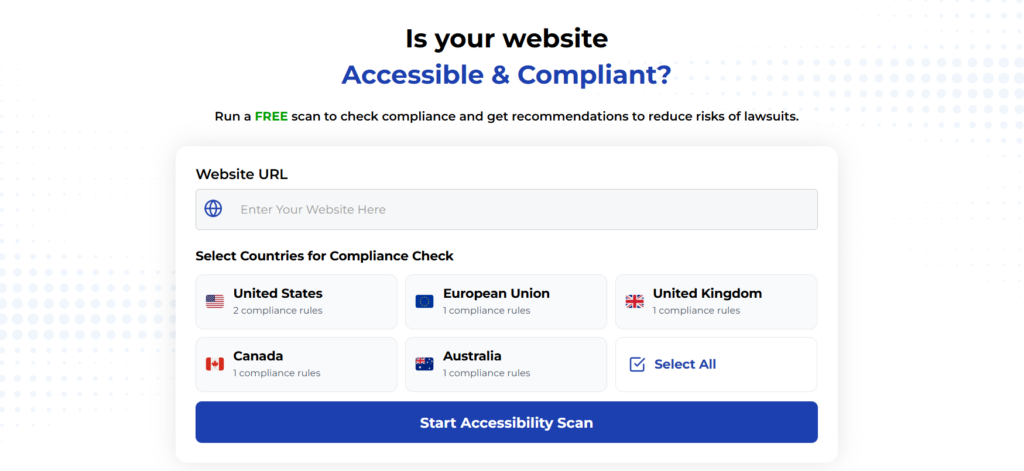
Run a FREE scan to check compliance and get recommendations to reduce risks of lawsuits
Final Thoughts
A great first step is to see where your website stands right now. You can use tools like the Accessibility-Test.org Scanner to get a quick overview of potential issues, including missing alt text. Use it as your starting point, but don’t stop there. Use what you’ve learned here to go beyond the scan and turn your website into a place that truly works for everyone.
Run a Free Scan to Find E-commerce Accessibility Barriers
Curious about where your site stands? An automated scan is a great first step to identify potential accessibility issues on your e-commerce platform. Run a free scan on our website today to get an initial report on your site’s accessibility health.
Want More Help?
Try our free website accessibility scanner to identify heading structure issues and other accessibility problems on your site. Our tool provides clear recommendations for fixes that can be implemented quickly.
Join our community of developers committed to accessibility. Share your experiences, ask questions, and learn from others who are working to make the web more accessible.