



Siteimprove Review
Managing a handful of accessibility errors on a small website is one thing. But what happens when you’re responsible for a site with thousands of pages, dozens of content editors, and multiple development teams? The task of making sure your digital presence is usable for people with disabilities can quickly become overwhelming. This is where dedicated platforms for accessibility monitoring come into play, and Siteimprove is a prominent name in this space. For large businesses, moving from occasional checks to a structured, platform-based approach isn’t just a good idea, it’s necessary for making real, sustainable progress toward WCAG 2.2 compliance.
How to Manage Enterprise Web Accessibility with Siteimprove
Keeping a large, dynamic website accessible requires more than just good intentions. It demands a system, a process, and tools that give you visibility across your entire digital footprint. A platform like Siteimprove is designed to provide this structure, helping organizations turn a chaotic, reactive process into a proactive accessibility program. It’s about creating a single source of truth for your accessibility status, assigning clear ownership for fixing issues, and tracking progress over time. This shifts the effort from a small, dedicated team to a shared responsibility across the organization, which is the only way to succeed at scale.
Why Large Organizations Need Platform-Level Monitoring
For any enterprise, managing digital quality is a serious challenge. Websites are no longer simple online brochures; they are complex applications with content managed by people across different departments. Without a centralized system to watch over this complexity, accessibility issues can multiply unchecked. Platform-level monitoring tools give you the bird’s-eye view needed to get a handle on the problem before it spirals out of control.
Moving Past Single-Page Scans to Site-Wide Visibility
Running a free accessibility checker on your homepage is a fine starting point. It might catch a few obvious problems, like low-contrast text or missing alt text on your logo. But what about the thousands of other pages buried deep in your site architecture? Your product pages, your blog archives, your support articles, and your user account settings are all part of the user experience. A single-page scan can’t tell you if a systemic issue, like an inaccessible navigation menu, affects every single page.
This is the core value of a platform like Siteimprove. It crawls your entire website, much like a search engine bot, and tests every page it finds against WCAG standards. This gives you a complete inventory of your accessibility health. You can finally see the true scope of your challenges, identify patterns of errors, and understand which parts of your site need the most urgent attention. Are all of your blog posts missing headings? Do your product filtering tools fail keyboard navigation? These are the kinds of site-wide insights that single-page scans will always miss.
Creating Team Ownership and Tracking Progress
When nobody owns a problem, the problem never gets fixed. In large organizations, it’s common for accessibility to be seen as “someone else’s job.” Developers might blame content editors for empty links, while content editors might not even know they are responsible for writing alt text. An enterprise accessibility solution helps put an end to this cycle of confusion.
With a platform, you can create a system of accountability. You can assign specific issues or groups of pages to the relevant teams or individuals. For example, all accessibility problems within the “Careers” section can be assigned to the HR content team. All issues related to forms can go to the front-end development team. Siteimprove then allows you to track progress against these assignments. You can see which teams are actively fixing problems and which might need more training or support. This turns accessibility from a vague ideal into a measurable part of everyone’s job, complete with dashboards that show clear progress over time.

The Problem with Ad-Hoc Testing in Big Companies
Without a platform, accessibility testing in large companies often becomes a series of disjointed, one-off efforts. A team might run an accessibility audit before a major product launch, fix the reported issues, and then forget about it for another year. This ad-hoc approach is incredibly inefficient. The same problems often get reintroduced with the next site update because there’s no system in place to prevent them. It’s a bit like mopping up a leak without fixing the pipe.
A monitoring platform shifts this process from reactive to proactive. Instead of waiting for an audit to tell you what’s broken, the platform constantly scans your site and alerts you to new issues as they appear. This continuous accessibility monitoring allows you to catch problems early, often before they even impact a real user. It creates a baseline for your website’s health, so you can ensure that every new feature or content update doesn’t undo the progress you’ve already made. This systematic approach is far more effective and less costly than running expensive, fire-drill audits every six months.
Getting Siteimprove Set Up for Meaningful Results
Just buying a subscription to an accessibility platform won’t magically fix your problems. The tool is only as good as the strategy you build around it. Setting it up correctly from the start is what separates organizations that get real value from those that just get another dashboard to ignore. A thoughtful setup ensures the data you receive is relevant, the tasks are actionable, and the right people are held accountable.
Configuring Crawls to Match Your Business Priorities
Not all pages on your website are created equal. Your homepage, checkout process, and top landing pages are likely far more important to your business than a blog post from five years ago. A powerful feature within platforms like Siteimprove is the ability to customize how it crawls your site. Instead of treating all pages the same, you can group them based on business importance, user traffic, or section ownership.
For example, you can create a group for all your marketing landing pages and another for your customer support portal. This allows you to focus your initial efforts on the most critical user journeys. You can set stricter goals for these high-priority sections and run more frequent scans on them. By configuring your crawls to mirror your business structure, you ensure that your teams are spending their time fixing the issues that have the biggest impact on your users and your bottom line. It’s about working smarter, not just harder.
Assigning Roles to Create Accountability
Clear roles and responsibilities are the bedrock of any effective accessibility program. A platform like Siteimprove allows you to move beyond a single “admin” user and create a permission structure that reflects your organizational chart. You can define roles for different types of users, giving them access to only the information and tools they need to do their jobs.
A content editor, for instance, doesn’t need to see technical issues related to your site’s JavaScript framework. You can give them a simplified view that only shows content-related problems, like missing alt text or confusing link descriptions, on the pages they personally manage. A developer, on the other hand, can be given a more technical view with access to code-level suggestions. This role-based access reduces noise and makes the information more relevant to each person. When users log in and see a short, manageable list of issues that are clearly their responsibility, they are far more likely to take action.

Integrating with Your Existing Tools (Jira, etc.)
An accessibility platform shouldn’t be another isolated silo of information. To be truly effective, it needs to fit into the workflows your teams already use every day. Many development teams live inside project management tools like Jira or Azure DevOps. The best accessibility platforms, including Siteimprove, offer integrations that can push accessibility issues directly into these systems.
When the platform finds a bug, it can automatically create a Jira ticket, pre-populate it with all the relevant details, and assign it to the correct development team. This means developers don’t need to learn yet another tool or remember to log into a separate dashboard. The accessibility tasks appear in their existing backlog, right alongside their other work. This simple integration dramatically lowers the friction of getting technical issues fixed. It makes accessibility a natural part of the development process, not a separate, annoying task to be dealt with later.
Using Platform Rules for WCAG 2.2 and Beyond
Automated accessibility testing is built on a set of rules that check for violations of standards like WCAG 2.2. While Siteimprove comes with a great set of pre-built rules, its true power for enterprise users comes from the ability to customize and expand upon them. Every organization is unique, with its own design system, content types, and business requirements. Tailoring the platform’s rule set to match your specific context is how you make it a truly effective governance tool.
Making Custom Policies for Your Unique Content
WCAG provides the foundation, but it can’t cover every possible scenario specific to your website. Imagine your company has a strict branding rule that all author headshots on your blog must have alt text that includes the author’s name and title. This isn’t a WCAG rule, but it’s an important quality standard for your organization. With a platform like Siteimprove, you can create a custom policy to enforce this.
You can write a rule that checks every <img> tag within the author bio component to make sure the alt text follows your required format. If a content editor forgets, the platform will flag it as a policy violation. This is incredibly useful for maintaining consistency and quality at scale. You can create custom policies for almost anything: checking for placeholder text in forms, ensuring legal disclaimers are present on certain pages, or flagging outdated terminology. This turns the platform from a simple WCAG compliance checker into a powerful digital governance engine tailored to your business.
Setting Service Level Agreements (SLAs) Your Teams Can Hit
Finding accessibility issues is only half the battle; you also need a process for making sure they get fixed in a timely manner. Service Level Agreements, or SLAs, are a way to set clear expectations for remediation. In Siteimprove, you can define these SLAs based on the severity of the issue. For example, you might decide that all critical issues (like a non-functional checkout button) must be fixed within 24 hours, while minor issues (like a slightly off-color link) can be fixed within 30 days.
These SLAs add another layer of accountability. The platform can track how long an issue has been open and automatically escalate it if the deadline is approaching. This helps managers identify bottlenecks and understand where teams might be struggling. The key is to set realistic SLAs. If you demand that everything be fixed immediately, your teams will quickly become overwhelmed and disengaged. Work with your teams to establish targets that are both ambitious and achievable, creating a sustainable pace of improvement.
Prioritizing Issues Based on Severity and Impact
A raw list of thousands of accessibility errors isn’t very helpful. It’s overwhelming and provides no clear starting point. Effective prioritization is essential. Accessibility platforms categorize issues based on severity, typically mapping them to WCAG levels (A, AA, AAA). This is a good first step, but a more advanced approach also considers the issue’s impact.
A minor color contrast issue on your privacy policy page is far less impactful than a keyboard trap on your login page. Siteimprove helps you combine these factors to create a prioritized to-do list. You can focus on issues that are both severe and located in high-traffic, critical sections of your site. This ensures that you are always working on the problems that cause the most friction for the most users. It moves the conversation from “we have 10,000 issues” to “here are the 20 most important issues we need to fix this week.” That’s a conversation that leads to real action.
Combining Platform Data with Manual Testing
Automated tools are powerful, but they can’t catch everything. No platform can tell you if your link text is genuinely descriptive or if your page’s reading order makes sense to a screen reader user. Automated testing is brilliant at finding technical errors with clear pass/fail conditions. But assessing the quality of the human experience still requires a human. The most mature accessibility programs pair the scale of an automated platform like Siteimprove with the depth of regular manual testing.
Building a Rhythm for Monthly Screen Reader Checks
One of the most important manual tests is to navigate your key user journeys with a screen reader, just as a user who is blind would. This simple exercise often reveals issues that automated tools miss completely. Does the screen reader announce when a new item is added to the shopping cart? Can you understand the layout of your data tables? Are form field labels clearly associated with their inputs?
You don’t need to test every page this way. Instead, identify your five to ten most critical user flows, like registering for an account, purchasing a product, or finding contact information. Then, create a schedule to test these flows with a screen reader once a month. This regular rhythm ensures that you’re constantly evaluating the actual usability of your site, not just its technical compliance. Documenting your findings and sharing them with your development teams provides invaluable context that goes beyond a simple automated report.
Creating Keyboard Testing Workflows That Actually Get Done
Another essential manual check is to unplug your mouse and try to use your website with only a keyboard. This simulates the experience of users with motor disabilities who cannot operate a mouse. Can you see a visible focus indicator as you tab through the page? Can you operate all interactive elements, like dropdown menus and sliders? Are there any “keyboard traps” where your focus gets stuck in a component and you can’t escape?
Like screen reader testing, this doesn’t have to be an overwhelming task. Integrate keyboard testing into your existing processes. For example, make it a required step in your definition of “done” for any new feature. Before a new component can be released, a developer or QA tester must verify that it is fully keyboard accessible. By embedding this workflow directly into your development cycle, you make it a routine quality check, not an extra chore. This prevents keyboard accessibility issues from ever making it into production in the first place.
Using Manual Findings to Educate Your Content Editors
Manual testing isn’t just about finding bugs; it’s also a powerful training tool. When you find an issue, like a page with a completely illogical heading structure, don’t just fix it. Use it as a learning opportunity. Take a screenshot, record a short video of the screen reader struggling with the page, and share it with the content team responsible.
This kind of concrete, practical feedback is far more effective than a generic training session about accessibility theory. When a content editor sees how their choices directly impact a user’s ability to navigate the page, the lesson sticks. You can use findings from your manual tests to build a library of real-world examples of what to do and what not to do. This helps scale your accessibility knowledge across the organization, empowering everyone to create better content from the start. A platform like Siteimprove can even be used to track these manual findings, assigning them to editors for correction and review.
Using Automated Tools for Quick Insights (Accessibility-Test.org Scanner)
Automated testing tools provide a fast way to identify many common accessibility issues. They can quickly scan your website and point out problems that might be difficult for people with disabilities to overcome.
Visit Our Tools Comparison Page!
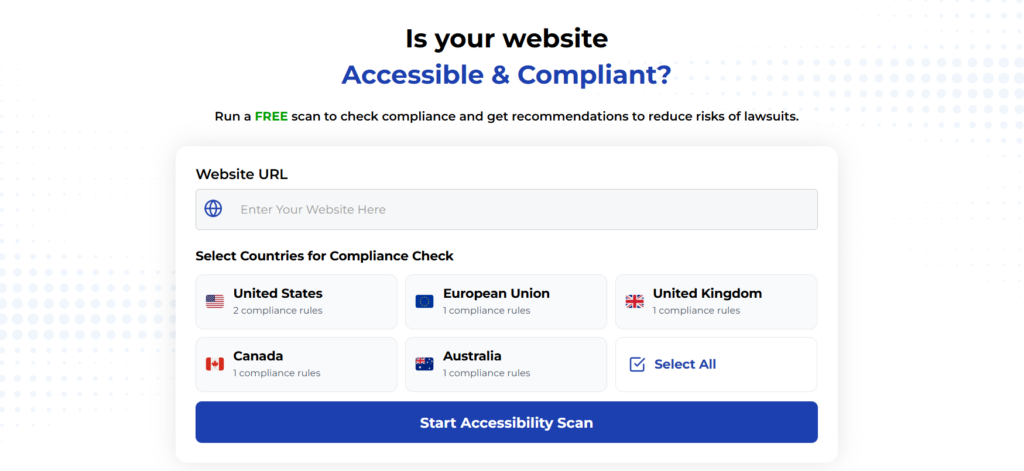
Run a FREE scan to check compliance and get recommendations to reduce risks of lawsuits
Final Thoughts
In the end, a tool like Siteimprove is an investment in process. It provides the structure, data, and workflows needed to manage the complex job of web accessibility in a large organization. But the tool itself doesn’t create an accessible website. People do. By pairing the platform’s powerful monitoring capabilities with a committed team and smart, sustainable workflows for both automated and manual testing, you can make lasting improvements that benefit all of your users.
Ready to see where your own site stands? Start by running a check with our free website accessibility scanner to get a quick snapshot of your most pressing issues.
Start your compliance journey, update your accessibility statement, and keep EAA top of mind in every project going forward.
Run a Free Scan to Find E-commerce Accessibility Barriers
Want More Help?
Try our free website accessibility scanner to identify heading structure issues and other accessibility problems on your site. Our tool provides clear recommendations for fixes that can be implemented quickly.
Join our community of developers committed to accessibility. Share your experiences, ask questions, and learn from others who are working to make the web more accessible.