



Embedding Accessibility into Your API
Application Programming Interfaces (APIs) are the unsung heroes of the digital age, piping content and data to everything from websites and mobile apps to smartwatches and kiosks. As developers build these sophisticated data pipelines, they often overlook a critical question: have we designed our APIs to be accessible?
API accessibility doesn’t center on how developers use the API itself. Instead, it focuses on how the data an API delivers enables client applications; like websites and mobile apps; to create accessible experiences for end-users. This approach means thinking about accessibility at the source, making the information that assistive technologies need a fundamental part of your data structure, not an afterthought.
What is API Accessibility and Why Does It Matter?
When we talk about web accessibility, the conversation usually centers on front-end code: semantic HTML, ARIA attributes, color contrast, and keyboard navigation. These are all incredibly important. But where does the content for that front-end come from? In many modern systems, it comes from an API.
An API acts as a messenger, fetching content and data from a backend system, like a Headless CMS, and delivering it to a client application. If that messenger forgets to carry the accessibility information along with the content, the front-end developer is left scrambling to fill in the gaps. This often leads to inconsistent or incomplete accessibility.
Have you ever considered how your data architecture could be creating barriers for users with disabilities? It’s a question that shifts the responsibility for accessibility further upstream, embedding it deep within your technical stack.
Beyond the Front-End | Accessibility at the Source
Thinking about accessibility at the API level is a move from reactive to proactive design. Instead of fixing accessibility issues on the website, you prevent them from ever happening by ensuring the data itself is complete. For example, every image on your website needs alternative (alt) text for screen reader users.
Where should that alt text live? It shouldn’t be hardcoded in the front-end. It should be a required field in your content management system, stored right alongside the image URL. When a client application requests image data from your API, the API should deliver both the URL and its corresponding alt text. If the alt text is missing, the API response itself is incomplete.
This approach makes accessibility a non-negotiable part of your content. It stops being a “nice-to-have” feature and becomes a core requirement of your data model. Ensuring the source is accessible means every application built on top of it has a head start on WCAG compliance.
The API as a Contract for Inclusivity
A well-designed API functions as a contract between the backend (your data) and the frontend (the user experience). This contract should explicitly include accessibility requirements. When a front-end developer uses your API, they should know exactly what data they will receive and trust that it includes the necessary information to build an accessible interface.
This contract might specify things like:
- Every image object will have an altText field.
- Every video object will include a link to a captions file or a transcript.
- Content designated as a “heading” will include its hierarchical level (e.g., level 2, level 3).
- Form field objects will include associated labels and instructions.
By defining these requirements at the API level, you create a shared understanding across teams. Backend developers know what data they must provide, and front-end developers know what data they can expect. It turns your API into a powerful checkpoint for ensuring your digital products are built on an inclusive foundation.
API Design Patterns for Accessibility Support
Designing an API that supports accessibility isn’t about adding a few extra fields. It requires a deliberate approach to how you structure and deliver data. The goal is to give front-end developers the raw, meaningful information they need to construct a fully accessible user interface, regardless of the platform.
Delivering Structured Data, Not Just Content
One of the most common mistakes in API design is delivering content as a pre-formatted block of HTML. This might seem convenient, but it undermines the flexibility of modern architectures and can lock in accessibility problems. For instance, if the API sends a chunk of text that includes <b> tags for emphasis, the front-end developer can’t easily change that to a more semantically appropriate <strong> tag.
A better method is to deliver content as structured data, often using a format like JSON. Instead of sending a block of HTML, the API sends a structured object that describes the content’s meaning and hierarchy.
For example, instead of this:
“content”: “<h2>Our Mission</h2><p>We aim to do great things.</p>”
Your API should send something like this:
“content”: [
{ “type”: “heading”, “level”: 2, “text”: “Our Mission” },
{ “type”: “paragraph”, “text”: “We aim to do great things.” }
]
This approach gives the front-end developer complete control. On a website, they can map this data to the correct <h2> and <p> tags. In a native mobile app, they can use it to populate native heading and text components that are accessible by default on iOS and Android. This preserves the semantic structure and ensures a consistent, accessible experience across all channels.
Making Alt Text a First-Class Citizen
Alternative text for images is one of the most fundamental requirements of web accessibility. It’s not optional, and your API design should reflect that. The alt text for an image is as important as its source URL.
Therefore, your API should never send an image object that only contains a URL. It should treat the alt text as a required, top-level property of the image.
A poor API response for an image might look like this:
“heroImage”: “https://example.com/image.jpg”
A much better, accessibility-focused response would be:
“heroImage”: {
“url”: “https://example.com/image.jpg”,
“altText”: “A smiling team of developers collaborating around a laptop.”
}
By structuring the data this way, you make it clear that the alt text is essential.
Handling Complex Components and ARIA Roles
Modern interfaces are built with more than just headings and paragraphs. They include complex components like accordions, tabs, and carousels. An accessible API should provide the necessary information to build these components correctly.
This means your API might need to deliver data that helps developers implement ARIA (Accessible Rich Internet Applications) attributes. For example, if you’re delivering the content for a set of tabs, the API response could include the state of each tab.
Consider a tabbed interface. The API could send data like:
“tabs”: [
{ “id”: “tab1”, “label”: “Our Services”, “panelId”: “panel1”, “isSelected”: true },
{ “id”: “tab2”, “label”: “About Us”, “panelId”: “panel2”, “isSelected”: false }
]
This structured data tells the client application everything it needs to know to build an accessible tab component. The developer can use this to set the correct aria-selected, aria-controls, and role attributes, ensuring that screen reader users can understand and operate the interface.
Providing Metadata for Media and Interactive Elements
For multimedia content like audio and video, accessibility depends on providing alternatives like captions and transcripts. Your API must be designed to deliver these alternatives alongside the media itself.
An API response for a video shouldn’t just be a link to the video file. It should be a complete object containing all the necessary accessibility information.
An accessible video object might look like this:
“featuredVideo”: {
“videoUrl”: “https://example.com/video.mp4”,
“captionFileUrl”: “https://example.com/captions.vtt”,
“transcriptUrl”: “https://example.com/transcript.html”,
“description”: “A short video demonstrating how our product works.”
}
This gives the client application all the pieces it needs to build a fully accessible media player. The developer can easily add the captions track, provide a link to the full transcript, and ensure users with visual or hearing impairments can access the information.
API Documentation Accessibility Standards
Even the most perfectly designed API is useless if developers don’t know how to use it. That’s where documentation comes in. Your API documentation is the instruction manual for your developers, and just like any other digital content, it needs to be accessible. If a developer with a disability can’t read your documentation, they can’t use your API.
Why Your API Docs Need to Be Accessible
Developers are users too. Some developers use screen readers, some rely on keyboard navigation, and others may need to zoom in on text to read it comfortably. If your API documentation is presented in a way that creates barriers for them, you are excluding talented people from your developer community.
Furthermore, accessible documentation sets a powerful example. By making your own resources accessible, you demonstrate a genuine commitment to inclusivity. It shows that you practice what you preach and encourages the developers using your API to adopt the same mindset. Have you ever checked if your own documentation site meets WCAG standards? It’s a great place to start.
Clear Language and Actionable Examples
Accessibility in documentation isn’t just about technical compliance; it’s also about clarity. Avoid jargon where possible, and when you must use technical terms, explain them clearly. The goal is to make your documentation easy to understand for developers with different levels of experience.
Your examples are particularly important. They should be practical and easy to copy, but also accessible themselves. For instance, if you provide sample API responses, make sure they include the accessibility-related fields you’ve designed, like altText for images or level for headings. This reinforces the “accessibility contract” and shows developers exactly what a good, inclusive API call looks like.
Documenting Accessibility-Specific Endpoints and Parameters
If your API includes specific features designed to support accessibility, document them thoroughly. Be explicit about why these features exist and how to use them correctly.
For example, your documentation should clearly explain:
- Which fields in a response contain accessibility information (e.g., “The altText field is required for all image objects and should contain a concise description of the image.”).
- How to request data in a structured format that preserves semantic meaning.
- Any parameters that might affect the accessibility of the response (e.g., a parameter to request a text transcript for a video).
Don’t bury this information. Create a dedicated “Accessibility” section in your documentation that gathers all this information in one place. This makes it easy for developers to find what they need and signals that accessibility is a priority for your team.
Using Accessible Formats for Documentation
The platform you use to host your documentation matters. It should generate clean, semantic HTML that follows a logical heading structure (H1, H2, H3) so that screen reader users can easily navigate the pages.
Other considerations for an accessible documentation platform include:
- Good Color Contrast: Text should be easy to read against its background.
- Keyboard Navigability: All links, buttons, and controls should be operable using only the keyboard.
- Resizable Text: Users should be able to increase the text size without breaking the layout.
- Accessible Tables: If you use tables to display information like endpoint parameters, ensure they are marked up correctly with headers so screen reader users can understand the data.
By ensuring your documentation itself is accessible, you create a more inclusive environment for all developers and set the stage for more accessible applications being built with your API.
Error Handling and Response Accessibility Considerations
Things go wrong. A client might send a malformed request, a server might time out, or the requested data might not exist. How your API communicates these errors is a point of accessibility. Clear, understandable error messages are essential for all users, but they are especially important for people using assistive technologies.
A generic “Error 400: Bad Request” message is frustrating for a sighted user. For a screen reader user, it can be a dead end, offering no clue as to what went wrong or how to fix it. A more accessible approach to error handling helps developers build front-ends that can gracefully manage problems and guide users toward a solution.
Moving Beyond Generic HTTP Status Codes
HTTP status codes (like 404 Not Found or 500 Internal Server Error) are a good starting point, but they are not enough for creating a user-friendly experience. They tell the developer what category of error occurred, but they don’t explain why it happened.
Your API should always accompany a status code with a detailed error response body. This response should provide context that a developer can use to either fix their code or display a helpful message to the end-user. Relying on the status code alone forces the developer to guess, which often results in them showing a generic and unhelpful error message like “An error occurred.”
Crafting Human-Readable Error Messages
The error messages within your API response should be written for humans. Avoid technical jargon and cryptic codes. The message should clearly explain the problem in plain language.
Let’s say a user is trying to sign up for an account but enters an email address that’s already in use.
A poor error response might be:
{ “error”: “duplicate_key_exception” }
A much better, more accessible response would be:
{
“errorCode”: “USER_ALREADY_EXISTS”,
“message”: “This email address is already registered. Please try logging in or use a different email address.”
}
This message is clear, actionable, and free of technical jargon. A front-end developer can display this message directly to the user, who immediately understands the problem and knows how to solve it. This respects the user’s time and reduces frustration.
Structuring Error Responses for Assistive Tech
Just like successful responses, your error responses should be structured. A consistent error structure makes it easier for developers to write code that handles problems reliably. It also allows them to extract specific pieces of information to present to users in an accessible way.
A good, structured error response might include:
- A unique error code: A stable, machine-readable identifier for the specific error (e.g., INVALID_API_KEY).
- A human-readable message: A clear explanation of the error, as described above.
- The specific field in error: If the error relates to a specific input field, your API should identify it (e.g., “field”: “emailAddress”). This allows the front-end to highlight the correct field and associate the error message with it programmatically, which is a great for screen reader users.
- A link to documentation: For more complex errors, you could include a URL that points to a page in your API docs with more detailed information.
By providing this level of detail, you empower developers to build truly helpful error-handling flows. They can programmatically associate an error message with its corresponding form field, which allows a screen reader to announce “Error: This email address is already registered” when the user focuses on the email input.
Differentiating Between Client and Server Errors
It’s important to distinguish between client errors (4xx codes) and server errors (5xx codes) in your responses.
- Client Errors (4xx): These are the user’s or the developer’s fault. The request was invalid in some way (e.g., missing a required field, using an invalid format). For these errors, the message should be user-focused and explain how to fix the request.
- Server Errors (5xx): These are your fault. Something went wrong on your end. For these errors, you should not expose sensitive internal details. Instead, provide a simple, apologetic message like, “We’re sorry, but something went wrong on our end. Please try again in a few moments.” You should, however, log the detailed internal error on your server so your team can investigate and fix it.
This distinction is key for both security and user experience. Exposing server-side stack traces can be a security risk, while blaming the user for a server failure is just bad form.
API Testing for Accessibility Compliance
You’ve designed your API with accessibility in mind, created accessible documentation, and planned for helpful error responses. But how do you ensure it all works as intended and continues to work as your system evolves? The answer is testing. Integrating accessibility checks into your API testing process is the best way to enforce your “accessibility contract” and catch issues before they reach users.
Integrating Automated Scans into Your CI/CD Pipeline
Many organizations use Continuous Integration/Continuous Deployment (CI/CD) pipelines to automate their build, testing, and release processes. This is the perfect place to add automated accessibility checks for your API.
You can write tests that make calls to your API endpoints and then inspect the responses to ensure they meet your accessibility requirements. These tests can be run automatically every time a developer commits new code. Tools that integrate with test automation suites can be used to weave these accessibility checks into existing QA processes.
For example, your automated tests could verify that:
- Every /images/{id} endpoint response includes a non-empty altText field.
- The /articles/{id} endpoint returns content in a structured JSON format, not as an HTML blob.
- Requests with invalid data return a properly structured 4xx error response with a human-readable message.
If a developer introduces a change that breaks one of these rules; for instance, by making the altText field optional; the automated test will fail. The build will be blocked, and the developer will be notified immediately. This creates a powerful feedback loop that prevents accessibility regressions from ever being deployed.
Contract Testing for Accessibility Requirements
Contract testing is a technique used to ensure that an API provider (like your backend) and an API consumer (like a front-end application) agree on how the API should behave. This is a perfect fit for enforcing your accessibility contract.
In contract testing, you define a “contract” that specifies the expected structure of API requests and responses. You can include all your accessibility-related fields in this contract. For example, the contract for your /products/{id} endpoint could state that the response must contain an array of images, and each image object must have a url and an altText property.
Both the front-end and backend teams then test their code against this shared contract. This ensures that the front-end team can rely on the accessibility data being present, and the backend team knows they can’t remove it without breaking the contract. It creates a shared responsibility for accessibility that is enforced by your testing suite.
The Role of Manual Checks for API-Driven Content
Automation is powerful, but it can’t catch everything. Automated tests are great at checking for the presence of data, but they can’t always judge its quality.
For example, an automated test can check that an altText field exists and is not empty. But it can’t tell you if the alt text is actually a good, meaningful description of the image. “Image” is not helpful alt text, but it would pass an automated check.
This is where manual checks become important. As part of your quality assurance process, it’s a good idea to periodically review the content being served by your API. This could involve having a content editor or accessibility specialist review a sample of images and their alt text from the CMS, or checking the transcripts provided for new videos. This human oversight helps ensure that the data being delivered by your API is not only technically compliant but also genuinely useful to end-users.
Using AI for More Advanced API Checks
The world of testing is constantly changing, and AI is beginning to offer new possibilities. AI-powered tools may soon be able to perform more sophisticated checks on API responses. For instance, an AI model could potentially analyze the content of an image and evaluate whether the provided alt text is an accurate and helpful description.
While this technology is still developing, it points to a future where API testing can become even smarter. AI could also be used to analyze error patterns, predict potential accessibility issues in new endpoints, or even suggest more user-friendly error messages based on the context of the request. Integrating AI into your testing could provide a deeper level of analysis, moving beyond simple presence checks to qualitative assessments.
Client Application Accessibility Integration Strategies
A perfectly accessible API is only half the story. The data it provides must be correctly used by the client application; the website or mobile app; to create an accessible user experience. This requires a strong partnership and clear communication between backend and front-end development teams.
The Developer’s Responsibility | Consuming Accessible Data
When a front-end developer receives a well-structured, accessibility-rich response from an API, they have a responsibility to use that data correctly. It’s not enough for the API to provide the alt text; the developer must ensure it gets rendered in the alt attribute of the <img> tag. It’s not enough for the API to specify a heading level; the developer must use it to generate the proper <h1> through <h6> tag.
This is where the “accessibility contract” becomes a two-way street. The backend team agrees to provide the data, and the front-end team agrees to implement it according to best practices. This shared understanding is the foundation of building an accessible product from end to end.
Mapping API Responses to Semantic HTML
The primary job of the front-end developer is to map the structured data from the API to semantic HTML. When the API delivers a response like { “type”: “heading”, “level”: 2, “text”: “Our Mission” }, the developer’s code should be smart enough to translate that into an <h2> element.
This mapping should be handled systematically. Developers can create reusable components that take the structured JSON from the API as input and render the correct, accessible markup as output. For example, they could have a single “Rich Text” component that knows how to render headings, paragraphs, lists, and blockquotes based on the type property in the API response.
This component-based approach has several advantages:
- Consistency: It ensures that the same type of content is always rendered in the same accessible way across the entire application.
- Maintainability: If you need to improve the accessibility of your headings, you only need to update the heading logic in one place.
- Efficiency: Developers don’t have to reinvent the wheel every time they display content from the API.
Graceful Degradation When Accessibility Data is Missing
Even with the best planning, sometimes data will be incomplete. What should a front-end developer do if the API response for an image is missing the altText field?
The application should fail gracefully. One approach is to treat missing accessibility data as a bug. The front-end code could be written to throw an error or log a warning to a monitoring service when it receives an image object without alt text. This alerts the team to a problem in the content or the API itself that needs to be fixed at the source.
In the meantime, the application should avoid rendering something that creates a worse experience. For a missing alt attribute, the best practice is often to render it as an empty string (alt=””) if the image is purely decorative. If the image is informative, the missing alt text represents a true content bug. This strategy of logging the error for a fix while preventing a bad user experience is a responsible way to handle unexpected data issues.
Building a Shared Understanding Between Teams
Ultimately, successful integration comes down to people. Backend and front-end developers need to be in regular communication. They should work together to design the API, agree on the “accessibility contract,” and discuss how the data will be used in the final interface.
This collaboration can be supported by:
- Shared Documentation: The API documentation should be the single source of truth for both teams.
- Joint Planning Sessions: When planning new features, both backend and front-end developers should be in the room to discuss the data requirements.
- Cross-functional Training: Educate both teams on the basics of web accessibility. When a backend developer understands why alt text is so important for screen reader users, they are more likely to make sure it’s always included in their API responses.
When teams work together with a shared goal of creating an inclusive product, the API stops being a simple data pipeline and becomes a powerful tool for building a more accessible web.
The Future of Accessible APIs
The conversation around API accessibility is still maturing, but the direction is clear. As digital experiences become more distributed and complex, the need for inclusive data interfaces will only grow. Looking ahead, we can see a few trends that are likely to shape the future of this space.
The Rise of Self-Documenting and Self-Testing APIs
In the future, we may see APIs that are even smarter about communicating their accessibility features. Imagine an API that can automatically generate its own accessible documentation based on its structure, complete with examples that highlight accessibility-related fields.
Similarly, APIs could come with built-in testing suites that automatically validate their own output against WCAG criteria. An API could have a special /health-check endpoint that not only confirms the server is online but also runs a series of self-tests to ensure its core responses are still providing the necessary data for building an accessible front-end. This would lower the barrier to entry for developers and make it even easier to maintain compliance over time.
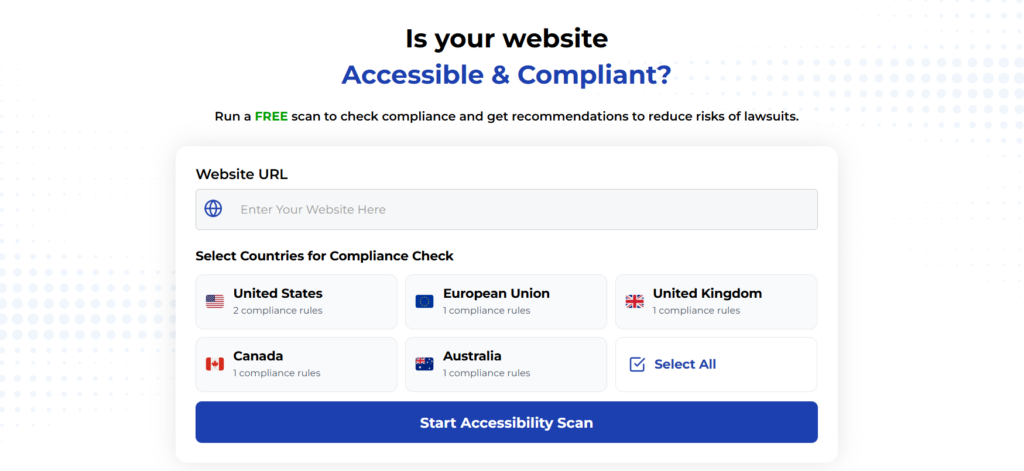
Using Automated Tools for Quick Insights (Accessibility-Test.org Scanner)
Automated testing tools provide a fast way to identify many common accessibility issues. They can quickly scan your website and point out problems that might be difficult for people with disabilities to overcome.
Visit Our Tools Comparison Page!
Run a FREE scan to check compliance and get recommendations to reduce risks of lawsuits
Final Thoughts
As we’ve touched on, artificial intelligence holds a lot of promise for improving accessibility at the data layer. AI could one day automatically generate high-quality alt text for images or create transcripts for audio content on the fly, embedding them directly into the API response.
Furthermore, AI could be used to personalize API responses based on a user’s needs. For example, an API could detect that a request is coming from a device with a screen reader running and automatically provide a more descriptive version of the content. This kind of context-aware, adaptive interface could lead to digital experiences that are not just compliant, but truly and personally accessible.
These future possibilities are exciting, but they all build on the foundational principles we’ve discussed. A commitment to structured data, a clear accessibility contract, and a collaborative spirit between teams will always be at the heart of designing inclusive data interfaces.
Building accessible APIs is a choice. It’s a decision to treat accessibility as a core architectural concern rather than a front-end clean-up task. By designing APIs that deliver structured, meaningful, and complete data, you empower developers to build truly inclusive experiences across any platform. You make accessibility the default, not the exception.
Ready to see where your own website stands? Start by conducting an accessibility audit using our free website accessibility scanner to identify immediate improvement opportunities in your website’s accessibility.
Want More Help?
Try our free website accessibility scanner to identify heading structure issues and other accessibility problems on your site. Our tool provides clear recommendations for fixes that can be implemented quickly.
Join our community of developers committed to accessibility. Share your experiences, ask questions, and learn from others who are working to make the web more accessible.